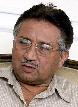
From its independence in 1947 the Pakistani conscience or the political paradigm has been rift apart between the contending values of democratic norms and the jingoist diction of the military junta. Within a decade of the death of the Father of the Nation, Muhammad Ali Zinnah, the country was taken over by the military dictatorship under Ayub Khan. Ayub Khan's exemplar was carried forward by various persons through which the entire nation has passed though turbulent times. The latest inclusion in that category is Pervez Musharraf. He is at present the President of Pakistan, along with the Chief of the Army Staff of the Pakistan Army and being the fourth General of Pakistan to administer the country in the wake of a coup. His seizure of power by overthrowing the then elected Prime Minister Nawaz Shariff overnight on October 12,1999 socked the international politics and the question of the political instability in the Indian sub continent. By ousting the then Prime Minister he assumed the title of Chief Executive. Later on he declared himself the President of Pakistan aftera referrendum on June 20, 2001.
Musharraf hails from a middle clas family of the Muhajir community who though was bron in Delhi of the British India opted for the city of Karachi in the newly formed Pakistan following the Partition of India. His educational career is nothing special and attended the St. Patrick's Hih School graduating in 1958 before attending the Forman Christian College in Lahore. It was in 1961 he entered into the Pakistan Military Academy t Kakul and in the succeeiding years through exemplarty show of courage and determination to serve the father land. He fought gallantly in all his might against the two succeeding wars against India in 1965 and 1971, but all his attempts failed as he could not save his country's humiliating defeat and surrender to India. It was in 1991 on 15 th of January when he was promoted to the rank of Major General and was assigned the command of an Infantry Division. Later, on promotion to Lieutenant General on 21st October, 1995 he took over command of 1 Corps,the elite strike Corps. However, his moronic life took a new turn when in 1998 following the resignation of the then General Jehangir Karamat, he was personally promoted supersiding other senior officers by Prime Minister Nawaz Shariff, who supposed him as an obedient General leading ultimately to be the Chief of Army Staff.
His personal realation though emotioanally with India has always been strained and this became evident in the Pakistani policy of Kargil misadventure from May to July, 1999 leading to the substantial loss of international reputation of Pakistan and ledaing to his dismissal by the P.M. Shariff since he was supposed to be the brain behind the faux pas. His sudden takeover of power from the civilian government to many, was a revenge of his earlier humiliation. From that time on he has been the target of the several Human Rights Organizations and several political parties for humiliating and trampling of the democratic norms of the country. With the occurrence of the 9/11 episode against the whims of the Islamic World he advocated the US standpoint and thus entered into never ending vie with the hardline Islamic factions in Pakistan.
He is generally viewed as a moderate leader, with comparatively liberal and progressive ideas. He has made good attempts of economic and social reforms to modernize Pakistan. To some he wants to step into the shoes of secular reformer Kemal Ataturk of Turkey, outraging religious anti-secularists in the country.
|