| . |
: Rudy Giuliani..
| Rudolph W. Giuliani |
|
| Mayor of New York City |
| In office |
| 1994�–�2001 |
| Preceded by | David N. Dinkins |
| Succeeded by | Michael R. Bloomberg |
| Born |
May 28, 1944
Brooklyn, New York |
| Residence |
New York |
| Political�party |
Republican |
| Religion |
Roman Catholic |
| Spouse |
Judith Nathan |
| Children |
Andrew, Caroline, Whitney |
| Website: http://www.solutionsamerica.com/ |
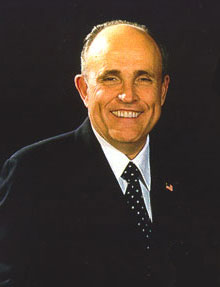
Rudolph William Louis "Rudy" Giuliani III, (born May 28, 1944) is an American politician and attorney, best known for his service as the Mayor of New York City from January 1, 1994, through December 31, 2001. His role in leading the City during and after the September 11 terrorist attacks raised his national stature[The Economist.com, Rudolph Giuliani - America's Mayor.". Retrieved on 2006-11-15.] and led him to be named Time Magazine's 2001 Person of the Year.[[1]]
The defining moment in Giuliani's career was his management of the September 11, 2001 attacks on the World Trade Center. His public visibility in the days following the attacks earned him the nickname "America's Mayor."[This term, now in common usage, seems to have been coined by Oprah Winfrey at a 9/11 Memorial service held at Yankee Stadium on September 23, 2001. See:[2] and this excerpt from Newsday: "City Mourns at Stadium Prayer Service.". Retrieved on 2006-11-15.] Since leaving office as Mayor of New York, Giuliani has pursued business and legal interests, and has remained politically active by campaigning for Republican candidates for political offices at all levels. On November 13, 2006, he formed an exploratory committee to consider entering the 2008 Presidential Campaign.[Giuliani takes step toward '08 bid, Devlin Barrett, Associated Press, November 13, 2006] and is expected to declare his candidacy. The committee filed papers with the FEC on November 22, 2006.
Giuliani is currently Chairman and Chief Executive Officer of Giuliani Partners LLC, a security consulting company he founded in 2002, and is a partner in the Houston-based law firm Bracewell & Giuliani LLP.
Contents
- 1 Personal
- 2 Early career
- 2.1 Marc Rich, Pincus Green case
- 2.2 Mafia Commission trial
- 2.3 Boesky, Milken trials
- 3 Mayoral campaigns, 1989 and 1993
- 3.1 1989 campaign
- 3.2 1993 campaign and election
- 4 Mayoralty
- 4.1 Crime control
- 4.2 Urban reconstruction
- 4.3 Immigration
- 4.4 Media management
- 4.5 Foreign Policy Actions
- 4.6 Brooklyn Museum art controversy
- 5 Run for United States Senate
- 6 September 11 terrorist attacks
- 6.1 "America's Mayor"
- 6.2 2001 Mayoral election controversy
- 6.3 Time Person of the Year
- 6.4 Political critics
- 7 Post-mayoralty
- 7.1 2003 television biopic
- 7.2 Consulting
- 7.3 Commercial endorsement
- 7.4 2004
- 7.5 2005
- 7.6 2006
- 8 Anticipated 2008 presidential campaign
- 8.1 Political views
- 8.2 Potential pitfalls
- 9 Electoral history
- 10 Further reading
- 11 See also
- 12 External links
- 13 Notes
|
Personal
Giuliani was born in Brooklyn, New York, raised in Garden City South on Long Island, to Harold Angelo Giuliani and Helen C. D'Avanzo, the children of Italian immigrants. He attended Manhattan College before graduating from the prestigious New York University School of Law cum laude in 1968.
Giuliani is married to Judith Nathan; this is his third marriage. He has two children, Andrew and Caroline, from his second marriage to television personality Donna Hanover, and one stepdaughter, Whitney, who is Nathan's daughter. Giuliani's first marriage, to Regina Peruggi, was annulled after fourteen years, according to Giuliani, because he discovered he and his wife were second cousins.[Powell, Michael and Goldfarb, Zachary A. On 'Feeling Thermometer', Giuliani is the Hottest.'. Retrieved on 2006-11-15. Washington Post, March 8, 2006, p. A04.]. The couple did not have any children.
Early career
After a law clerkship following graduation from NYU School of Law, in 1970, Giuliani joined the Office of the US Attorney.
In 1973, he was named Chief of the Narcotics Unit and rose to serve as executive US Attorney. In 1975, Giuliani was recruited to Washington, D.C., where he was named Associate Deputy Attorney General and chief of staff to the Deputy Attorney General. His first high-profile prosecution was of Congressman Bert Podell, who was convicted of corruption. From 1977 to 1981, Giuliani practiced law at the Patterson, Belknap, Webb and Tyler law firm.
In 1981, Giuliani was named Associate Attorney General in the Reagan Administration, placing him in the third-highest position in the Department of Justice. As Associate Attorney General, Giuliani supervised all of the US Attorney Offices' Federal law enforcement agencies, the Department of Corrections, the Drug Enforcement Administration, and the United States Marshals Service.
In a well-publicized 1982 case, Giuliani testified in defense of the federal government "detention posture" of interning over 2,000 unlawfully-immigrated Haitian refugees in refugee camps, at one point stating that there was "no political repression" under President Jean-Claude "Baby Doc" Duvalier.[[3]]
In 1983, Giuliani was appointed U.S. Attorney for the Southern District of New York. It was in this position that he first gained national prominence by prosecuting numerous high-profile cases, including the successful prosecutions of Wall Street figures Ivan Boesky and Michael Milken for insider trading. He also spearheaded the effort to jail drug dealers, combat organized crime, break the web of corruption in government, and prosecute white-collar criminals. He amassed a record of 4,152 convictions with only 25 reversals. Critics disparaged Giuliani, claiming he arranged public arrests of people, then dropped charges for lack of evidence rather than going to trial.[citation�needed]
Marc Rich, Pincus Green case
It was in 1983 that Giuliani indicted financiers Marc Rich and Pincus Green on charges of tax evasion and making illegal oil deals with Iran during the hostage crisis, in one of the first cases in which the RICO Act was employed in a non-organized crime case.[ Montgomery, Alicia. "Isn't it rich?". Retrieved on 2006-11-15. Salon.com, February 9, 2001.] Rich and Green fled the United States to avoid prosecution; both were controversially pardoned by the executive order of President Bill Clinton in 2001.[Reaves, Jessica. "The Marc Rich Case: a Primer.". Retrieved on 2006-11-15. Time.com ]
Mafia Commission trial
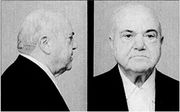 Anthony "Fat Tony" Salerno, head of the Genovese crime family, was convicted by Giuliani and sentenced to 100 years in prison. [ Stengel, Richard. "The Passionate Prosecutor.". Retrieved on 2006-11-15. Time Magazine onlnie, posted June 24, 2001.]
The inital defendants included:
- Paul "Big Paul" Castellano, head of the Gambino crime family
- Anthony "Fat Tony" Salerno, head of the Genovese crime family
- Carmine "Junior" Persico, head of the Colombo Family
- Anthony "Tony Ducks" Corallo, head of the Lucchese crime family
- Philip "Rusty" Rastelli, head of the Bonanno family,
and six subordinates. Eight defendants were found guilty on all counts and subsequently sentenced on January 13, 1987 to hundreds of years of prison time.
Boesky, Milken trials
Ivan Boesky was a Wall Street arbitrageur who had amassed a fortune of about US$200 million by betting on corporate takeovers. He was investigated by the U.S. Securities and Exchange Commission for making investments based on tips received from corporate insiders. These stock acquisitions were sometimes brazen, with massive purchases occurring only a few days before a corporation announced a takeover.
Although insider trading of this kind was illegal, laws prohibiting it were rarely enforced until Boesky was prosecuted. Boesky cooperated with the SEC and informed on several of his insiders, including junk bond trader Michael Milken:"Boesky admitted to numerous offenses and then turned state's evidence, primarily against Milken. He received a 3 1/2 year prison sentence and $100 million fine after admitting to the charges and reached a plea bargain with Rudy Giuliani...[who would] draw criticism because Ivan was allowed to unload his holdings before his indictment was officially announced, realizing profits from it before being convicted. Others considered the sentence and fine as being too light. But Giuliani and company was [sic] after a much bigger fish, namely Milken."[ Trumbore, Brian. "Ivan Boesky". Retrieved on 2006-11-15.]
In 1989, Giuliani charged Milken under the RICO act with 98 counts of racketeering and fraud. In a highly-publicized case, Milken was indicted by a federal grand jury, and after a plea bargain, pled guilty to six lesser securities and reporting violations.
He paid a total of $900 million in fines and settlements relating primarily to civil lawsuits and was banned for life from the securities industry.
Mayoral campaigns, 1989 and 1993
Giuliani was U.S. Attorney until January 1989, resigning as the Reagan administration ended. He then joined the law firm White & Case in New York City, as a partner. He remained with White & Case until May 1990, when he joined the law firm Anderson Kill Olick & Oshinsky, also in New York City.
1989 campaign
Giuliani first ran for New York City Mayor as the candidate of both the Republican and Liberal parties, attempting to succeed Ed Koch in 1989. Giuliani lost to Democrat David Dinkins by 47,080 votes out of 1,899,845 votes cast, in the closest election in city history.[ "A Biography of Mayor Rudolph W. Giuliani.. Retrieved on 2006-11-18. City of New York website.]
1993 campaign and election
In 1993, Giuliani again ran for Mayor. The principal issues of the election of 1993 were crime and taxes. Giuliani also campaigned on what he perceived to be the unchecked expansion of the city's budget and the lack of managerial competence of incumbent David Dinkins. While Dinkins had frequently and eloquently voiced his affection for New York City diversity while in office, his tenure bore witness to anti-Semitic rioting in Crown Heights and an Al Sharpton-led black boycott of Korean businesses in Brooklyn.
Giuliani focused on what he described as a breakdown of social and political order that Dinkins had been either unwilling or unable to address effectively. In addition, the City was suffering from a spike in unemployment associated with the nationwide recession, with local unemployment rates going from 6.7% in 1989 to 11.1% in 1992[New York State Department of Labor statistics, Workforce industry data.. Retrieved on 2006-11-18.], and was suffering from an all-time high in the crime rate.[New York City Crime Rate] These were contrasted with Dinkins's appeal to the "gorgeous mosaic" of New York ethnic diversity.
Giuliani promised a return to social order, addressing day-to-day issues rather than past or imminent crises: Poverty, welfare, and the prevalence of homeless panhandlers on streets and subways, and improving New York City's image via improvements on crime, infrastructure and urban revitalization.
He promised to focus the police department on shutting down petty crimes and nuisances as a way of restoring the City's quality of life: "It's the street tax paid to drunk and drug-ridden panhandlers. It's the squeegee men shaking down the motorist waiting at a light. It's the trash storms, the swirling mass of garbage left by peddlers and panhandlers, and open-air drug bazaars on unclean streets."[[4]]
Giuliani won the election by a margin of 53,367 votes, with 49.25% of the electorate to the incumbent's 46.42% share. He became the first Republican elected Mayor of New York City since John Lindsay won re-election in 1969.
Mayoralty
Crime control
In his first term as mayor, Giuliani, in conjunction with New York City Police Department Commissioner Bill Bratton, adopted an aggressive enforcement-deterrent strategy based on James Q. Wilson's Broken Windows research. This involved crackdowns on relatively minor offenses such as graffiti, turnstile jumping, and aggressive "squeegeemen", on the principle that this would send a message that order would be maintained, and that the city would be "cleaned up".
Giuliani also directed the New York City Police Department to aggressively pursue enterprises linked to organized crime, such as the Fulton Fish Market and the Javits Center on the West Side (Gambino crime family), in the breaking up of mob control of solid waste removal, the city was able to save city businesses over $600 million.
One of the first initiatives of Giuliani and Bratton was the institution of CompStat in 1994, a comparative statistical approach to mapping crime geographically and in terms of emerging criminal patterns, as well as charting officer performance by quantifying criminal apprehensions. CompStat was operationalized by the empowerment of precinct commanders, based on the assumption that local authorities could best institute crime reduction techniques specific to their experiential knowledge of their own localities. This system also enhanced the accountability of both the commanders and the officers themselves. Critics of the system assert that it creates an environment in which police officials are encouraged to underreport or otherwise manipulate crime data.[5]
Giuliani continued to highlight crime reduction and law enforcement as central missions of his mayoralty throughout both terms, efforts which largely met with success. Concurrent with his achievements, a number of tragic cases of abuse of authority took place, and numerous allegations of civil rights abuses were leveled.
Giuliani's own Deputy Mayor, Rudy Washington, alleged that he had been harassed by police on several occasions. More controversial still were several police shootings of unarmed suspects[6], and the scandals surrounding the brutalization of Abner Louima and the killing of Amadou Diallo.
In a case less nationally-publicized than those of Louima and Diallo, unarmed bar patron Patrick Dorismond was killed shortly after declining the overtures of what turned out to be an undercover officer soliciting illegal drugs. Even while hundreds of outraged New Yorkers protested, Giuliani staunchly supported the New York City Police Department, going so far as to take the unprecedented step of releasing Dorismond's "extensive criminal record" to the public.[7]
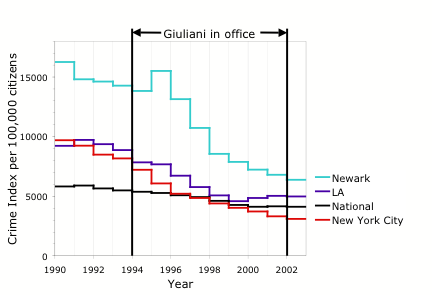
The amount of credit Giuliani's policies deserve for the drop in the crime rate is disputed by critics. A small but significant nationwide drop in crime preceded Giuliani's election, and he may have been the beneficiary of a trend already in progress. Additional contributing factors to the overall decline in crime during the 1990's was federal funding of an additional 7,000 police officers and an overall improvement in the national economy. Many experts believe changing demographics were the factor most responsible for crime rate reductions, which were similar across the country during this time. [8] Different studies show that New York's drop in crime rate in the '90s and '00s exceeds all national figures and therefore should be linked with a local dynamic that was not present as such anywhere else in the country: "most focused form of policing in history. Zimring (Frank Zimring - The Great American Crime Decline) estimates that up to half of New York’s crime drop in the 1990s, and virtually 100 percent of its continuing crime decline since 2000, has resulted from policing." However, any "credit for keeping Gotham on the path of ongoing crime reduction belongs to Ray Kelly, serving his second tour of duty as the NYPD’s commissioner.(...) Giuliani loyalists, perennially predicting le déluge, greeted Kelly’s appointment with dismay." [9]
Many New Yorkers believe the policies under Mayor Giuliani's pertaining to the policing of NYC to have been effective. This view was obviously not limited to New York City residents, as several programs similar to CompStat were subsequently instituted by a variety of urban police departments nationwide.[10][11]
Urban reconstruction
Giuliani pursued similarly aggressive real estate policies. The Times Square redevelopment project saw Times Square transformed from a seedy, run-down center for businesses ranging from tourist attractions and peep shows to a gleaming, high-priced district filled with family-oriented stores and theaters, including the MTV studios and a massive Disney store and theater. Giuliani faced some opposition to these changes, which critics alleged displaced low income residents of the area in favor of large corporations. His critics also alleged that the Giuliani administration's real estate policies tended to reduce the amount of usable public space in the city while increasing the amount of private or corporate space (e.g., the sale of city-owned community gardens to private developers). Throughout his term, Giuliani also pursued the construction of a new sports stadium in Manhattan, a goal in which he did not succeed, though new minor league baseball stadiums opened in Brooklyn, for the Brooklyn Cyclones, and in Staten Island, for the Staten Island Yankees. Conversely, Guiliani refused to attend the opening ceremonies for a Dinkins success, Arthur Ashe Stadium in Flushing Meadows, Queens, stating his anger with a contract that fines the city if planes from LaGuardia Airport fly over the stadium during U.S. Open matches. Giuliani boycotted the U.S. Open throughout his mayoralty.
Immigration
Giuliani has been criticized for embracing illegal immigration. Giuliani continued a policy of preventing city employees from contacting INS about immigration violations. He ordered city attorneys to defend this policy in federal court.[12] Giuliani has also expressed doubt that the federal government can stop illegal immigration.[13] In April 2006, Giuliani went on the record as favoring the US Senate's comprehensive immigration plan which includes a path to citizenship and a guest worker plan. He rejected the US House approach because he does not think House Resolution 4437 could be enforced.[14]
Media management
Giuliani, after being elected, started a weekly call-in program on WABC radio. He avoided one-on-one interviews with the press, preferring to only speak to them at press conferences or on the steps of City Hall. Giuliani made frequent visits to The Late Show with David Letterman television show, sometimes appearing as a guest and sometimes participating in comedy segments. In one highly publicized appearance that took place shortly after his election, Giuliani filled a pothole in the street outside the Ed Sullivan theater.
Foreign Policy Actions
In 1995, Giuliani made national headlines by ordering PLO Chairman Yasser Arafat ejected from a Lincoln Center concert held in celebration of the 50th anniversary of the founding of the United Nations. "Maybe we should wake people up to the way this terrorist is being romanticized," Giuliani said, and noted that Arafat had been implicated in the murder of American civilians and diplomatic personnel.[ Murdock, Deroy. 9/11 keeps Rudy a Presidential Frontrunner.". Retrieved on 2006-11-17. Capitol Hill Blue, September 7, 2006.] A spokesman for the Clinton Administration stated Giuliani's actions were "an embarrassment to everyone associated with diplomacy."[ Moaz, Jason. "When Rudy Booted Arafat.". Retrieved on 2006-11-17. FrontPage magazine.com, October 28, 2005.]
Brooklyn Museum art controversy
In 1999 Giuliani threatened to cut off city funding for the Brooklyn Museum if the museum did not remove a number of works in an exhibit entitled “Sensation: Young British Artists from the Saatchi Collection.” One work in particular, The Holy Virgin Mary by Turner Prize winning-artist Chris Ofili (a Catholic himself), featured the Virgin Mary next to elephant dung and female genitalia pictures. It was targeted as being offensive to some in the Christian community in New York, leading the artist to comment that "This is all about control."
In its defense, the museum filed a lawsuit, charging Giuliani with violating the First Amendment right to freedom of speech. Religious groups such as the Catholic League for Religious and Civil Rights supported the mayor's actions, while it was condemned by groups such as the American Civil Liberties Union, objecting to the mayor's censorship and interference with the first amendment rights of the museum.[CATHOLIC LEAGUE for Religious and Civil Rights. Retrieved on November 15, 2005.][American Civil Liberties Union�: Civil Liberties Union Files Brief Supporting Brooklyn Museum In Controversy with Mayor Giuliani. Retrieved on November 15, 2005.] The museum's lawsuit was successful; the mayor was ordered to resume funding, and the judge, Federal District Judge Nina Gershon, declared "[t]here is no federal constitutional issue more grave than the effort by government officials to censor works of expression and to threaten the vitality of a major cultural institution as punishment for failing to abide by governmental demands for orthodoxy."[Giuliani Is Ordered to Halt Attacks Against Museum. Retrieved on November 15, 2005.]
Run for United States Senate
In April 1999 Giuliani formed an exploratory committee in connection with the 2000 New York United States Senate election, seeking the Republican nomination to fill the seat vacated by the retiring Daniel Patrick Moynihan. His expected Democratic opponent was Hillary Rodham Clinton. On May 19, 2000, before the Republican primary, which he was expected to win, he withdrew his candidacy because of prostate cancer, the Farmersville Garbage Scandal which significantly reduced his support in his core upstate counties, and the fallout from his affair and messy divorce from his wife Donna Hanover. During the ill-fated campaign, Giuliani was forced to confess to his marital infidelities and, in the process, lost a further significant base of electoral support. New York Congressman Rick Lazio replaced Giuliani as the Republican nominee and lost to Clinton.
September 11 terrorist attacks
The defining episode in Giuliani's career was his management of the September 11, 2001 attacks on the World Trade Center. He witnessed the first collapse, the South Tower at the World Trade Center. He coordinated the response of various city departments while organizing the support of state and federal authorities for the World Trade Center site, for city-wide anti-terrorist measures, and for restoration of destroyed infrastructure. He made frequent appearances on radio and television on September 11 and afterwards to communicate critical information to the public; for example, to indicate that tunnels would be closed as a precautionary measure, and that there was no reason to believe that the dispersion of chemical or biological weaponry into the air were a factor in the attack. He balanced the need to make hundreds of decisions directly and immediately, to delegate hundreds of others, and to visit the injured and console the families of the dead.
When Saudi Prince Alwaleed bin Talal suggested that the attacks were an indication that the United States "should re-examine its policies in the Middle East and adopt a more balanced stand toward the Palestinian cause," Giuliani asserted,
- There is no moral equivalent for this [terrorist] act. There is no justification for it... And one of the reasons I think this happened is because people were engaged in moral equivalency in not understanding the difference between liberal democracies like the United States, like Israel, and terrorist states and those who condone terrorism. So I think not only are those statements wrong, they're part of the problem.
[[15]]
New York City subsequently rejected the prince's $10 million donation to disaster relief in the aftermath of the attack.
In the wake of the attacks, Giuliani was widely hailed for his decisive and undaunted leadership during the crisis. For this, he was named TIME magazine's Person of the Year for 2001, and given an honorary knighthood by Queen Elizabeth II on February 13, 2002.[16]
Giuliani has been subject to increased criticism for downplaying the health effects of the air in the Financial District and lower Manhattan areas in the vicinity of the Ground Zero.[Ben Smith, "Rudy's Black Cloud," "New York Daily News," September 18, 2006, p. 14] He moved quickly to reopen Wall Street, and it was reopened on September 17. However, in the weeks after the attacks, the United States Geological Survey identified hundreds of asbestos hot spots of debris dust that remained on buildings. By the end of the month the USGS reported that the toxicity of the debris was akin to that of a household cleaner.[http://www.alternet.org/911oneyearlater] The city's health agencies, such as the Department of Environmental Protection, did not supervise or issue guidelines for the testing and cleanup of private buildings. Instead, the city left this responsibility to building owners. Firefighters, police and their unions, have criticized Giuliani over the issue of protective equipment and illnesses after the attacks.[http://www.democracynow.org/article.pl?sid=06/09/08/1349248]
"America's Mayor"
In his public statements, Giuliani mirrored the emotions of New Yorkers after the September 11 attacks: shock, sadness, anger, resolution to rebuild, and the desire for justice to be done to those responsible. "Tomorrow New York is going to be here," he said. "And we're going to rebuild, and we're going to be stronger than we were before...I want the people of New York to be an example to the rest of the country, and the rest of the world, that terrorism can't stop us." Giuliani was widely praised for his close involvement with the rescue and recovery efforts.
As an avid and public fan of the New York Yankees, who won four World Series Championships during his time as mayor, Giuliani was frequently sighted at Yankee games, often accompanied by his son. On September 21, 2001, the first game was played in New York City after the attacks, with the New York Mets at home facing the Atlanta Braves. Despite his being a Yankee fan, the crowd cheered for him and for his leadership over the preceding days.
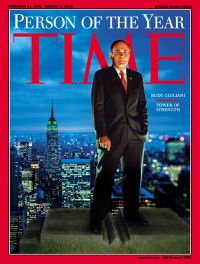 Rudy Giuliani, 2001 Time Person of the Year. 2001 Mayoral election controversy
The 9/11 attack occurred on the scheduled date of the mayoral primary to select the Democratic and Republican candidates to succeed Giuliani. The primary was immediately delayed two weeks to September 25. During this period, Giuliani sought an unprecedented three-month emergency extension of his term, from its scheduled expiration on January 1 to April 1, due to the circumstances of the emergency besetting the city. He threatened to challenge the law imposing term limits on elected New York City officials and run for another full four-year term, if the primary candidates did not consent to permit the extension of his mayoralty.[Conservative Party and Courts May Hold Key to NYC Mayor's Race -- 1 October 2001. Retrieved on November 15, 2005.]
Advocates for the extension contended that Giuliani was needed to manage the initial requests for funds from Albany and Washington, speed up recovery, and slow down the exodus of jobs from lower Manhattan to outside New York City. Opponents viewed the extension as an unprecedented power grab and as a means for Giuliani to profit politically from the sudden, international prominence of the role of New York City Mayor. Although a provision for emergency extensions is written into the New York State Constitution (Article 3 Section 25),[Content Removed. Retrieved on November 15, 2005.] leaders in the State Assembly and Senate indicated that they did not believe the extension was necessary and the election and inauguration proceeded as scheduled.
Time Person of the Year
In 2001, TIME magazine named Giuliani Person of the Year.[TIME 2001 Person of the Year: Rudy Giuliani Profile. Retrieved on November 15, 2005.] TIME observed that, prior to 9/11, the public image of Giuliani had been that of a rigid, self-righteous, ambitious politician. After 9/11, and perhaps owing also to his bout with cancer, his public image had been reformed to that of a man who could be counted on to unite a city in the midst of its greatest crisis. Thus historian Vincent J. Cannato concluded in September, 2006, "With time, Giuliani's legacy will be based on more than just 9/11. He left a city immeasurably better off -- safer, more prosperous, more confident -- than the one he had inherited eight years earlier, even with the smoldering ruins of the World Trade Center at its heart. Debates about his accomplishments will continue, but the significance of his mayoralty is hard to deny."[Washington Post Wook World Sept 3, 2006[17]]
Political critics
At the same time, however, voices were being raised against the refrain that it was the mayor who had pulled the city together. "You didn't bring us together, our pain brought us together and our decency brought us together. We would have come together if Bozo was the mayor," said civil-rights activist Al Sharpton, in a statement largely supported by Fernando Ferrer, one of three main candidates for the mayoralty at the end of 2001.[REVEREND AL SHARPTON IN NEW SLAM AT RUDY GIULIANI. Retrieved on November 15, 2005.]
Post-mayoralty
2003 television biopic
In 2003, the "USA Network" aired a made-for-television movie: "Rudy: The Rudy Guiliani Story" with James Woods in the title role. [18]
Consulting
After leaving the mayor's office, Giuliani built a security consulting business and gave speeches. On D
|