| . |
: Pervez Musharraf پرويز مشرف Image:Pervez Musharraf.
General Pervez Musharraf
پرويز مشرف
|
Image:Pervez Musharraf.jpg
|
12th President of the Islamic Republic of Pakistan
|
| Incumbent
|
Assumed�office�
October 12, 1999
|
| Preceded�by
| Muhammad Rafiq Tarar
|
| Succeeded�by
| Incumbent
|
|
| Born
| August 11, 1943
Delhi, India
|
| Political�party
| None
|
| Spouse
| Begum Sehba Musharraf
|
(PA – 6920) General Pervez Musharraf (Urdu: پرويز مشرف; born August 11, 1943) is currently the President of the Islamic Republic of Pakistan and the Chief of Army Staff of the Pakistan Army. He took power on October 12, 1999 after a coup d'état and assumed the title of President on June 20, 2001.
Contents
- 1 Family background
- 2 Early life
- 3 Military career
- 4 Coup d'état
- 5 Presidential elections
- 6 Electoral College elections
- 7 Role after 9/11
- 7.1 Support for the War on Terror
- 7.2 Relations with India
- 7.3 Denouncing extremism
- 7.4 Assassination attempts
- 8 Richard Armitage comments controversy
- 9 Dual-office controversy
- 10 Views and perceptions of Musharraf
- 11 Corruption
- 12 Support for the War on Terror
- 13 Elections during Musharraf's administration
- 14 Nuclear proliferation
- 15 Musharraf in the media
- 16 Notes
- 17 References
- 18 See also
- 19 External links
|
Family background
Syed Pervez Musharraf, the second of three brothers, was born in Daryaganj in Delhi, India on August 11, 1943. After the Partition of India, his parents immigrated to Pakistan and chose to settle in Karachi. He comes from a middle class family, his father having worked for the foreign ministry as a clerk in the Pakistan embassy in Turkey. He spent his early years in Turkey, from 1949 to 1956. Musharraf is married to Begum Sehba Musharraf, who is from Okara; they have one son, Bilal Musharraf, and a daughter, Ayla, and have four grandchildren, two from each child. Bilal is settled in the United States and is a green card holder.
Early life
Musharraf attended Saint Patrick's High School, Karachi, graduating in 1958 before going on to attend Forman Christian College in Lahore.
Military career
In 1961, he entered the Pakistan Military Academy at Kakul, graduated 11th in his class and was later commissioned into the Artillery Regiment. A graduate of the Staff College, Quetta, and the National Defense College, Rawalpindi, Musharraf is also a graduate of the Royal College of Defence Studies of the United Kingdom. In 1965, Musharraf reveals in his memoirs that he was charged with taking unauthorized leave and was about to be court-martialed for it, but was let off due to the war with India.[Pervez Musharraf (2006). In the Line of Fire: A Memoir. Free Press. ISBN 0-7432-8344-9.]
Musharraf participated in the Indo-Pakistani War of 1965 as the 2nd Lieutenant in the 16 (SP) Field Artillery Regiment. His regiment saw action as part of the First Armoured Division’s offensive in the Khemkaran sector, where a major offensive was planned against the Indian Army.[The Battle of Assal Uttar: Pakistan and India 1965] the 1st armoured division (labelled "pride of the Pakistan Army") suffered a crushing defeat and Khemkaran became known a graveyard of Pakistan tanks.[PakDef.Info]. By all accounts the vital advance failed at the Battle of Asal Uttar, as Pakistan lost a golden opportunity to make major strategic gains, and was a turning point in the war.[Musharraf’s fiery memoirs By Anwar Kemal, Dawn (newspaper) October 14, 2006]
Later, in the Indo-Pakistani War of 1971 he served as a Company Commander in the SSG Commando Battalion. Originally scheduled to be flown to East Pakistan along with other SSG troops, he was redeployed in Punjab as war broke out and all flights over India were cancelled. He later admitted that he "broke down and wept"[Musharraf’s 1971, a sob story, Musharraf 'wept' when East Pak fell] Later he commanded Regiments of Artillery, there after an Artillery Brigade and then went on to command an Infantry Division. In September 1987, heading a newly formed SSG at Khapalu base (Kashmir), he launched an unsuccessful assault to capture the Indian held posts of Bilafond La in Siachen Glacier.[Jamestown Foundation]
On promotion to the rank of Major General on January 15, 1991, he was assigned the command of an Infantry Division. Later, on promotion to Lieutenant General on October 21, 1995 he took over command of the I Corps. In 1998, following the resignation of General Jehangir Karamat, he was personally promoted over other senior officers by Prime Minister Nawaz Sharif, as an obedient General and took over as the Chief of Army Staff. In 1999, he led the Pakistan Army during the Kargil Conflict. Gen. Musharraf also attended SSG and was the trainer of Pakistani commandos.
- Role in Kargil Conflict
Main article: Kargil War
From April to June 1999, Pakistan and India were involved in the Kargil Conflict which was planned and executed while General Pervez Musharraf was Pakistan's Army chief. Ex-CENTCOM Commander Anthony Zinni, and ex-PM Nawaz Sharif, state that it was the General who requested Sharif to withdraw the Pakistani troops.[Tom Clancy, Gen. Tony Zinni (Retd) and Tony Koltz (2004). Battle Ready. Grosset & Dunlap. ISBN 0-399-15176-1.][Musharraf Vs. Sharif: Who's Lying?] Sharif placed the onus of the Kargil attacks squarely on the army chief Pervez Musharraf. The war ended in disaster for Pakistan which lost not only the military battle but also paid dearly on the political and diplomatic fronts.
This conflict resulted in eventual mistrust between civil and military leaderships and this division ultimately saw the demise of Sharif's government.
Coup d'état
Musharraf became de facto Head of Government (using the title Chief Executive and assuming extensive powers) of Pakistan following a bloodless coup d'état on 12 October 1999. That day, the constitutional Prime Minister Nawaz Sharif attempted to dismiss Musharraf and install Inter-Services Intelligence (ISI) Director Khwaja Ziauddin in his place. Musharraf, who was out of the country, boarded a commercial airliner to return to Pakistan. Senior Army generals refused to accept Musharraf's dismissal. Sharif ordered the Karachi airport closed to prevent the landing of the airliner, which then circled the skies over Karachi. In the coup, the generals ousted Sharif's administration and took over the airport. The plane landed with allegedly only a few minutes of fuel to spare, and Musharraf assumed control of the government. Sharif was put under house arrest and later exiled. He and other democratic leaders have subsequently been prevented from entering Pakistan. Reportedly, the disagreement between Musharraf and Sharif centered around the democratically elected Prime Minister's desire to find a diplomatic resolution to the conflict.[BBC profile on Musharraf]
The existing President of Pakistan, Rafiq Tarar, remained in office until June 2001. Musharraf formally made himself President on June 20, 2001, just days before his scheduled visit to Agra for talks with India.
Presidential elections
Shortly after Musharraf's takeover, several people filed court petitions challenging his assumption of power. On May 12, 2000, the Supreme Court of Pakistan ordered Musharraf to hold general elections by October 12, 2002. In an attempt to legitimize his presidency and assure its continuance after the approaching restoration of democracy, he held a referendum on April 30, 2002 to extend his presidential term to five years after the October elections. However, the referendum was boycotted by the majority of Pakistani political groupings, which later complained that the elections were heavily rigged, and voter turnout was 30% or below by most estimates. A few weeks later, Musharraf went on TV and apologized to the nation for "irregularities" in the referendum.
Musharraf also forcibly removed many of the Supreme Court Justices who had voted against his usurpation of power. These included Justice Taqi Usmani, a world authority on International financial law and Constitutional law. Newspaper editors who were critical of Musharraf, such as the editor of the Balochistan Post, have also been exiled.
General elections were held in October 2002 and a plurality of the seats in the Parliament was won by the PML-Q, a pro-Musharraf party consisting of feudal landlords whose power and hold on politics Musharraf had promised to destroy.[citation�needed] However, parties opposed to Musharraf effectively paralysed the National Assembly for over a year.
The deadlock ended in December 2003, when Musharraf made a deal with the Muttahida Majlis-e-Amal party, an alliance of Islamic parties sympathetic to Talibans agreeing to leave the army by December 31, 2004. He subsequently refused to keep his promise. With that party's support, pro-Musharraf legislators were able to muster the two-thirds supermajority required to pass the Seventeenth Amendment, which retroactively legalized Musharraf's 1999 coup and many of his decrees.
Electoral College elections
In a vote of confidence on January 1, 2004, Musharraf won 658 out of 1,170 votes in the Electoral College of Pakistan, and according to Article 41(8) of the Constitution of Pakistan, was "deemed to be elected" to the office of President until October 2007.
Role after 9/11
Support for the War on Terror
Following the September 11, 2001 terrorist attacks in the United States, Musharraf sided with the United States against the Taliban government in Afghanistan after an ultimatum by the United States. Musharraf agreed to give the United States the use of three airbases for Operation Enduring Freedom. Secretary of State Colin Powell and other administration officials met with Musharraf. Musharraf's reversal of policy and help to the U.S. military was necessary in the U.S. bombing that rapidly overcame the Taliban regime. On September 19, 2001, Musharraf addressed the people of Pakistan and stated while he supported the
Taliban, unless Pakistan reversed its support, Pakistan risked being endangered by an alliance of India and the USA.[President General Pervez Musharraf: Address to People of Pakistan]. In 2006, Musharraf testified that this stance was pressured by threats from the U.S.[Reuters: U.S. threatened to bomb Pakistan after 9/11: Musharraf Reuters 2006-09-21]
Relations with India
Musharraf was Chief of Army Staff at the time of Pakistani incursions into the Indian-held Kashmir, in the summer of 1999. After suffering many reverses, the Pakistani Army was ordered to retreat. Some reports suggest that Musharraf retreated after huge pressure from the former Pakistani Prime Minister Nawaz Sharif from the American President Bill Clinton, who feared the conflict could turn into a nuclear catastrophe.
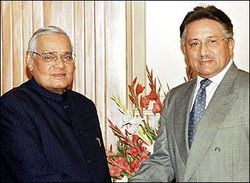 Musharraf with Atal Behari Vajpayee, former Prime Minister of India at the Agra Summit during 2001 However, in Battle Ready, a recent book co-authored by ex-CENTCOM Commander in Chief Anthony Zinni and novelist Tom Clancy, the former alleges that Musharraf was the one who pushed Sharif to withdraw the Pakistani troops after being caught in a losing scenario.[Tom Clancy, Gen. Tony Zinni (Retd) and Tony Koltz (2004). Battle Ready. Grosset & Dunlap. ISBN 0-399-15176-1.] According to an ex-official of the Musharraf government, Hassan Abbas, it was Musharraf who planned the whole operative and sold the idea to Nawaz Sharif.[Hassan Abbas (2004). Pakistan's Drift Into Extremism: Allah, the Army, and America's War on Terror. M.E. Sharpe. ISBN 0-7656-1497-9.] The view that Musharraf wanted to attempt the Kargil infiltrations much earlier was also revealed by Former Pakistani PM Benazir Bhutto in an interview to a leading daily newspaper, where he had supposedly boasted that "he would hoist the flag of Pakistan atop the Srinagar Assembly" if his plan was executed[Musharraf advised against Kargil, says Benazir] PML(N), a leading Pakistan party added that Musharraf had planned the Kargil intrusions but panicked when the conflict broke out with India and decided to brief then Pakistan premier Nawaz Sharif.[http://timesofindia.indiatimes.com/articleshow/2153729.cms] As the Kargil incident came just after the Lahore Peace Summit earlier that year, Musharraf was viewed with mistrust in India.
On December 13, 2001, a group of militants attacked India's Parliament with bombs and guns. India, who blamed Pakistan for the attack, mobilized for a potential war. Musharraf denied any Pakistani involvement with the attacks. Intense pressure from Washington followed. The Washington Post (Jim Hoagland, January 17) said that "the United States extracted promises from Gen. Musharraf that Pakistan's intelligence service and army will cease giving food, weapons and other logistical help to infiltrators who carry out raids into India and Indian-controlled Kashmir. The army will no longer provide mortar fire to cover the militants, who have been cut adrift by Musharraf".
In the middle of 2004, Musharraf began a series of talks with India to solve the Kashmir dispute. Both India and Pakistan have the tactical capability to launch nuclear strikes on every city within each others' borders. The two countries are continuing to aggressively increase their nuclear capabilities by actively producing even more nuclear weapons and perfecting their missile technologies by routinely conducting tests of ever more sophisticated missiles.
As well as discussing the Kashmir dispute, both leaders discussed the following issues:
Wullar Barrage and Kishangaga power project, Baglihar Dam on the Chenab River being built by India in Jammu and Kashmir, Disputed Sir Creek estuary at the mouth of the Rann of Kutch, Siachin glacier, Issues of Gurdaspur and Ferozepur's status, Hindu-Muslim Relations, Autonomy for the Sikhs in Indian Punjab, Minority rights, Indian contentions that Pakistan is sponsoring "cross-border" terrorism.
Denouncing extremism
On January 12, 2002, Musharraf gave a landmark speech against Islamic extremism. He unequivocally condemned all acts of terrorism, including those carried out in the name of freeing Kashmir's Muslim majority from Indian rule. He also pledged to combat Islamic extremism and lawlessness within Pakistan itself.
He has also used it to ban funding of madrasas and mosques from outside the country.[citation�needed] At the same time as banning foreign funding of Islamic educational institutions, he made it compulsory for them to teach a whole host of additional subjects such as computing. This meant that many had to close due to the halt of funds from Pakistanis working abroad resulting in not being able to teach the additional subjects that he had made compulsory. Musharraf also instituted prohibitions on foreign students' access to studying Islam within Pakistan, an effort which began as an outright ban but was later reduced to restrictions on obtaining visas. On December 7, 2004, Musharraf denounced the Hijab calling it "a backward view of Islam".["Pakistani women 'must not hide'", BBC News, 7 December 2004]
Assassination attempts
On December 14, 2003, General Musharraf survived an assassination attempt when a powerful bomb went off minutes after his highly-guarded convoy crossed a bridge in Rawalpindi. It was the third such attempt during his four-year rule. Eleven days later, on December 25, 2003, two suicide bombers tried to assassinate Musharraf, but their car bombs failed to kill the president; 16 others nearby died instead. Musharraf escaped with only a cracked windscreen on his car. Militant Amjad Farooqi was apparently suspected as being the mastermind behind these attempts, and was killed by Pakistani forces in 2004 after an extensive manhunt.
Richard Armitage comments controversy
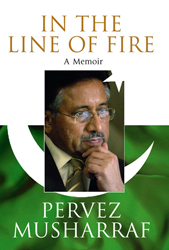 Cover of the UK edition of In the Line of Fire: A MemoirDuring a September 24, 2006 interview with CBS News's 60 Minutes program (interviewed by Steve Kroft), Musharraf described how then-U.S. Deputy Secretary of State Richard Armitage had called Musharraf's intelligence director shortly following the September 11, 2001 attacks and threatened military action if Pakistan did not support the U.S.-led War on Terror. According to Musharraf, Armitage warned: "Be prepared to be bombed. Be prepared to go back to the Stone Age."
Dual-office controversy
A pro-Musharraf party, the PML-Q, won a plurality in the elections of October 2002, and formed a majority coalition with independents and allies such as the MQM. Nevertheless, the opposition parties effectively deadlocked the National Assembly, refusing to accept the legitimacy of Musharraf's authority. In December 2003, as part of a compromise with the main Islamist opposition group, the Muttahida Majlis-e-Amal, an alliance of Islamist radicals including the Jammat Islami whose leaders have known links to bin Laden, General Musharraf said he would step down as Army Chief by January 1, 2005. In return, the MMA agreed to support a constitutional amendment that would retroactively legalize Musharraf's coup, and restore some formal checks and balances to Pakistan's system of government. In late 2004, pro-Musharraf legislators in the Parliament passed a bill allowing Musharraf to keep both offices.
Views and perceptions of Musharraf
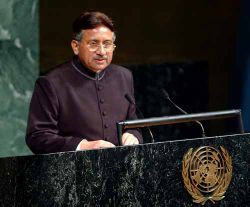 General Pervez Musharraf, President and Chief Executive of the Islamic Republic of Pakistan, addressing the UN General Assembly on November 10, 2001 At present, Musharraf is considered as the most acceptable Pakistani leader by Western governments. Support for General Pervez Musharraf is conditional on his cooperation with Coalition Forces in the War on Terror. Many believe that Musharraf is sincere in his desire to bridge the Islamic and Western worlds and has previously spoken strongly against the idea of the inevitability of 'clash of civilisations' between them[citation�needed]. Furthermore, he has coined the phrase of "Enlightened moderation" and is believed to be an ardent promulgator of the same. Musharraf's emotional ties to the United States may be conjectured[citation�needed] to be significant since at least two close members of his family live there: his brother, a doctor, lives near Chicago, Illinois, and his son, who lives in Boston, Massachusetts. Musharraf's son Bilal runs a venture funded high-tech startup in Boston.
Corruption
One of the expectations when Musharraf came to power was that the rampant corruption existing in government machinery would be cleaned up. Musharraf himself stated that a crackdown on corruption would be initiated but years into his administration, many neutral analysts have noted that the military regime is letting the corrupt go free.[BBC] In fact, according to a survey by Transparency International, Musharraf's regime is now perceived by many Pakistanis to be more corrupt than the previous democratic governments led by Ms. Bhutto and Sharif.[[1]]
Critics of his administration point to the fact that Pakistan, which was placed at 79 in the ranking 5 years back[[2]] is now ranked at 142[[3]] putting them at one of the most corrupt countries in the world. There have also been allegations that corrupt servicemen aren't been prosecuted because of the Military Junta's clout.[Bogged Down By Endless Troubles by AYAZ GUL Islamabad - Asiaweek] Pakistani media too have alleged that individual corruption of the previous government was replaced by institutionalised corruption of the Pakistan Army, awarding land deeds and a life of luxury to its officers.[George Orwell and Musharraf's book By Aisha Fayyazi Sarwari November 03, 2006 The News] During his trip to the US to promote his book, he is accused by many in Pakistan to have costed the government exchequer up to $1 million, for which he was criticised by the opposition parties in Pakistan.[Pervez's trip to US cost Pakistan $1m 31 October, 2006 - The Times of India]
Support for the War on Terror
Since his involvement as a senior officer of Pakistan's special forces during the Soviet invasion of Afghanistan, Musharraf has had excellent personal relations with several sections of the US security establishment.
It is widely believed that Musharraf was coerced by the United States into turning his back on his former allies, the Taliban government of Afghanistan. Certainly his speeches on national television expressed his belief that he 'had no choice' but to act in unison with the United States.
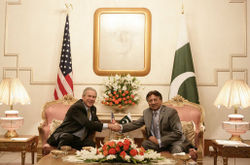 Musharraf with United States President George W. Bush at the Presidency in Islamabad, Pakistan Musharraf's support for the USA was indispensable in defeating the Taliban in Afghanistan with the ease that it was routed. This was done after his swift and strategically sound decision to cease Pakistan's long-running support of the Taliban. Pakistan cut the Taliban's oil and supply lines, provided intelligence and acted as a logistics support area for Operation Enduring Freedom. It has also allowed US forces to operate inside Pakistan, and Pakistani forces especially the military controlled Inter-Services Intelligence Directorate have been implicated in the use of torture on suspected militants.
Under U.S. pressure, Musharraf has launched a major military offensive in the tribal region of Wana, displacing many resident families in the hunt for militants, and has caused a national insurgency movement made up of disaffected militants and former residents of Wana whose homes were demolished by the army in its heavy bombing campaign.
However, after the more recent resurgence of the Taliban, the United States is taking a harder look at Pakistan's continuing role in the Taliban insurgency, according to reports in the New York Times ["Musharraf Vows to Aid Afghanistan in Fighting Taliban". New York Times. 7 September 2006.] Seth G. Jones, a political scientist at the RAND Corporation, said that there was increasing evidence that Pakistani intelligence agents had been financing, training, providing intelligence and assistance to Taliban insurgents. Whether the orders come from General Musharraf himself is not clear, Mr. Jones said, but he said it was clear that he knew about the support, and that he so far had failed to stop the militancy.
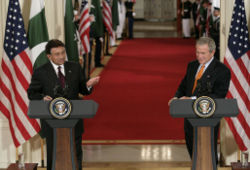 US President George W. Bush and President Musharraf answer reporters in the East Room of the White House in late 2006. Musharraf speaks fluent English and has given many interviews and speeches on various US and European TV channels and other media. He is also known for giving contrasting views in his interviews. He has spoken at think tanks such as the RAND Corporation in Santa Monica, California, in June 2003. His support for the US-led War on Terror has been a cause for increasing public support for right-wing Islamic parties in Pakistan. The US's image in Pakistan has suffered ostensibly after the war in Iraq without an authorising UN resolution. Musharraf has bluntly refused to send any Pakistani troops to Iraq without a UN resolution and also due to public pressure in Pakistan.
After lengthy talks with his Afghan counterpart, Hamid Karzai, he said on September 7, 2006 he was committed to crushing the Taliban, their al Qaeda allies and "Talibanisation", a reference to the spread of hardline Islam. "The best way to fight this common enemy is to join hands, trust each other and form a common strategy," he told reporters in Kabul, days before the fifth anniversary of the September 11 attacks that prompted the US-led invasion of Afghanistan. "Any militant activity will be addressed with force. No Talibanisation. No Taliban activity on our side of the border and across the border in Afghanistan," Musharraf said. The issue of cross-border movement clouded President George W. Bush's visit to Islamabad early 2006 and Musharraf's pledge comes ahead of a trip to the United States and Cuba and an expected meeting with Bush.[Pakistan vow to help crush Taliban. The Age. 7 September 2006.]
Elections during Musharraf's administration
On 12 May 2000, the Supreme Court ordered Musharraf to hold national elections by 12 October 2002; elections for local governments took place in 2001. Elections for the national and provincial legislatures were held in October 2002, with no party winning a majority. In November 2002, Musharraf handed over certain powers to the newly elected Parliament. The National Assembly elected Mir Zafarullah Khan Jamali as Prime Minister of Pakistan, who in turn appointed his own cabinet.
On January 1, 2004 Musharraf won a confidence vote in the Electoral College of Pakistan, consisting of both houses of Parliament and the four provincial assemblies which are dominated by the landed elite of the country, most of whom have been given governmental posts under Musharraf. Musharraf received 658 out of 1170 votes, a 56% majority, but many opposition and Islamic members of parliament walked out to protest the vote. As a result of this vote, according to Article 41(8) of the Constitution of Pakistan, Musharraf was "deemed to be elected" to the office of President. His term now extends to 2007.
Prime Minister Jamali resigned on 26 June 2004. His resignation is widely believed to be on the command of General Pervez Musharraf. Jamali, in the first place was appointed by Musharraf, who controls the PML(Q). He formed PML(Q) by horse-trading with different parties (largely the PML(N) and the PPPP). Most of the ministers of the cabinet were senior members of other parties, who joined PML(Q) after the elections just because Musharraf promised them important offices in the government. Musharraf replaced Jamali due to his poor performance and in his place Musharraf appointed Shaukat Aziz, a former Vice President of Citibank[Citigroup: Global Consumer Business Announces Management Structure] and head of Citibank Private Banking as the new prime minister. Musharraf choose Shaukat Aziz due to his successful measures in revitalizing Pakistan's economy as the Finance Minister. The new government is mostly supportive of Musharraf, who remains the President and Head of State in the new government. Musharraf continues to be the active executive of Pakistan, especially in foreign affairs. Although whether he stays the president after he gives up the post of Chief of Army staff is still to be seen.
Nuclear proliferation
Recently, Musharraf has come under fire from the West after the disclosure of nuclear proliferation by Dr. Abdul Qadeer Khan, the metallurgist known as the father of Pakistan's bomb. Musharraf has denied knowledge of or participation by Pakistan's government or army in this proliferation despite deep domestic criticism for singularly vilifying Khan, a former national hero. Musharraf continues to enjoy strong support of the White House and former Defense Secretary Donald Rumsfeld. AQ Khan has been pardoned in exchange for cooperation in the investigation of his nuclear-proliferation network. The fate of those who were found to have conspired with Khan is yet to be decided.[Pakistan nuclear case 'is closed']
Musharraf in the media
In the Time 100 Poll 2006 of "The People Who Shape Our World", he is currently ranked at number thirteen. In September of 2006, he became the first sitting president of a country to appear on the The Daily Show.[Pervez Musharraf appears on ‘The Daily Show’].
In a list titled "The World's 10 Worst Dictators" prepared by Parade magazine in 2005, Pervez Musharraf is placed at number 7 in the ranking for the first time, in previous years he never appeared [PARADE February 13, 2005]. He subsequently "dropped out" of this listing in 2006.
Notes
References
See also
- List of national leaders
- Politics of Pakistan
- Line of Succession to President of Pakistan
- List of dictators
- Nawaz Sharif
- Musharraf view on Enlightened moderation
- Mirza Tahir Hussain
External links
|