| . |
: John F. Kennedy, White House color photo portrait.
- For other persons named John Kennedy, see John Kennedy (disambiguation).
"JFK" redirects here. For other uses, see JFK (disambiguation).
John Fitzgerald Kennedy (May 29, 1917 – November 22, 1963), also referred to as John F. Kennedy, JFK, John Kennedy or Jack Kennedy, was the 35th President of the United States. He served from 1961 until his assassination in 1963. His leadership during the ramming of his USS PT-109 during World War II led to being cited for bravery and heroism in the South Pacific. Kennedy represented Massachusetts during 1947–1960, as both a member of the U.S. House of Representatives and U.S. Senate. He was elected President in 1960 in one of the closest elections in American history. He is, to date, the only Roman Catholic to be elected President of the United States.
Major events during his presidency included the Bay of Pigs invasion, the Cuban Missile Crisis, the building of the Berlin Wall, the Space Race, early events of the Vietnam War, and the American Civil Rights Movement.
John F. Kennedy was assassinated on November 22, 1963. The Warren Commission concluded that Lee Harvey Oswald acted alone in killing the president, although later the House Select Committee on Assassinations concluded that a conspiracy may have been involved in the assassination [1], and the subject remains controversial. Kennedy's assassination is considered to be a defining moment in U.S. history due to its traumatic impact on the nation as well as on the political history of the ensuing decades, his subsequent branding as an icon for a new generation of Americans and American aspirations, and for the mystery and conspiracy allegations which surround it.
Contents
- 1 Early life and education
- 2 Military service
- 3 Early political career
- 4 1960 presidential election
- 5 Presidency (1961-1963)
- 5.1 Foreign policies
- 5.1.1 Cuba and the Bay of Pigs Scandal
- 5.1.2 Cuban Missile Crisis
- 5.1.3 Latin America and Communism
- 5.1.4 Peace Corps
- 5.1.5 Vietnam
- 5.1.6 West Berlin Speech
- 5.1.7 Nuclear Test Ban Treaty
- 5.1.8 Ireland
- 5.2 Domestic policies
- 5.2.1 Civil rights
- 5.2.2 Space program
- 5.3 Cabinet
- 5.4 Supreme Court appointments
- 6 Image, social life and family
- 7 Assassination
- 8 Legacy and memorials
- 9 Criticism
- 10 Trivia
- 11 Kennedy in film
- 12 See also
- 13 References
- 13.1 Primary sources
- 13.2 Secondary sources
- 13.3 Other sources
- 14 Media
- 15 External links
|
Early life and education
Kennedy was born in Brookline, Massachusetts, the son of Joseph P. Kennedy, Sr. and Rose Fitzgerald; Rose, in turn, was the eldest child of John "Honey Fitz" Fitzgerald, a prominent figure in Boston politics who was the city's mayor and a three-term member of Congress.
Kennedy attended Edward Devotion School for four years (kindergarten in 1922 to third grade), Riverdale Country School in the Bronx, the Dexter School in Boston, a year at Canterbury School, and then The Choate School in Wallingford, Connecticut,[KENNEDY, John Fitzgerald - Biographical Information. Biographical Directory of the United States Congress. Retrieved on 2006-10-15.] one of the country's most elite private boarding schools for boys, from which he graduated in 1935. On September 25, 1935, he sailed to London with his parents and his sister Kathleen. There he enrolled at the London School of Economics with the intention of studying political economy for a year under the tutelage of Professor Harold Laski, but an illness hospitalized him shortly after his enrollment. His father insisted he return to the US. Later during the autumn of 1935, he enrolled in Princeton University, but was forced to leave after developing jaundice. The next autumn, he began attending Harvard College, where he resided in Winthrop House. Kennedy traveled to Europe twice during his Harvard years, visiting Britain, where his father was serving as ambassador to the Court of St. James. In 1937, Kennedy was prescribed steroids to control his colitis, which only increased his medical problems, causing him to develop osteoporosis of the lower lumbar spine [2]. After graduating from Harvard, he attended Stanford University’s business school for a few months and then traveled to South America.
In 1940, Kennedy wrote his honors thesis, entitled "Appeasement in Munich" about the British dealings concerning the Munich Agreement. He initially intended for his thesis to be only for college use, but his father encouraged him to publish it in a book. He graduated cum laude from Harvard with a degree in international affairs in June 1940. His thesis was published in 1940 as a book entitled, "Why England Slept,"[Why England Slept. Museum Store. John F Kennedy Presidential Library and Museum. Retrieved on 2006-09-19.] and became a bestseller.
[3]
Years later, it was revealed that, as a young man, Kennedy had been diagnosed with Addison's disease, a rare endocrine disorder. This and other medical disorders were kept from the press and public throughout Kennedy's lifetime.[Online NewsHour with Senior Correspondent Ray Suarez and physician Jeffrey Kelman, Pres. Kennedy's Health Secrets, The NewsHour with Jim Lehrer transcript, 2002-11-18]
Military service
Main article: PT-109
In the spring of 1941, Kennedy volunteered for the U.S. Army but was rejected, mainly because of his troublesome back. Nevertheless, in September of that year, the U.S. Navy accepted him, due to the influence of the director of the Office of Naval Intelligence (ONI), a former naval attaché to Ambassador Joseph Kennedy. As an ensign, he served in the office which supplied bulletins and briefing information for the Secretary of the Navy. It was during this assignment that the attack on Pearl Harbor occurred. He attended the Naval Reserve Officers Training School and Motor Torpedo Boat Squadron Training Center before being assigned for duty in Panama and eventually the Pacific theater. He participated in various commands in the Pacific theater and earned the rank of lieutenant, commanding a patrol torpedo (PT) boat.[4]
On August 2, 1943, Kennedy's boat, the PT-109, was taking part in a nighttime maritime patrol near New Georgia (in the Solomon Islands) when it was rammed by a Japanese destroyer. Kennedy was thrown across the deck, injuring his already-troubled back. Still, Kennedy towed a wounded man three miles (5 km) in the ocean, arriving at an island where his crew was subsequently rescued. Kennedy said that he blacked out for periods of time during the life-threatening ordeal. For these actions, Kennedy received the Navy and Marine Corps Medal under the following citation:
|
| For heroism; the rescue of 3 men following the ramming and sinking of his motor torpedo boat while attempting a torpedo attack on a Japanese destroyer in the Solomon Islands area on the night of Aug 1–2, 1943. Lt. KENNEDY, Capt. of the boat, directed the rescue of the crew and personally rescued 3 men, one of whom was seriously injured. During the following 6 days, he succeeded in getting his crew ashore, and after swimming many hours attempting to secure aid and food, finally affected the rescue of the men. His courage, endurance and excellent leadership contributed to the saving of several lives and was in keeping with the highest traditions of the United States Naval Service.
|
|
Kennedy's other decorations in World War II included the Purple Heart, Asiatic-Pacific Campaign Medal, and the World War II Victory Medal. He was honorably discharged in early 1945, just a few months before Japan surrendered. The incident was popularized when he became president, and would be the subject of several magazine articles, books, comic books, TV specials and a feature length movie, making the PT-109 one of the most famous U.S. Navy ships of the war. Scale models and even G.I. Joe figures based on the incident were still being produced in the 2000s. The coconut which was used to scrawl a rescue message given to Solomon Islander scouts who found him was kept on his presidential desk and is still at the John F. Kennedy library.
During his presidency, Kennedy privately admitted to friends that he didn't feel that he deserved the medals he had received, because the PT-109 incident had been the result of a botched military operation that had cost the lives of two members of his crew. When asked by interviewers how he became a war hero, Kennedy's grim reply was: "It was involuntary. They sank my boat."
In May 2002, a National Geographic expedition found what is believed to be the wreckage of the PT-109 in the Solomon Islands. One of the Kennedy family also returned to the islands to give a gift to the scouts who are still alive today, but were turned away when they traveled to the inauguration because of communication problems. The Australian coastwatcher who dispatched the natives was also invited to the White House.[Ted Chamberlain (July 11, 2002). JFK's PT-109 Found, U.S. Navy Confirms. National Geographic News.]
Early political career
After World War II, John thought about being a journalist for a while before he decided to run for political office. Prior to the war, he hadn't really thought about being a politician primarily because his older brother, Joseph P. Kennedy, Jr. had been tabbed by the family as the future politician, and hopefully, the future President. Tragically, Joe was killed in World War II, making Jack next in line to fulfill his father's political ambitions. In 1946, Representative James Michael Curley vacated his seat in an overwhelmingly Democratic district to become mayor of Boston, and Kennedy ran for that seat, beating his Republican opponent by a large margin. He was a congressman for six years but had a mixed voting record, often diverging from President Harry S. Truman and the rest of the Democratic Party. In 1952, he defeated incumbent Republican Henry Cabot Lodge, Jr. for the U.S. Senate.
Kennedy married Jacqueline Lee Bouvier on September 12, 1953. He underwent several spinal operations in the two following years, nearly dying (receiving the Catholic faith's "last rites" four times during his life), and was often absent from the Senate. During this period, he published Profiles in Courage, highlighting eight instances in which U.S. Senators risked their careers by standing by their personal beliefs. The book was awarded the 1957 Pulitzer Prize for Biography.
John F. Kennedy voted for final passage of the Civil Rights Act of 1957, after having earlier voted for the "Jury Trial Amendment", which effectively rendered the Act toothless, because convictions for violations could not be obtained. Staunch segregationists such as James Eastland, John McClellan, and Mississippi Governor James Coleman were early supporters in Kennedy's presidential campaign. [T. Reeves, "A Question of Character', p. 140]
Sen. Joseph McCarthy was a friend of the Kennedy family; Robert F. Kennedy worked on the staff of McCarthy's committee, and McCarthy dated Patricia Kennedy. In 1954, when the Senate was poised to condemn McCarthy, John Kennedy had a speech drafted calling for the censure of McCarthy but he never delivered it. When the Senate rendered its highly publicized decision to censure McCarthy on December 2, 1954, Senator Kennedy was in a hospital and never indicated then or later how he would have voted. The episode seriously affected Kennedy in the liberal community, especially with Eleanor Roosevelt, as late as the 1960 election. [T. Reeves, & Collier & Horowitz]
1960 presidential election
Main article: United States presidential election, 1960
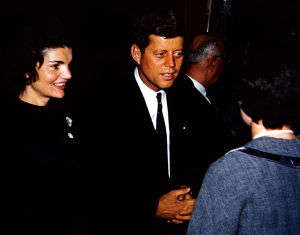 John and Jackie Kennedy campaigning in Appleton, Wisconsin in March 1960. In 1960, Kennedy declared his intent to run for President of the United States. In the Democratic primary election, he faced challenges from Senator Hubert H. Humphrey of Minnesota, Senator Lyndon B. Johnson of Texas, and Adlai Stevenson, the Democratic nominee in 1952 and 1956, who was not officially running but was a favorite write-in candidate. Kennedy won key primaries like Wisconsin and West Virginia. In the latter state, Kennedy made a visit to a coal mine, and talked to the mine workers to win their support; most people in that conservative, mostly Protestant state were deeply suspicious about Kennedy being a Catholic. Kennedy emerged as a universally acceptable candidate for the party after that victory.
On July 13, 1960, the Democratic Party nominated Kennedy as its candidate for President. Kennedy asked Johnson to be his Vice-Presidential candidate, despite clashes between the two during the primary elections. He needed Johnson's strength in the South to win what was considered likely to be the closest election since 1916. Major issues included how to get the economy moving again, Kennedy's Catholicism, Cuba, and whether both the Soviet space and missile programs had surpassed those of the U.S. To allay fears that his Catholicism would impact his decision-making, he said in a famous speech in Houston, Texas (to the Greater Houston Ministerial Association), on September 12, 1960, "I am not the Catholic candidate for President. I am the Democratic Party's candidate for President who also happens to be a Catholic. I do not speak for my Church on public matters—and the Church does not speak for me." [5] Kennedy also brought up the point of whether one-quarter of Americans were relegated to second-class citizenship just because they were Catholic.
In September and October, Kennedy debated Republican candidate Vice President Richard Nixon in the first televised U.S. presidential debates. During the debates, Nixon looked tense and uncomfortable, while Kennedy was composed, which led the television audience to deem Kennedy the winner, although radio listeners in general thought Nixon had won or the debate was a draw. [6] Nixon did not wear make-up during the debate unlike Kennedy. The debates are considered a political landmark: the point at which the medium of television played an important role in politics.
Presidency (1961-1963)
John Kennedy was sworn in as the 35th President on January 20, 1961. In his inaugural address he spoke of the need for all Americans to be active citizens. "Ask not what your country can do for you, ask what you can do for your country", he said. He also asked the nations of the world to join together to fight what he called the "common enemies of man: tyranny, poverty, disease, and war itself." [7]
Foreign policies
Cuba and the Bay of Pigs Scandal
In hopes of overthrowing the leftist Castro regime, Kennedy and his young cabinet drew the Bay of Pigs operation. U.S. trained Cuban insurgents would invade Cuba and instigate the Cuban people in hopes of achieving their goal. On April 17, 1961, Kennedy gave orders allowing the previously planned invasion of Cuba to proceed. With support from the Central Intelligence Agency (CIA), in what is known as the Bay of Pigs Invasion, 1,500 U.S.-trained Cuban exiles, called "Brigade 2506", returned to the island in the hope of deposing Fidel Castro. However, the CIA proceeded to allow the troops to go even though Kennedy did not authorize air support. By April 19, Castro's government had captured or killed most of the invading exiles and Kennedy was forced to negotiate for the release of the 1,189 survivors. After 20 months, Cuba released the captured exiles in exchange for $53 million worth of food and medicine. The incident was a major embarrassment for Kennedy, but he took full personal responsibility for the debacle. Furthermore, the incident made Castro wary of the U.S. and untrusting, leading him to believe that another invasion such as that one would occur. [8]
Cuban Missile Crisis
The Cuban Missile Crisis began on October 14, 1962, when American U-2 spy planes took photographs of a Soviet intermediate-range ballistic missile site under construction in Cuba. America would soon be posed with a serious nuclear threat. Here Kennedy faced a dilemma: if the U.S. attacked the sites it might lead to nuclear war with the U.S.S.R. If the U.S. did nothing, it would endure the perpetual threat of nuclear weapons within its region—in such close proximity that if the weapons were launched pre-emptively, the U.S. may have been unable to retaliate. Another fear was that the U.S. would appear to the world as weak in its own hemisphere. Many military officials and cabinet members pressed for an air assault on the missile sites, but Kennedy ordered a naval blockade in which the U.S. Navy inspected all ships. He began negotiations with the Soviets. He ordered the Soviets to remove all "defensive" material that is being built off the Cuban island. Without doing so, the Soviet people would face a naval blockade, as well as Cuba. A week later, he and Soviet Premier Nikita Khrushchev reached an agreement. Khrushchev agreed to remove the missiles while the U.S. publicly promised never to invade Cuba and also secretly promised to remove U.S. ballistic missiles from Turkey within six months. Following this incident, which brought the world closer to nuclear war than at any point before or since, Kennedy was more cautious in confronting the Soviet Union.[citation�needed]
Latin America and Communism
Arguing that "those who make peaceful revolution impossible, make violent revolution inevitable," Kennedy sought to contain communism in Latin America by establishing the Alliance for Progress, which sent foreign aid to troubled countries in the region and sought greater human rights standards in the region. He worked closely with Puerto Rican Governor Luis Muñoz Marín for the development of the Alliance of Progress, as well as developments on the autonomy of the Commonwealth of Puerto Rico.
Peace Corps
As one of his first presidential acts, Kennedy created the Peace Corps. Through this program, Americans volunteered to help underdeveloped nations in areas such as education, farming, health care and construction.
Vietnam
In Vietnam, Kennedy used limited military action to fight the Communist Nationalist forces in that Country led by Ho Chi Minh. Proclaiming a fight against the spread of Communism, Kennedy enacted policies providing political, economic, and military support for the unstable French-installed South Vietnamese government, which included sending 18,000 military advisors and U.S. Special Forces to the area. Kennedy also agreed to the use of napalm, defoliants, free-fire zones and jet planes. U.S. involvement in the area continually escalated until regular U.S. forces were directly fighting the Vietnam War in the next administration. The Kennedy Administration increased military support, but the South Vietnamese military was unable to make headway against the pro-independence Viet-Minh and Viet Cong forces. By July 1963 Kennedy faced a crisis in Vietnam. The Administration's response was to assist in the coup d'état of the Catholic President of South Vietnam, Ngo Dinh Diem (LeFeber, "America, Russia and the Cold War", p. 233). In 1963, South Vietnamese generals overthrew the Diem government, arresting Diem and later killing him (though the exact circumstances of his death remain unclear).[http://www.gwu.edu/~nsarchiv/NSAEBB/NSAEBB101/vn28.pdf] Kennedy sanctioned Diem's overthrow. One reason for the support was a fear that Diem might negotiate a neutralist coalition government which included Communists, as had occurred in Laos in 1962. Dean Rusk, Secretary of State, remarked "This kind of neutralism...is tantamount to surrender."
It remains a point of controversy among historians whether or not Vietnam would have escalated to the point it did had Kennedy served out his full term and possibly been re-elected in 1964.[ Joseph Ellis, "Making Vietnam History ," Reviews in American History 28.4 (2000) 625-629 ] Fueling this speculation are statements made by Kennedy's and Lyndon Johnson's Secretary of Defense Robert MacNamara that Kennedy was strongly considering pulling out of Vietnam after the 1964 election. [ The Fog of War: Eleven Lessons from the Life of Robert S. McNamara ] Nevertheless, given the stated reason for the overthrow of the Diem government, such action would have been a dramatic policy reversal.
West Berlin Speech
Under simultaneous and opposing pressures from the Allies and the Soviets, Germany was divided. The Berlin Wall separated the West and East Berlin, the latter being under the control of the Soviets. On June 26, 1963, Kennedy visited West Berlin and gave a public speech criticizing communism. Kennedy used the construction of the Berlin Wall as an example of the failures of communism: "Freedom has many difficulties and democracy is not perfect, but we have never had to put a wall up to keep our people in." The speech is known for its famous phrase "Ich bin ein Berliner". Nearly 5/6th of the population were on the street when Kennedy said that famous phrase. He remarked to aides afterwards: "We'll never have another day like this one." {(trueman,C.). (2003). Berlin Wall. History learning site. 10/31/06.}
Nuclear Test Ban Treaty
Troubled by the long-term dangers of radioactive contamination and nuclear weapons proliferation, Kennedy pushed for the adoption of a Limited or Partial Test Ban Treaty, which prohibited atomic testing on the ground, in the atmosphere, or underwater, but did not prohibit testing underground. The United States, the United Kingdom and the Soviet Union were the initial signatories to the treaty. Kennedy signed the treaty into law in August 1963.
Ireland
- Further information: The Ireland Funds
On the occasion of his visit to Ireland in 1963, President Kennedy joined with Irish President Éamon de Valera to form The American Irish Foundation. The mission of this organization was to foster connections between Americans of Irish descent and the country of their ancestry. Kennedy furthered these connections of cultural solidarity by accepting a grant of armorial bearings from the Chief Herald of Ireland.
He also visited the original cottage where previous Kennedys had lived before emigrating to America, and said, "This is where it all began...."
Domestic policies
Kennedy called his domestic program the "New Frontier". It ambitiously promised federal funding for education, medical care for the elderly, and government intervention to halt the recession. Kennedy also promised an end to racial discrimination. In 1963, he proposed a tax reform which included income tax cuts, but this was not passed by Congress until 1964, after his death. Few of Kennedy's major programs passed Congress during his lifetime, although, under his successor Lyndon Johnson, Congress did vote them through in 1964-65.
As President, Kennedy oversaw the last pre-Furman federal execution, and last, to date, military execution. In both cases he refused ask for commutation the death sentences (Iowa Governor Harold Hughes personally contacted Kennedy to request clemency for Victor Feguer who was sentenced to death under federal law in Iowa and executed on March 15, 1963).
Civil rights
The turbulent end of state-sanctioned racial discrimination was one of the most pressing domestic issues of Kennedy's era. The U.S. Supreme Court had ruled in 1954 that racial segregation in public schools would no longer be permitted. However, many schools, especially in southern states, did not obey the Supreme Court's injunction. Segregation on buses, in restaurants, movie theaters, bathrooms, and other public places remained. Kennedy supported racial integration and civil rights, and during the 1960 campaign he telephoned Coretta Scott King; wife of the jailed Reverend Martin Luther King, Jr., which perhaps drew some additional black support to his candidacy.
In 1962, James Meredith tried to enroll at the University of Mississippi, but he was prevented from doing so by white students. Kennedy responded by sending some 400 federal marshals and 3,000 troops to ensure that Meredith could enroll in his first class. Kennedy also assigned federal marshals to protect Freedom Riders.
As President, Kennedy initially believed the grassroots movement for civil rights would only anger many Southern whites and make it even more difficult to pass civil rights laws through Congress, which was dominated by Southern Democrats, and he distanced himself from it. As a result, many civil rights leaders viewed Kennedy as unsupportive of their efforts.
On June 11, 1963, President Kennedy intervened when Alabama Governor George Wallace blocked the doorway to the University of Alabama to stop two African American students, Vivian Malone and James Hood, from enrolling. George Wallace moved aside after being confronted by federal marshals, Deputy Attorney General Nicholas Katzenbach, and the Alabama National Guard. That evening Kennedy gave his famous civil rights address on national television and radio. [9] Kennedy proposed what would become the Civil Rights Act of 1964.
[10]
[11]
Space program
Kennedy was eager for the United States to lead the way in the space race. Sergei Khrushchev says JFK approached his father, Nikita, twice about a "joint venture" in space exploration—in June 1961 and Autumn 1963. On the first occasion, Russia was far ahead of America in terms of space technology. JFK later made a speech at Rice University in September 1962, in which he said, "No nation which expects to be the leader of other nations can expect to stay behind in this race for space" and, "We choose to go to the moon in this decade and do the other things, not because they are easy, but because they are hard."[12]. On the second approach to Khrushchev, the Russian was persuaded that cost-sharing was beneficial and American space technology was forging ahead. The U.S. had launched a geostationary satellite and Kennedy had asked Congress to approve more than $22 billion for the Apollo Project, which had the goal of landing an American man on the moon before the end of the decade. Khrushchev agreed to a joint venture in Autumn 1963, but JFK died in November before the agreement could be formalized. On July 20, 1969, almost six years after Kennedy's death, the Project Apollo's goal was realized when Neil Armstrong and Buzz Aldrin became the first men to land on the moon.
Cabinet
|
|
| OFFICE | NAME | TERM
|
|
|
| President | John F. Kennedy | 1961–1963
|
| Vice President | Lyndon B. Johnson | 1961–1963
|
|
|
| State | Dean Rusk | 1961–1963
|
| Treasury | C. Douglas Dillon | 1961–1963
|
| Defense | Robert S. McNamara | 1961–1963
|
| Justice | Robert F. Kennedy | 1961–1963
|
| Postmaster General | J. Edward Day | 1961–1963
|
| � | John A. Gronouski | 1963
|
| Interior | Stewart L. Udall | 1961–1963
|
| Agriculture | Orville L. Freeman | 1961–1963
|
| Commerce | Luther H. Hodges | 1961–1963
|
| Labor | Arthur J. Goldberg | 1961–1962
|
| � | W. Willard Wirtz | 1962–1963
|
| HEW | Abraham A. Ribicoff | 1961–1962
|
| � | Anthony J. Celebrezze | 1962–1963
|
Supreme Court appointments
Kennedy appointed the following Justices to the Supreme Court of the United States:
- Byron Raymond White – 1962
- Arthur Joseph Goldberg – 1962
Image, social life and family
- Further information: Kennedy political family
Kennedy and his wife "Jackie" were very young in comparison to earlier Presidents and first ladies, and were both extraordinarily popular in ways more common to
|