|
Jane Austen
| . |
: Sense and SensibilityRecent Penguin classic's paperback coverAuthorJane AustenCountryUnited KingdomLanguageEnglishGenre(s)Romantic novelPublisherMr.
Sense and Sensibility | | Recent Penguin classic's paperback cover |
| Author | Jane Austen |
|---|
| Country | United Kingdom |
|---|
| Language | English |
|---|
| Genre(s) | Romantic novel |
|---|
| Publisher | Mr. Egerton |
|---|
| Released | 1811 |
|---|
| Media Type | Print (Hardback & Paperback) |
|---|
| ISBN | NA |
|---|
| Followed�by | Pride and Prejudice |
|---|
For other uses, see Sense and Sensibility (disambiguation).
Sense and Sensibility is a novel by Jane Austen that was first published in 1811. It was the first of Austen's novels to be published, under the pseudonym "A Lady." The novel has been adapted for film and television a number of times, most notably in Ang Lee's 1995 version.
Contents
- 1 Plot introduction
- 2 Plot summary
- 3 Characters in Sense and Sensibility
- 4 Critical appraisal
- 5 Film, TV and theatre adaptations
- 6 Notes
- 7 External links
|
Plot introduction
Elinor and Marianne Dashwood are sisters with opposite temperaments. Elinor is 19, the oldest daughter in the family, and represents the "sense" (reason) of the title. Marianne is three years younger and represents "sensibility" (emotion).
Elinor and Marianne are the daughters of Mr. Dashwood by his second wife. They also have a younger sister, Margaret, and an older half-brother named John. When their father dies, the family estate passes to John and the Dashwood women are left impoverished. Fortunately, a distant relative offers to rent the women a cottage on his property.
The novel follows the Dashwood sisters to their new home, where they experience both romance and heartbreak. The contrast between the sisters' characters is eventually resolved as they each find love and lasting happiness.
Plot summary
Mrs. Dashwood and her daughters Elinor, Marianne, and Margaret, are impoverished after the death of her husband. His estate, Norland, must pass to John Dashwood, his son from his first marriage. Although John promised his father that he would take care of his stepmother and sisters, his selfish wife Fanny easily dissuades him from giving them their fair share of the inheritance. The Dashwood women are treated as unwelcome guests in their own home, and soon begin looking for another place to live.
In the meantime, Elinor becomes attached to Fanny's visiting brother Edward Ferrars. Edward is a quiet, unassuming young man with a gentle nature. He has no desire to live up to his mother and sister's desire to see him a famous politician or "fine figure in the world". Although he is not handsome or charming, Elinor soon comes to admire Edward's intelligence and good sense. However, Edward's fortune is dependent on the will of his mother. Elinor knows that Mrs. Ferrars wants her son to marry a woman of high rank, and does not allow herself to hope for marriage.
Mrs. Dashwood and her daughters soon move from Norland to Barton Cottage. Their landlord is Sir John Middleton, a distant cousin who generously offers them a low rent. He lives at Barton Park with his coldly elegant wife and their children. Also staying at Barton Park are Lady Middleton's mother, Mrs. Jennings, and Colonel Brandon, an old friend of Sir John. Mrs. Jennings, a jovial old woman who loves to joke and gossip, soon decides that Colonel Brandon must be in love with Marianne. She teases them both about the matter, much to Marianne's confusion. Marianne considers Colonel Brandon, age thirty-five, to be an infirm old bachelor incapable of falling in love or inspiring love in anyone else.
When on a walk in the countryside near Barton Cottage, Marianne is caught in the rain. She slips on the wet grass and sprains her ankle. Mr. Willoughby, a dashing and handsome young man, happens to be passing nearby. He races to Marianne's rescue, and wins her admiration and that of her family by carries her back home. After this incident, Willoughby begins to visit Marianne every day.
The two become increasingly intimate, and Elinor and Mrs. Dashwood begin to suspect that the couple has secretly become engaged. However, Mrs. Dashwood's sentimental nature prevents her from following Elinor's advice and simply asking Marianne about her relationship with Willoughby. Marianne is devastated when Willoughby unexpectedly announces that he must go to London on business, not to return for at least a year.
Edward Ferrars comes to visit the Dashwoods at Barton Cottage, but seems unhappy and is distant towards Elinor. She fears that he no longer has feelings for her. However, unlike Marianne, she does not wallow in her sadness.
Shortly afterward, Ann and Lucy Steele, cousins of Lady Middleton, come to stay at Barton Park. Sir John tells Lucy that Elinor is attached to Edward, prompting Lucy to inform Elinor that she (Lucy) has been secretly engaged to Edward for four years. Though Elinor initially blames Edward for engaging her affections when he was not free to do so, she soon realises that he became engaged to Lucy while he was young and naive. Elinor understands that Edward does not love or admire Lucy, but that he will not hurt or dishonor her by breaking their engagement. Elinor hides her disappointment from her family and friends, and succeeds in persuading Lucy that she feels nothing for Edward.
Elinor and Marianne spend the winter at Mrs. Jennings' home in London. Marianne writes to Willoughby, but her letters are unanswered. They meet Willoughby at a party, where he treats them in a coldly formal manner. He later sends Marianne a letter informing her that he is engaged to one Miss Grey, a very wealthy woman of inferior birth. Marianne admits to Elinor that she and Willoughby were never engaged, but that she loved him and that he led her to believe that he truly loved her.
Colonel Brandon reveals to Elinor that Willoughby had seduced Brandon's foster daughter, Miss Williams, and abandoned her when she became pregnant. The Colonel was once in love with Miss Williams's mother, a woman who resembled Marianne and whose life was destroyed by an unhappy arranged marriage to the Colonel's brother.
Later, Mrs. Jennings tells Elinor that Mrs. Ferrars has discovered Edward and Lucy's engagement. Edward refuses to end the engagement and his mother disinherits him. Elinor and Marianne feel sorry for Edward, and think him honourable for remaining engaged to a woman he will probably not be happy with. Ann Steele tells Elinor that Lucy still intends to marry Edward. Edward intends to take religious orders so that he can support them. Colonel Brandon, knowing how lives can be ruined when true love is denied, offers his parish at Delaford to Edward, although he hardly knows him. Elinor meets Edward's boorish brother Robert and is shocked to discover that he has no qualms about claiming his brother's inheritance.
Marianne becomes very ill after a walk in the rain during which she was wallowing in misery because of Willoughby, and Colonel Brandon goes to get Mrs. Dashwood. Willoughby arrives and tells Elinor that he was left with large debts when his benefactress discovered his actions towards Miss Williams and disinherited him. He then decided to marry a wealthy woman. He says that he still loves Marianne. He seeks forgiveness, but has poor excuses for his selfish actions. Meanwhile, Colonel Brandon reveals his love for Marianne to Mrs. Dashwood.
Marianne recovers and the Dashwoods return to Barton Cottage. Elinor tells Marianne about Willoubghby's visit. However, Marianne states that though she loved him, she couldn't have been happy with the libertine father of an illegitimate child even if he had stood by her. Marianne also states that she realises that her illness was brought on by her wallowing in her grief, by her excesive sensibility, and that, had she died, it would have been morally equivalent to suicide. With particular reference to Elinor's bravery and sense, she now resolves to become a reformed character.
The family now learn that Mr. Ferrars has married Lucy. When Mrs. Dashwood sees how upset Elinor is, she finally realises how strong Elinor's feelings for Edward are and is sorry that she did not pay more attention to her unhappiness. However, the very next day Edward arrives and reveals that it was his brother who married Lucy. He says that he was trapped in his engagement with Lucy, "a woman he had long since ceased to love," but that she had broken the engagement to marry the now wealthy Robert. Edward asks Elinor to marry him, and she agrees. Edward reconciles with his mother, and she gives him ten thousand pounds, sufficent for them to live comfortably. They marry and move into the parsonage at Delaford. However, Edwards reconciliation with his mother is partial and insufficient. His mother disowned him for wanting to marry Lucy, but when Lucy married her second son Mrs Ferrars became great friends with her. Mrs Ferrars continues to favour her second son, never reinstating Edward to his former favoured position.
Mr Willoughby's patroness does eventually give him back his money, stating that his marriage to a woman of good character redeemed him. Willoughby realizes that marrying Marianne would have produced the same effect. He must live with the knowledge that had he behaved honourably he could have had both love and money.
Over the next two years, Mrs. Dashwood, Marianne, and Margaret spend most of their time at Delaford. Marianne matures and decides to marry the Colonel even though she feels more respect than passion for him. However, after the marriage she realizes that she does truly love him. She and the Colonel set up house near Elinor and Edward, so the sisters and their husbands can visit each other often.
Characters in Sense and Sensibility
- Henry Dashwood — a wealthy gentleman who dies at the beginning of the story. The terms of his estate prevent him from leaving anything to his second wife and their children together. He asks John, his son by his first wife, to look after (meaning ensure the financial security) of his second wife and their three daughters.
- Mrs. Dashwood — the second wife of Henry Dashwood, who is left in difficult financial straits by the death of her husband.
- Marianne Dashwood — The romantically inclined and expressive second daughter of Mr. and Mrs. Henry Dashwood. She is the object of the attentions of Col. Brandon and Mr. Willoughby.
- Margaret Dashwood — the youngest daughter of Mr. and Mrs. Henry Dashwood.
- John Dashwood — the son of Henry Dashwood by his first wife.
- Fanny Dashwood — the wife of John Dashwood, and sister to Edward and Robert Ferrars.
- Sir John Middleton — a distant relative of Mrs. Dashwood who, after the death of Henry Dashwood, invites her and her three daughters to live in a cottage on his property. Middleton, his wife, and their children are visited by his mother-in-law, Mrs. Jennings. He and Mrs. Jennings are a jolly and gossipy pair, taking an active interest in the romantic affairs of the young people around them and seeking to encourage suitable matches.
- Lady Middleton — The genteel and idle wife of Sir John Middleton, she is primarily concerned with mothering her four spoilt children.
- Edward Ferrars — The elder of Fanny Dashwood's two brothers. He forms an attachment to Elinor Dashwood. Years before meeting the Dashwoods, Ferrars proposed to Lucy Steele, the niece of his tutor. The engagement has been kept secret owing to the expectation that Ferrars's family would object to his marrying Miss Steele.
- Robert Ferrars — the younger brother of Edward Ferrars and Fanny Dashwood.
- Mrs. Ferrars — Fanny Dashwood and Edward and Robert Ferrars' mother. A bad tempered, vain woman who embodies all the foibles demonstrated in Fanny and Robert's characteristics. Determined that her sons should marry well, she ends up disowning Edward in light of his engagement with the expedient Lucy Steele, then ironically embracing Robert for marrying or threatening to marry Lucy.
- Col. Christopher Brandon — a close friend of Sir John Middleton. In his youth, Brandon had fallen in love with his father's ward, but was prevented by his family from marrying her because she was intended for his older brother. He was sent abroad to be away from her, and while gone, the girl suffered numerous misfortunes partly as a consequence of her unhappy marriage, finally dying penniless and disgraced, and with a natural daughter, who Colonel Brandon takes in.
- John Willoughby — a nephew of a neighbour of the Middletons, a dashing figure who charms Marianne.
- Charlotte Palmer — the daughter of Mrs. Jennings and the younger sister of Lady Middleton, Mrs. Palmer is empty-headed and laughs at inappropriate things, such as her husband's continual rudeness to her and to others.
- Mr. Palmer — the husband of Charlotte Palmer who is running for a seat in Parliament in spite of his idleness and rudeness.
- Lucy Steele — a young, distant relation of Mrs. Jennings, who has for some time been secretly engaged to Edward Ferrars. She assiduously cultivates the friendship with Elinor Dashwood and with Mrs. John Dashwood. She is manipulative and scheming
- Anne/Nancy Steele — Lucy Steele's elder sister.
- Miss Grey — a wealthy heiress who Mr. Willoughby marries after he is disinherited in order to retain his comfortable lifestyle.
- Lord Morton — the father of Miss Morton
- Miss Morton — a wealthy woman whom Mrs. Ferrars wants her eldest son, Edward, to marry
- Mr. Pratt — an uncle of Lucy Steele
Spoilers end here.
Critical appraisal
Austen wrote the first draft of Elinor and Marianne (later retitled Sense and Sensibility) c. 1795, when she was about 19 years old. While she had written a great deal of short fiction in her teens, Elinor and Marianne was her first full-length novel. The plot revolves around a contrast between Elinor's sense and Marianne's emotionalism; the two sisters may have been loosely based on Jane and Cassandra Austen, with Austen casting Cassandra as the restrained and well-judging sister and herself as the emotional one. Austen clearly intended to vindicate Elinor's sense and self-restraint, and on the simplest level, the novel may be read as a parody of the full-blown romanticism and sensibility that was fashionable around the 1790s. Yet Austen's treatment of the two sisters is complex and multi-faceted. Austen biographer Claire Tomalin argues that Sense and Sensibility has a "wobble in its approach," which developed because Austen, in the course of writing the novel, gradually became less certain about whether sense or sensibility should triumph.[ Claire Tomalin, Jane Austen: A Life (New York: Vintage, 1997), p.155.] She endows Marianne with every attractive quality: intelligence, musical talent, frankness, and the capacity to love deeply. She also acknowledges that Willoughby, with all his faults, continues to love and, in some measure, appreciate Marianne. For these reasons, some readers find Marianne's ultimate marriage to Colonel Brandon an unsatisfactory ending.[ Tomalin, Jane Austen: A Life, pp. 156-157.] The ending does, however, neatly join the themes of sense and sensibility though having the sensible sister marry her true love after long, romantic obstacles to their union, and the emotional sister find happiness with a man she did not initially love, but who was an eminently sensible choice of a husband.
The novel displays Austen's subtle irony at its best, with many outstanding comic passages about the Middletons, the Palmers, Mrs. Jennings, and Lucy Steele.
Film, TV and theatre adaptations
Sense and Sensibility has been the subject of several adaptations [1]:
- 1971: Sense and Sensibility, BBC series starring Joanna David as Elinor Dashwood and Ciaran Madden as Marianne Dashwood
- 1981: Sense and Sensibility, BBC series starring Irene Richard as Elinor Dashwood and Tracey Childs as Marianne Dashwood
- 1995: Sense and Sensibility, film starring Emma Thompson as Elinor Dashwood, Kate Winslet as Marianne Dashwood, with Hugh Grant as Edward Ferrars and Alan Rickman as Colonel Brandon. Directed by Ang Lee, this film was hugely successful. Emma Thompson's screenplay took some liberties with Austen's story in the interests of a modern audience's requirements.
- 2000: Kandukondain Kandukondain, a contemporary Indian film set in the present, based on the same plot, starring Tabu as Sowmya (Elinor Dashwood), Aishwarya Rai as Meenakshi (Marianne Dashwood), with Ajit as Manohar (Edward Ferrars), Abbas as Srikanth (Willoughby) and Mammootty as Captain Bala (Colonel Brandon).
Notes
External links
Wikiquote has a collection of quotations related to:
Wikisource has original text related to this article:
- Chronology/Calendar for Sense and Sensibility http://www.jimandellen.org/austen/s&s.calendar.html;
The text is now in the public domain.
- Sense and Sensibility, available freely at Project Gutenberg
- Sense and Sensibility, online at Ye Olde Library
- Sense and Sensibility Literary analysis of the novel
- Grade Saver - Notes and Analysis on Sense and Sensibility
| Jane Austen's novels
|
| Sense and Sensibility (1811) | Pride�and�Prejudice�(1813) | Mansfield�Park�(1814) | Emma�(1815) | Northanger�Abbey�(1818) | Persuasion�(1818)
| es:Sensatez y sentimientos
fr:Raison et sentiments
he:תבונה ורגישות
nl:Sense and Sensibility
ja:分別と多感
pt:Sense and Sensibility
sv:Förnuft och känsla
zh:理智与情感
This article is licensed under the GNU Free Documentation License. It uses material from Wikipedia
|
| . |
: Pride and Prejudice, see Pride and Prejudice (film).
For films named Pride and Prejudice, see Pride and Prejudice (film).
Pride and Prejudice | | Recent Penguin edition book cover |
| Author | Jane Austen |
|---|
| Country | United Kingdom |
|---|
| Language | English |
|---|
| Genre(s) | Novel |
|---|
| Publisher | Mr. Egerton |
|---|
| Released | 28 January 1813 |
|---|
| Media Type | Print (Hardback & Paperback) |
|---|
| ISBN | NA |
|---|
| Preceded�by | Sense and Sensibility |
|---|
| Followed�by | Mansfield Park |
|---|
Pride and Prejudice, first published on 28 January 1813, is the most famous of Jane Austen's novels. It is one of the first romantic comedies in the history of the novel and its opening is one of the most famous lines in English literature—"It is a truth universally acknowledged, that a single man in possession of a good fortune, must be in want of a wife."
Its manuscript was first written between 1796 and 1797, and was initially called First Impressions, but was never published under that title. Following revisions, it was first published on 28 January 1813. Like both its predecessor and Northanger Abbey, it was written at Steventon Rectory.
Contents
- 1 Plot introduction
- 2 Plot summary
- 3 Characters in Pride and Prejudice
- 3.1 Mr. Bennet
- 3.2 Mrs. Bennet
- 3.3 Jane Bennet
- 3.4 Elizabeth Bennet
- 3.5 Mary Bennet
- 3.6 Catherine "Kitty" Bennet
- 3.7 Lydia Bennet
- 3.8 William Collins
- 3.9 Charlotte Lucas
- 3.10 Charles Bingley
- 3.11 Fitzwilliam Darcy
- 3.12 Georgiana Darcy
- 3.13 Louisa Hurst and Caroline Bingley
- 3.14 George Wickham
- 3.15 Lady Catherine de Bourgh
- 3.16 Anne de Bourgh
- 3.17 Colonel Fitzwilliam
- 3.18 Edward Gardiner
- 3.19 Mrs. Gardiner
- 3.20 Mrs. Philips
- 4 Major themes
- 5 Artistic depictions of and related to Pride and Prejudice
- 5.1 Film, television, and theatrical adaptations
- 5.2 Related works of film and literature
- 6 Awards and nominations
- 7 External links
|
Plot introduction
The story addresses courtship and marriage among the landed gentry in the early 19th century. The main character is Elizabeth Bennet, a beautiful 20-year-old woman in possession of a quick mind and a quicker tongue. Elizabeth's beloved eldest sister, Jane, is gentler and more attractive. Mr. Bennet is an eccentric who spends much of his time hiding in his study, a refuge from his bothersome wife, and the rest of his time making humorously disparaging remarks about his family. Another sister, Mary, is a dowdy moraliser in love with books, while the others, Kitty and Lydia, are reckless teenage flirts attracted to any attentive man especially if in uniform. Meanwhile, the querulous, gauche Mrs. Bennet is desperately determined to secure good matches for her five daughters, while trying to keep control of her "nerves". The Bennet family's modest estate in Hertfordshire is entailed in default of heirs male—which means a cousin, Mr. Collins, will inherit the estate on Mr. Bennet's death, leaving Mrs. Bennet and any unmarried daughters homeless and left to live on a very small and insufficient income.
Plot summary
The very beginning of the novel describes Mrs. Bennet's excitement over the arrival of a single man "of considerable fortune" in the neighbourhood. Mr. Bingley has leased the estate of Netherfield to live in with his single sister Miss Bingley and his married sister, Mrs. Hurst, whose husband is more fashionable than wealthy. After a short period, Mr. Bingley goes on a short trip to London and returns with his friend, Mr. Fitzwilliam Darcy. Soon afterwards, Bingley and his party attend a public ball in the village of Meryton, which is thought to be based on the real life town of Hertford. At first, Darcy is admired for his fine figure and a rumoured income of £10,000 a year. Quickly, however, the neighbours come to perceive him as a most disagreeable sort, one who believes those present to be beneath him socially. This is brought home to the Bennet family when Darcy slights Elizabeth—when Bingley suggests that Darcy dance with Elizabeth, he notes that "she is not handsome enough to tempt me" within her hearing. Bingley, on the other hand, proves highly agreeable, dancing with many of the single ladies in attendance and showing his decided admiration for Jane Bennet.
Shortly after the ball, Mr. Bennet announces to the family that a visitor is expected. Mrs. Bennet and the girls amuse themselves guessing whom it could be, but are disappointed to find out it is only their cousin, Mr. Collins, a pompous buffoon of a clergyman whose idea of a pleasant evening is reading to his female cousins from Fordyce's Sermons. Collins delights in dropping the name of his great patroness, Lady Catherine de Bourgh, at every opportunity. Following Lady Catherine's imperious suggestion that he get married, Collins immediately looks to his "poor cousins" to find a wife and make amends for his role in the frequently anticipated impoverishment of the Bennets. Collins initially chooses the eldest and most comely daughter Jane, second only to Elizabeth in intelligence. Upon being informed that she is "practically engaged" to Mr. Bingley, Mr. Collins easily transfers his unwanted attentions to the lovely Elizabeth. Mrs. Bennet greatly approves of the match and tries to browbeat Elizabeth into marriage. However, Mr. Bennet supports his favourite daughter's repeated refusals in his own idiosyncratic, humorous way, telling her "Your mother will never see you again if you do not marry Mr. Collins, and I will never see you again if you do." Meanwhile, Elizabeth begins falling for a recently arrived militia officer, Mr. Wickham, who claims to have been robbed of his rightful inheritance by none other than Mr. Darcy, strengthening her disapprobation of the latter.
Finally accepting Elizabeth's rejection, Mr. Collins next turns to her best friend, Charlotte Lucas. She readily accepts and they are soon married—to Mrs. Bennet's and Elizabeth's profound dismay, though for entirely different reasons. Mrs. Bennet hates the idea that Charlotte will someday supplant her as mistress of Longbourn, the Bennet estate; Elizabeth, on the other hand, is mortified that her best friend would marry merely for economic security. Soon after this blow, Mrs. Bennet is further discouraged by the sudden departure of Bingley. Jane is heartbroken and Mrs. Bennet's disparaging remarks about Bingley serve only to heighten her sorrow.
Elizabeth is invited to visit the newlyweds. While she is staying with them, Darcy visits his aunt, Lady Catherine de Bourgh, at her adjoining estate, Rosings. Elizabeth and Darcy are perforce thrown daily into each other's company. Elizabeth's charms eventually entrance Mr. Darcy, leading him to finally declare his love for her "against his own will" and his desire to marry her, in spite of her objectionable family. Elizabeth is appalled (especially since she has recently learned that Darcy dissuaded Bingley from proposing to Jane) and informs Darcy "he is the last man on earth [she] would ever desire to marry."
The morning after, Darcy intercepts Elizabeth on her daily walk and hands her a letter before coldly taking his leave. In the letter, Darcy justifies his actions. He notes that, apart from her embarrassing relations, Darcy did not believe Jane a suitable match for Bingley because of her own seeming indifference to Bingley. (Elizabeth admits to herself that Jane's reserved character does indeed make it difficult for others to ascertain her true feelings.) Darcy also reveals Wickham's true character as a womanising cad and opportunist. This throws all of Darcy's past actions in a new light for Elizabeth and gradually her prejudices against him are broken down.
Later, while on holiday with her aunt and uncle, the Gardiners, she is persuaded to visit nearby Pemberley, Darcy's estate, though only agreeing after discreetly finding out that the owner is away and not expected back anytime soon. While on a tour of the grounds, she is therefore mortified when she bumps into him unexpectedly. However, his altered behaviour towards her, distinctly warmer from their last meeting, begins to persuade her that underneath his pride lies a true and generous nature.
Just as her relationship with Darcy starts to thaw, Elizabeth is horrified by news that her headstrong younger sister Lydia has run away with Wickham. In Elizabeth's absence, sixteen-year-old Lydia attracted Wickham's attentions and she ran away with him. When the family investigates, it is learned that Wickham resigned his commission to evade gambling debts. When told of this by Elizabeth, Darcy takes it upon himself to find Wickham and bribe him into marrying Lydia, but keeps this secret from Elizabeth and her family. Elizabeth accidentally learns of Darcy's involvement from Lydia's careless remarks, later confirmed by Mrs. Gardiner. This final act completes a reversal in Elizabeth's sentiments.
A complication arises when Lady Catherine discovers Darcy's feelings, threatening her long cherished ambition for him to marry her own daughter. She pays Elizabeth an unannounced visit and brusquely tries to bully her into giving him up, a fruitless undertaking. When Lady Catherine complains to Darcy about Elizabeth's obstinacy, he realizes her feelings have changed, giving him hope to try again. He confesses to Bingley that he was mistaken about Jane's indifference to him, and after an awkward reconciliation, Bingley and Jane become engaged. Then, when Darcy proposes a second time to Elizabeth, she opens her heart to him and both his pride and her prejudices are forgotten.
Characters in Pride and Prejudice
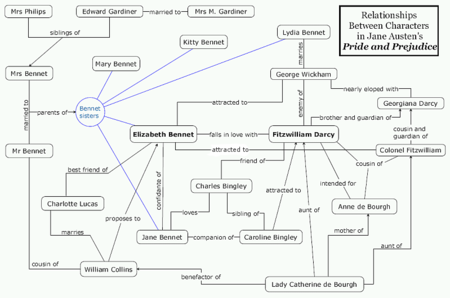 A comprehensive web showing the relationships between the main characters in Pride and Prejudice
Mr. Bennet
Main article: Mr. Bennet (Pride and Prejudice)
An English gentleman with an estate in Hertfordshire. He is married and has five daughters, a circumstance injurious to his dependents. The property is entailed; it can only be inherited by a male heir. Because he has no son, that would be his closest male relative, Mr. Collins, a clergyman who provides him with much amusement. Mr. Bennet, a gentle if eccentric man, is very close to his two eldest daughters, Jane and particularly Elizabeth. However, he has a poor opinion of the intelligence and common sense of his wife and three youngest daughters, frequently declaring them "silly" and visiting them with insulting remarks as well as gentle teasing.
Mrs. Bennet
The querulous wife of Mr. Bennet. Her main concern in life is seeing her daughters married well. She angles for her new neighbour, Mr. Bingley, for one of them. She also hopes to match one of her girls with Mr. Collins.
Jane Bennet
22 years old at the start of the story. The eldest and most beautiful of the Bennet daughters. She has a reserved personality and tends to hide her feelings from outsiders. She is incapable of suspecting the worst of people, seeing only the good.
Elizabeth Bennet
Main article: Elizabeth Bennet
The 20-year-old second sister, and the protagonist of the story. She is her father's favorite and inherits his intelligence and wit. She is generally regarded as one of the most endearing and popular female protagonists in English literature.
Mary Bennet
The third sister, bookish, plain, and ill at ease in company. She disdains her sisters' frivolous interests and seeks to impress others instead with her scholarly yet ill-timed aphorisms and limited musical abilities.
Catherine "Kitty" Bennet
The irritable fourth sister, 17 years old, who generally follows the lead of her younger sister, Lydia.
Lydia Bennet
The youngest sister, when the story begins, Lydia is extremely flirtatious, naive, headstrong and reckless. She is described as being idle and indulging in frivolous pursuits, the chief of which involves the officers stationed at Meryton.
William Collins
A clergyman and nephew of Mr. Bennet. Mr. Collins, the closest male relation, stands to inherit the Bennet estate. When not pompously full of himself, Collins is a narrow-minded sycophant, excessively devoted to his patroness, Lady Catherine de Bourgh. He is always overly keen to show his admiration and gratitude--trying to inflate his self-importance by basking in the glow of his patroness.
Charlotte Lucas
Close friend of Elizabeth and daughter of a neighbouring landowner. Twenty-seven years old and with no other prospects in sight, she is willing to put up with Mr. Collins's flaws in retu n for a home and security.
Charles Bingley
An outgoing, extremely good-natured, and wealthy young man who leases property near the Bennets' estate. He is attracted to Jane Bennet.
Fitzwilliam Darcy
Main article: Mr. Darcy
Mr. Bingley's close friend, an intelligent, wealthy and reserved man, who often appears haughty or proud to strangers. He is wary of his friend Bingley's romantic entanglements with unsuitable women. He is a very proud man but changes for the better.
Georgiana Darcy
Much younger sister of Mr. Darcy. The age difference is so great that he is more of a father figure than a brother. Since their parents' death, she has been under the joint guardianship of Darcy and their cousin Colonel Fitzwilliam. She became infatuated with George Wickham and was persuaded by him to elope. Fortunately, she felt it was her duty to inform her brother and he quickly put a stop to this ill-advised plan.
Louisa Hurst and Caroline Bingley
Mr. Bingley's sisters, who look down upon the Bennets and their society. Caroline has a secret desire for Mr Darcy.
George Wickham
A dashing, handsome young soldier who attracts the attention of Elizabeth Bennet. His father was the manager of the Darcy estate, so he grew up with Mr. Darcy and his sister. Though a favourite of Darcy's now-deceased father, there is bitter enmity between him and Darcy, due to his attempt to elope with Georgiana Darcy for her substantial inheritance.
Lady Catherine de Bourgh
Aunt of Mr. Darcy and patroness of Mr. Collins. A proud and domineering woman, she had planned for the marriage of Mr. Darcy and her daughter since they were infants.
Anne de Bourgh
Daughter of Lady Catherine and intended betrothed of her cousin Mr. Darcy, suffers from some infirmity. A gently humorous running joke has the proud mother describing extraordinary talents her daughter would have possessed had she applied herself.
Colonel Fitzwilliam
Another nephew of Lady Catherine and friend and cousin of Mr. Darcy. He is attracted to Elizabeth Bennet, but is not wealthy enough to consider her seriously as a spouse.
Edward Gardiner
The intelligent, level-headed younger brother of Mrs. Bennet and Mrs. Philips. He is in trade in London.
Mrs. Gardiner
Wife of Mr. Gardiner and the favourite aunt of Jane and Elizabeth Bennet.
Mrs. Philips
Sister of Mrs. Bennet. She has the same silly character as Lydia and often indulges her schemes.
Major themes
As the original title First Impressions suggests, the text can be read as a conservative criticism of the Romantic movement and in particular its conceit of love at first sight. Early in the story Charlotte Lucas declares that happiness in marriage is a matter of chance and that a woman has equal odds of being happy with a man if she marries immediately after meeting him or if she studies his character for a year - yet she speaks from cynicism. Elizabeth Bennet's first suitor, Mr. Collins, mouths Romantic clichés without a trace of genuine feeling when he proposes marriage and claims to have experienced love at first sight for Elizabeth although the reader already knows that his first interest was in Elizabeth's more beautiful sister Jane. Immediately after Elizabeth's refusal he proposes to Charlotte, who tests her theory of marital happiness with dubious success. Elizabeth's two other romantic interests, Wickham and Darcy, amount to another test of Charlotte's theory. In the course of a year the former makes a wonderful first impression before proving to be a scoundrel and the other overcomes several early faux pas to demonstrate warmth, generosity, and goodness. A further warning about Romanticism's excesses is the subplot involving Lydia's elopement, which nearly ruins her own future as well as her entire family's social standing and finances.
Irony also permeates the novel. Immediately after the opening sentence, which sets forth matchmaking as a postulate of social mathematics, the text undercuts its premise. Superficial ironies delineate several minor characters such as Lady de Bourgh's pompousness in boasting her expertise about music despite not knowing how to play any instrument and Miss Bingley's insincerity in declaring how well she likes books while she yawns and sets one down. A deeper irony is that, despite Elizabeth's insistence to Mr. Collins that she would never want a man to propose to her twice, she spends much of the story regretting her refusal of Mr. Darcy.
Unlike most novels of its era, which describe fantastic or improbable events, Pride and Prejudice depicts ordinary provincial life with keen observation. It sidesteps flashy scenes: Lydia's elopement occurs "offstage" and she returns before the reader only after her marriage; the sole hint of the ongoing Napoleonic wars is a militia regiment that seems to exist for the amusement of teenage girls. The active mind of the protagonist and her sparring courtship provide most of the story's interest.
Marriage plays a huge role in Pride and Prejudice. Some characters marry for security, some marry for wealth, and some marry for love. The idea of marriage is very important throughout the novel, primarily because it was often the only way for a woman of the period to secure her freedom, social status, and living standard.
Another Pride and Prejudice book cover (Bantam Classics). The woman portrayed is most likely Elizabeth Bennet. Social classes are also taken into account and play a major role as a theme in Pride and Prejudice. People of higher class are very proud of themselves and do not like to socialise with those of lower class. A good example is Darcy when he first appears. Also, the Bingley sisters often talk together about the way people of lower classes act and look bitterly upon them. A notable exception is Colonel Fitzwilliam, the polite and intelligent younger son of an earl who exhibits embarrassment at his wealthier relatives' rudeness. It is also seen as bad for people of higher classes to mingle with lower classes, but Bingley puts this idea away and proves to be a very social character. Jane Austen ridicules almost all of her aristocratic characters, and her heroes tend to be the landed gentry or the upper-middle class. Lizzy Bennet insists that she is of the same class as Mr. Darcy, and snobbery is one of the characteristics of a villain in Jane Austen's novels.
Appearance versus reality is a recurring motif all throughout the novel. Near the beginning of the novel, Mr. Darcy points out that humility is the most deceitful appearance of all, and that it is often a careless remark, but can be a way to uplift one's view among others.
An important theme of all of Jane Austen's novels is how one correctly assesses the characters of the people one meets. Because Elizabeth Bennet and her sisters need to marry, and need to marry well, it is vital that they be able to "read" the men in their social circle—or they might end up married to unprincipled, immoral men like Wickham. The "pride" of the book's title refers not only to Mr. Darcy's pride, but also to Lizzy's pride in her ability to read characters, which turns out to be faulty.
Another major theme is that pride and prejudice both stand in the way of relationships, as embodied in the persons of Darcy and Elizabeth respectively. Pride narrows the vision of a person and causes one to underestimate other mortals. Prejudice blinds the vision and leads to false perceptions about others. Darcy’s pride and Elizabeth’s prejudice come in their way of understanding each other and keep them apart. Only when Darcy becomes more humble and Elizabeth becomes more accepting can they relate to one another and find happiness together.
Another major theme is family. Austen portrays the family as primarily responsible for the intellectual and moral education of children. Mr. and Mrs. Bennet's failure to provide this education for their daughters leads to the utter shamelessness, foolishness, frivolity, and immorality of Lydia. Elizabeth and Jane have managed to develop virtue and strong characters in spite of the negligence of their parents, perhaps through the help of their studies and the good influence of Mr. and Mrs. Gardiner, who are the only relatives in the novel that take a serious concern in the girls' well-being and provide sound guidance. Elizabeth and Jane are constantly forced to put up with the foolishness and poor judgment of their mother and the sarcasm and detachment of their father. Even when Elizabeth advises her father not to allow Lydia to go to Brighton, he ignores the advice because he thinks it would be too difficult to deal with Lydia's complaining. The result is the scandal of Lydia's elopement with Wickham. It is only when Lydia elopes with Wickham that Mr. Bennet is moved ineffectively to action. The conclusion indicates that Mr. Bennet has learned little from the crisis, as he indulges in sarcastic comments at his younger daughters' expense.
Spoilers end here.
Artistic depictions of and related to Pride and Prejudice
- See main article: List of artistic depictions of and related to Pride and Prejudice
Film, television, and theatrical adaptations
Pride and Prejudice has engendered numerous adaptations. Some of the notable film versions include Pride & Prejudice (2005 film) starring Keira Knightley and Pride and Prejudice (1940 film) starring Greer Garson and Laurence Olivier. Notable television versions include Pride and Prejudice (1995 TV serial) starring Jennifer Ehle and Colin Firth, as well as a BBC adaptation from 1980 starring Elizabeth Garvie and David Rintoul. First Impressions is a Broadway musical version.
Related works of film and literature
Pride and Prejudice has inspired a number of other works. Bride and Prejudice is a Bollywood adaptation of the novel while Pride and Prejudice (2003 film) places the novel in contemporary times. Books inspired by Pride and Prejudice include Mr. Darcy's Daughters (novel) and Pemberley�: Or Pride & Prejudice Continued by Emma Tennant.
Awards and nominations
- In 2003 the BBC conducted the largest ever poll for the "UK's Best-Loved Book" in which Pride and Prejudice came second, behind The Lord of the Rings.
External links
Wikisource has original text related to this article:
Wikiquote has a collection of quotations related to: - Chronology/Calendar for Pride and Prejudice http://www.jimandellen.org/austen/p&p.calendar.html;
- Pride and Prejudice, available freely at Project Gutenberg
- Pride and Prejudice, online at Ye Olde Library
- Pride and Prejudice PDF eBook
- Free audiobook from LibriVox
- Filmography of Jane Austen Adaptations
- Pride & Prejudice timeline
- Free typeset PDF ebook of Pride and Prejudice, optimized for printing at home
| Jane Austen's novels
|
| Sense and Sensibility (1811) | Pride�and�Prejudice�(1813) | Mansfield�Park�(1814) | Emma�(1815) | Northanger�Abbey�(1818) | Persuasion�(1818)
| cs:Pýcha a předsudek
de:Stolz und Vorurteil
es:Orgullo y prejuicio
fa:غرور و تعصب
fr:Orgueil et préjugés
it:Orgoglio e pregiudizio (romanzo)
he:גאווה ודעה קדומה
lb:Pride and Prejudice
hu:Büszkeség és balítélet
nl:Pride and Prejudice (boek)
ja:高慢と偏見
pl:Duma i uprzedzenie
pt:Pride and Prejudice (Jane Austen)
simple:Pride and Prejudice
sk:Pýcha a predsudok
fi:Ylpeys ja ennakkoluulo
sv:Stolthet och fördom
vi:Kiêu hãnh và định kiến
zh:傲慢與偏見
This article is licensed under the GNU Free Documentation License. It uses material from Wikipedia This article is licensed under the GNU Free Documentation License. It uses material from Wikipedia
|
| . |
: Jane AustenImage:Jane-Austen-portrait-victorian-engraving.
Jane Austen
Image:Jane-Austen-portrait-victorian-engraving.png
Jane Austen, in a portrait based on one drawn by her sister Cassandra. |
| Born:
| 16 December, 1775
Steventon, Hampshire, England
| | Died: | 18 July, 1817
Winchester, Hampshire, England |
|---|
| Occupation(s):
| Novelist
|
Jane Austen (16 December, 1775 – 18 July, 1817) was an English novelist. Her insights into women's lives and her mastery of form and irony have made her one of the most noted and influential novelists of her era despite being only moderately successful during her lifetime.
Contents
- 1 Life
- 2 Work
- 3 Criticism
- 4 Filmography
- 5 Bibliography
- 5.1 Novels
- 5.2 Shorter works
- 5.3 Juvenilia
- 6 Notes
- 7 Further reading
- 8 External links
- 8.1 Works
- 8.2 Author information
- 8.3 Fan sites and societies
|
Life
In 1775, Jane Austen was born at a rectory in Steventon, Hampshire, one of two daughters of the Rev. George Austen (1731–1805) and his wife Cassandra (née Leigh) (1739–1827). Her brothers James and Henry followed in the path of their father and joined the clergy (the latter towards the end of his life after a successful career as a banker), while Francis and Charles both pursued naval careers. She also had a sister, Cassandra, with whom she maintained a close relationship throughout her life. The abundant correspondence between the sisters provides historians with the greatest insight into Austen's past. The only undisputed portrait of Jane Austen is a somewhat rudimentary coloured sketch done by Cassandra, which currently resides in the National Portrait Gallery, London. In 1783, she was educated briefly by a relative in Oxford, then in Southampton, and finally in 1785–1786 attended the Reading Ladies boarding school in the Abbey gatehouse in Reading, Berkshire. This uncommonly advanced level of education may have contributed to her early proclivity towards writing, and she began her first novel in 1789. This was also due to her family life, though. The Austen family often enacted plays, which gave Jane an opportunity to present her stories. They also rented novels out of the local library, which influenced Austen's writings. She was encouraged to write especially by her brother Henry, who wrote a little himself.
Austen's life was even less eventful than that of her characters. In 1801 the family moved to the socially esteemed spa city of Bath, which provides the setting for many of her novels; though Jane Austen, like her character Anne Elliot, seemed to have "persisted in a disinclination for Bath", although her dislike may have been influenced by the family's precarious financial situation in that city. In 1802 Austen received a marriage proposal from a wealthy but "big and awkward" man named Harris Bigg-Wither, who was six years her junior. Such a marriage would have freed her from some of the constraints and dependency then associated with the role of a spinster. Such considerations may have influenced her initially to accept his offer, only to change her mind and refuse him the following day. It seems clear that she did not love him. After the death of her father in 1805, Austen, her sister, and her mother lived in Southampton with her brother Frank and his family for several years before moving to Chawton in 1809. Here her wealthy brother Edward had an estate with a cottage, where he allowed his mother and sisters to live. This home is now a museum and is a popular site for tourists and literary pilgrims alike.
Austen lived at Chawton, and wrote her later novels there. In 1816, she began to suffer from ill-health. In May 1817 she moved to Winchester to be closer to her doctor. It is now thought by some that she may have suffered from Addison's disease, a failure of the adrenal glands that was often caused by tuberculosis. The disease was at that time unnamed. Others, such as one of her biographers, Carol Shields, have hypothesized that she died from breast cancer. Her condition became increasingly unstable, and on July 18, 1817 she died at the age of forty-one and was buried in Winchester Cathedral.
Work
Austen's best-known work is Pride and Prejudice, which is viewed as an exemplar of her socially astute comedies of manners. Austen also wrote a satire of the popular Gothic novels of Ann Radcliffe, Northanger Abbey, which was published posthumously.
Adhering to a common contemporary practice for female authors, Austen published her novels anonymously; her anonymity kept her out of leading literary circles.
Austen's comedies of manners, especially Emma, are often cited for their perfection of form. Modern critics continue to unearth new perspectives on Austen's keen commentary regarding the predicament of unmarried genteel English women in the late 1790s and early 1800s, a consequence of inheritance law and custom, which usually directed the bulk of a family's fortune to eldest male heirs.
Although Austen's career coincided with the Romantic movement in literature, she was not an intensely passionate Romantic. Passionate emotion usually carries danger in an Austen novel: the young woman who exercises twice a day is more likely to find real happiness than one who irrationally elopes with a capricious lover. Austen's artistic values had more in common with David Hume and John Locke than with her contemporaries William Wordsworth or Lord Byron. Among Austen's influences were Samuel Johnson, William Cowper, Samuel Richardson, George Crabbe and Fanny Burney.
Although Austen did not privilege passionate emotion as did other Romantic movement writers, she was also skeptical of its opposite -- excessive calculation and practicality often leads to disaster in Austen novels.
 In 1816, the editors of the New Monthly Magazine didn't see Emma as an important novel. Criticism
Austen's novels received only moderate renown when they were published, though Sir Walter Scott in particular praised her work:
- "That young lady has a talent for describing the involvements of feelings and characters of ordinary life which is to me the most wonderful I ever met with."
In Austen's final novel Persuasion, several characters read a work by Scott and praise it, but Marianne Dashwood in "Sense and Sensibility" had already counted Scott as one of her favorites.
Austen also earned the admiration of Macaulay (who thought that in the world there were no compositions which approached nearer to perfection), Samuel Taylor Coleridge, Robert Southey, Sydney Smith, Edward FitzGerald, and the Prince Regent, who even managed to get her to visit him at Brighton. Twentieth century scholars rank her among the greatest literary geniuses of the English language, sometimes even comparing her to Shakespeare. Lionel Trilling and Edward Said have both written treaties on Austen's works. Said referred extensively to Mansfield Park in his 1993 work, Culture and Imperialism.
Trilling wrote in an essay on Mansfield Park,
- "It was Jane Austen who first represented the specifically modern personality and the culture in which it had its being. Never before had the moral life been shown as she shows it to be, never before had it been conceived to be so complex and difficult and exhausting. Hegel speaks of the "secularization of spirituality" as a prime characteristic of the modern epoch, and Jane Austen is the first to tell us what this involves. She is the first novelist to represent society, the general culture, as playing a part in the moral life, generating the concepts of "sincerity" and "vulgarity" which no earlier time would have understood the meaning of, and which for us are so subtle that they defy definition, and so powerful that none can escape their sovereignty. She is the first to be aware of the Terror which rules our moral situation, the ubiquitous anonymous judgment to which we respond, the necessity we feel to demonstrate the purity of our secular spirituality, whose dark and dubious places are more numerous and obscure than those of religious spirituality, to put our lives and styles to the question ..."
Negative views of Austen have been notable, with more demanding detractors frequently accusing her writing of being unliterary and middle-brow. Charlotte Brontë criticized the narrow scope of Austen's fiction:
- "Anything like warmth or enthusiasm, anything energetic, poignant, heartfelt, is utterly out of place in commending these works: all such demonstrations the authoress would have met with a well-bred sneer, would have calmly scorned as 'outré' or extravagant. She does her business of delineating the surface of the lives of genteel English people curiously well. There is a Chinese fidelity, a miniature delicacy, in the painting. She ruffles her reader by nothing vehement, disturbs him with nothing profound. The passions are perfectly unknown to her: she rejects even a speaking acquaintance with that stormy sisterhood ... What sees keenly, speaks aptly, moves flexibly, it suits her to study: but what throbs fast and full, though hidden, what the blood rushes through, what is the unseen seat of life and the sentient target of death--this Miss Austen ignores....Jane Austen was a complete and most sensible lady, but a very incomplete and rather insensible (not senseless) woman, if this is heresy--I cannot help it."
Mark Twain's reaction was revulsion:
- "Jane Austen? Why, I go so far as to say that any library is a good library that does not contain a volume by Jane Austen. Even if it contains no other book."
But Rudyard Kipling felt differently, going so far as to write the short story "The Janeites" about a group of soldiers who were also Austen fans, as well as two poems praising "England's Jane" and providing her with posthumous true love.
Austen's literary strength lies in the delineation of character, especially of women, by delicate touches arising out of the most natural and everyday incidents in the life of the middle and upper classes, from which her subjects are generally taken. Her characters, though of quite ordinary types, are drawn with such firmness and precision, and with such significant detail as to retain their individuality intact through their entire development, and they are uncoloured by her own personality. Her view of life seems largely genial, with a strong dash of gentle but keen irony.
Some contemporary readers may find the world she describes, in which people's chief concern is obtaining advantageous marriages, unliberated and disquieting. In her era options were limited, and both women and men often married for financial considerations. Female writers worked within the similarly narrow genre of romance. Part of Austen's prominent reputation rests on how well she integrates observations on the human condition within a convincing love story. Much of the tension in her novels arises from balancing financial necessity against other concerns: love, friendship, honor and self-respect. It is also important to point out that, at the time, romance novels were seen as a clever modern variation on the knightly romances of medieval times; these were damsels engaged in adventure, seeking their fortunes and carrying out quests.
There are two museums dedicated to Jane Austen. The Jane Austen Centre in Bath is a public museum located in a Georgian House in Gay Street, just a few doors down the street from number 25 where Austen stayed in 1805. The Jane Austen's House Museum is located in Chawton cottage, in Hampshire, where Austen lived from 1809 to 1817.
Filmography
In r culture">popular culture, Austen's novels have been adapted in a great number of film and television series, varying greatly in their faithfulness to the originals. Pride and Prejudice has been the most reproduced of her works, with six films, the most recent being the 2005 adaptation directed by Joe Wright, starring Keira Knightley (Elizabeth Bennett), Donald Sutherland (Mr. Bennett), Matthew Macfadyen (Mr. Darcy), and Dame Judi Dench (Lady Catherine de Bourgh), as well as the 2004 Bollywood adaptation Bride & Prejudice. There is also a 1940 film version of the novel starring Laurence Oliver as Mr. Darcy, and Greer Garson as Elizabeth Bennett. Previously, there were five television series produced by the BBC, the most noteworthy being the well-loved 1995 version, starring Colin Firth and Jennifer Ehle. The 2001 film Bridget Jones's Diary included characters and plot line inspired by the novel, though it is to be noted that this movie was based on a novel by Helen Fielding.
Emma has been adapted on television several times, first in 1948. Recent versions include a 1972 British television version, the 1996 film Emma, with Gwyneth Paltrow and Jeremy Northam, and also in 1996 on British television with Kate Beckinsale. The 1995 film Clueless, directed by Amy Heckerling and starring Alicia Silverstone, is a modernization of Emma in a California high school setting.
Sense and Sensibility has been made into four films including the 1995 version, from a screenplay adapted by Emma Thompson (who won the Academy Award for Best Adapted Screenplay); it was directed by Ang Lee and starred Thompson and Kate Winslet. Persuasion has been adapted into two television series and one feature film. Mansfield Park and Northanger Abbey have both been made into films. The 1980 film Jane Austen in Manhattan is about rival stage companies who wish to produce the only complete Austen play "Sir Charles Grandison" (from the Richardson novel of the same title), which was rediscovered in 1980.[BBC News. 2004. Rare Austen manuscript unveiled]
Bibliography
Novels
- Sense and Sensibility (published 1811)
- Pride and Prejudice (1813)
- Mansfield Park (1814)
- Emma (1816)
- Northanger Abbey (1817) posthumous
- Persuasion (1817) posthumous
Shorter works
- Lady Susan (novella)
- The Watsons (incomplete novel)
- Sanditon (incomplete novel)
Juvenilia
- The Three Sisters
- Love and Freindship [sic; the misspelling of "friendship" in the title is famous]
- The History of England
- Catharine, or the Bower
- The Beautifull Cassandra [sic]
Notes
Further reading
- Knox-Shaw, Peter. Jane Austen and the Enlightenment. Cambridge: Cambridge University Press, 2004. ISBN 100521843464
- Tomalin, Claire. Jane Austen: a life. Revised and updated edition. London: Penguin, 2000. ISBN 0-14-029690-5
- Le Faye, Deirdre. Jane Austen: A Family Record. 2nd. ed. Cambridge: Cambridge University Press, 2003. ISBN 0-521-53417-8
External links
Wikiquote has a collection of quotations related to:
Wikisource has original works written by or about:
Wikimedia Commons has media related to:
Works
- Works by Jane Austen at Project Gutenberg
- Works by Jane Austen in Classici Stranieri
- Jane Austen: e-books in easy-to-read HTML format.
- Jane Austen: e-books in easy-to-read HTML format.
- Free typeset PDF ebooks of Austen's novels optimized for printing at home, plus bibliography of books about Austen
- Jane Austen 'Bookweb' on literary website The Ledge, with suggestions for further reading.
Author information
- The Jane Austen Museum
- Guardian Books "Author Page": with profile and links to further articles.
- Polish site about Jane Austen
- Hampshire, inspirational home of Jane Austen
- Jane Austen at the National Portrait Gallery: includes Cassandra Austen's original sketch.
- Memoir of Jane Austen, by her nephew James Edward Austen-Leigh. 1871 edition, from Project Gutenberg.
- Selected letters of Jane Austen (old Brabourne edition)
Fan sites and societies
- The Republic of Pemberley: the largest Jane Austen site on the web.
- AustenBlog: coverage of Jane Austen in popular culture.
- The Jane Austen Society of Australia
- The Jane Austen Society of North America
- The Jane Austen Society of the United Kingdom
- Jane Austen font: font based upon Austen's handwriting.
| Jane Austen's novels
|
| Sense and Sensibility (1811) | Pride�and�Prejudice�(1813) | Mansfield�Park�(1814) | Emma�(1815) | Northanger�Abbey�(1818) | Persuasion�(1818)
| ar:جين أوستن
bs:Jane Austen
cs:Jane Austenová
cy:Jane Austen
da:Jane Austen
de:Jane Austen
et:Jane Austen
es:Jane Austen
eo:Jane Austen
eu:Jane Austen
fa:جین آستن
fr:Jane Austen
gl:Jane Austen
ko:제인 오스틴
hr:Jane Austen
id:Jane Austen
is:Jane Austen
it:Jane Austen
he:ג'יין אוסטן
ka:ოსტინი, ჯეინ
lt:Jane Austen
hu:Jane Austen
ms:Jane Austen
nl:Jane Austen
ja:ジェーン・オースティン
no:Jane Austen
pl:Jane Austen
pt:Jane Austen
ro:Jane Austen
ru:Остин, Джейн
sq:Jane Austen
simple:Jane Austen
sk:Jane Austenová
sl:Jane Austen
sr:Џејн Остин
fi:Jane Austen
sv:Jane Austen
th:เจน ออสเตน
tr:Jane Austen
vi:Jane Austen
zh:简·奥斯丁
This article is licensed under the GNU Free Documentation License. It uses material from Wikipedia This article is licensed under the GNU Free Documentation License. It uses material from Wikipedia
|
|
|
|
Find out What is on the Net About You!
|
|
|
|
|