| . |
: Che Guevara or el Che, was an Argentine-born Marxist revolutionary, political figure, and leader of Cuban and internationalist guerrillas.
| Ernesto Guevara de la Serna
|
|
| Born
| June 14, 1928
Rosario, [BOLIVIA]
|
| Died
| October 9, 1967
La Higuera, Bolivia
|
Ernesto Guevara de la Serna (June 14, 1928 – October 9, 1967), commonly known as Che Guevara or el Che, was an Argentine-born Marxist revolutionary, political figure, and leader of Cuban and internationalist guerrillas. As a young man studying medicine, Guevara traveled roughrough[›] throughout Latin America, bringing him into direct contact with the impoverished conditions in which many people lived. His experiences and observations during these trips led him to the conclusion that the region's socioeconomic inequalities could only be remedied by revolution, prompting him to intensify his study of Marxism and travel to Guatemala to learn about the reforms being implemented there by President Jacobo Arbenz Guzmán.
Some time later, Guevara joined Fidel Castro's paramilitary 26th of July Movement, which seized power in Cuba in 1959. After serving in various important posts in the new government and writing a number of articles and books on the theory and practice of guerrilla warfare, Guevara left Cuba in 1965 with the intention of fomenting revolutions first in Congo-Kinshasa, and then in Bolivia, where he was captured in a CIA/ U.S. Army Special Forces-organized military operation.[Death of Che Guevara National Security Archive Electronic Briefing Book No. 5 - Declassified top secret document] Guevara was summarily executed by the Bolivian Army in La Higuera near Vallegrande on October 9, 1967.[Rostow, Walter W. Memorandum for the President:"Death of 'Che' Guevara", dated 11 October 1967. Online at GWU National Security Archive accessed 08 October 2006.][Ryan, Henry Butterfield. The Fall of Che Guevara: A Story of Soldiers, Spies, and Diplomats, New York, 1998: Oxford University Press, pp 129-135.]
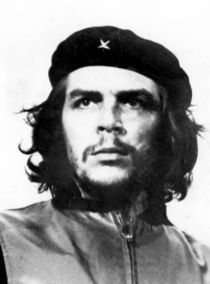
After his death, Guevara became an icon of socialist revolutionary movements worldwide. An Alberto Korda photo of him (shown) has received wide distribution and modification. The Maryland Institute College of Art called this picture "the most famous photograph in the world and a symbol of the 20th century."[Maryland Institute of Art, referenced at BBC News, "Che Guevara photographer dies", 26 May 2001.Online at BBC News, accessed January 42006.]
Contents
- 1 Family heritage and early life
- 2 Guatemala
- 3 Cuba
- 4 Disappearance from Cuba
- 5 Congo
- 5.1 Expedition
- 5.2 Interlude
- 6 Bolivia
- 6.1 Insurgent
- 6.2 Capture and execution
- 6.3 The Bolivian Diary
- 7 Legacy and criticisms
- 7.1 Legacy in Cuba
- 7.2 The "Cult of Che"
- 8 Timeline
- 9 Guevara's published works
- 10 See also
- 11 Source notes
- 12 Content notes
- 13 References
- 13.1 Printed matter
- 13.2 Websites
- 14 Further reading
- 15 External links
|
Family heritage and early life
Ernesto Guevara de la Serna was born in Rosario, Argentina, the eldest of five children in a family of Spanish and Irish descent; both his father and mother were of Basque ancestry.Basque[›] The date of birth recorded on his birth certificate was June 14, 1928, although one tertiary source (Julia Constenla, quoted by Jon Lee Anderson) asserts that he was actually born on May 14 of that year (Constenla alleges that she was told by an unidentified astrologer that his mother, Celia de la Serna, was already pregnant when she and Ernesto Guevara Lynch were married and that the birthdate of their son was forged a month later than the actual date to avoid scandal).[Anderson, Jon Lee. Che Guevara: A Revolutionary Life, New York: 1997, Grove Press, pp. 3 and 769.]
One of Guevara's forebears, Patrick Lynch, was born in Galway, Ireland, in 1715. He left for Bilbao, Spain, and traveled from there to Argentina. Francisco Lynch (Guevara's great-grandfather) was born in 1817, and Ana Lynch (his beloved grandmother) in 1868Galway[›] Her son, Ernesto Guevara Lynch (Guevara's father) was born in 1900. Guevara Lynch married Celia de la Serna y Llosa in 1927, and they had three sons and two daughters.
Growing up in this upper-class family with leftist leanings, Guevara became known for his dynamic personality and radical perspective even as a boy. He idolized Francisco Pizarro and yearned to have been one of his soldiers.[Anderson, Jon Lee. Che Guevara: A Revolutionary Life, New York: 1997, Grove Press, p. 446. "At one time I wanted to be one of Pizarro's soldiers; but [to fulfill] my quest for adventures and my yearnings to overlook climatic moments, that isn't a necessity any longer; today it is all here, and with an ideal to fight for, together with the responsibility of leaving an example." -- excerpt from a December 1959 letter to his parents.] Though suffering from the crippling bouts of asthma that were to afflict him throughout his life, he excelled as an athlete. He was an avid rugby union player despite his handicap and earned himself the nickname "Fuser" — a contraction of "El Furibundo" (English: "The Raging") and his mother's surname, "Serna" — for his aggressive style of play.[Anderson, Jon Lee. Che Guevara: A Revolutionary Life, New York: 1997, Grove Press, p. 28. ]
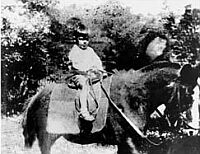 Guevara on a burro at the age of 3 Guevara learned chess from his father and began participating in local tournaments by the age of 12.[Digital Granma Internacional, "Simultaneous chess game on 37th anniversary of Che’s death", 13 October 2004.
Online at Granma International English Edition, accessed January 5, 2006.] During his adolescence he became passionate about poetry, especially that of Pablo NerudaNeruda[›]. Guevara, as is common practice among Latin Americans of his class, also wrote poems throughout his life. He was an enthusiastic and eclectic reader, with interests ranging from adventure classics by Jack London, Emilio Salgari and Jules Verne to essays on sexuality by Sigmund Freud and treatises on social philosophy by Bertrand Russell. In his late teens, he developed a keen interest in photography and spent many hours photographing people, places and, during later travels, archaeological sites.
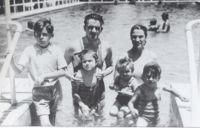 With his parents and siblings in 1936 Witnessing the widespread poverty, oppression and disenfranchisement throughout Latin America, and influenced by his readings of Marxist literature, Guevara decided that the only solution for the region’s inequalities was armed revolution. His travels and readings also led him to view Latin America not as a group of separate nations but as a single entity requiring a continent-wide strategy for liberation. His conception of a borderless, united Ibero-America sharing a common 'mestizo' cultureIbero-America[›] was a theme that would prominently recur during his later revolutionary activities. Upon returning to Argentina, he expedited the completion of his medical studies in order to resume his travels in Central and South America and received his diploma on 12 June 1953.Diploma[›]
Guatemala
On 7 July 1953, Guevara set out on a trip through Bolivia, Peru, Ecuador, Panama, Costa Rica, Nicaragua, Honduras, and El Salvador. During the final days of December 1953 he arrived in Guatemala where leftist President Jacobo Arbenz Guzmán headed a populist government that, through land reform and other initiatives, was attempting to bring an end to the U.S.-dominated latifundia system. In a contemporaneous letter to his Aunt Beatriz, Guevara explained his motivation for settling down for a time in Guatemala: "In Guatemala", he wrote, "I will perfect myself and accomplish whatever may be necessary in order to become a true revolutionary."[Guevara Lynch, Ernesto. Aquí va un soldado de América. Barcelona: Plaza y Janés Editores, S.A., 2000, p. 26. "En Guatemala me perfeccionaré y lograré lo que me falta para ser un revolulcionario auténtico." This statement in a letter written in Costa Rica on 10 December 1953 is important because it proves that, whereas many authors have asserted that Guevara became a revolutionary as a result of witnessing the US-sponsored coup against Arbenz, he had in fact already made the decision to become a revolutionary before arriving in Guatemala and indeed went there for that express purpose.]
Shortly after reaching Guatemala City, Guevara acted upon the suggestion of a mutual friend that he seek out Hilda Gadea Acosta, a Peruvian economist who was living and working there. Gadea, whom he would later marry, was well-connected politically as a result of her membership in the socialist American Popular Revolutionary Alliance (APRA) led by Víctor Raúl Haya de la Torre, and she introduced Guevara to a number of high-level officials in the Arbenz government. He also re-established contact with a group of Cuban exiles linked to Fidel Castro whom he had initially met in Costa Rica; among them was Antonio "Ñico" López, associated with the attack on the "Carlos Manuel de Céspedes" barracks in Bayamo in the Cuban province of Oriente,[Radio Cadena Agramonte, "Ataque al cuartel del Bayamo" Online, accessed February 25 2006] and who would die at Ojo del Toro bridge soon after the Granma landed in Cuba.[Granma.cu, "Walking towards sunrise" Online, accessed February 252006] Guevara joined these "moncadistas" in the sale of religious objects related to the Black Christ of Esquipulas, and he also assisted two Venezuelan malaria specialists at a local hospital. It was during this period that he acquired his famous nickname, "Che", due to his frequent use of the Argentine interjection Che (pronounced /tʃe/), which is used in much the same way as "hey", "pal", "eh", or "mate" are employed colloquially in various English-speaking countries. Argentina, Uruguay, and southern Brazil (where the interjection is rendered 'chê' or 'ché' in written Portuguese) are the only areas where this expression is used, making it a trademark of the Rioplatense region.
Guevara's attempts to obtain a medical internship were unsuccessful and his economic situation was often precarious, leading him to pawn some of Hilda's jewelry. Political events in the country began to move quickly after May 15, 1954 when a shipment of Skoda infantry and light artillery weapons sent from Communist Czechoslovakia for the Arbenz Government arrived in Puerto Barrios aboard the Swedish ship Alfhem. The amount of Czech weaponry was estimated to be 2000 tons by the CIA[U.S. Department of State, "Foreign Relations, Guatemala, 1952-1954". Online, accessed March 04 2006] though only 2 tons by Jon Lee Anderson.[Anderson, Jon Lee. Che Guevara: A Revolutionary Life, New York: 1997, Grove Press, p. 144] (Anderson's tonnage estimate is thought to be a typographical error due to how few scholarly sources support it.) Guevara briefly left Guatemala for El Salvador to pick up a new visa, then returned to Guatemala only a few days before the CIA-sponsored coup attempt led by Carlos Castillo Armas began.[U.S. Department of State. "Foreign Relations, Guatemala, 1952-1954". Online, accessed March 04 2006] The anti-Arbenz forces tried, but failed, to stop the trans-shipment of the Czechoslovak weapons by train. However, after pausing to regroup and recover energy, Castillo Armas' column seized the initiative and, apparently with the assistance of US air support, started to gain ground.[
Holland, Max."Private Sources of U.S. Foreign Policy: William Pawley and the 1954 Coup d'Etat in Guatemala", Journal of Cold War Studies, Volume 7, Number 4, Fall 2005, pp. 36-73] Guevara was eager to fight on behalf of Arbenz and joined an armed militia organized by the Communist Youth for that purpose; but, frustrated with the group's inaction, he soon returned to medical duties. Following the coup, he again volunteered to fight but his efforts were thwarted when Arbenz took refuge in the Mexican Embassy and told his foreign supporters to leave the country. After Gadea was arrested, Guevara sought protection inside the Argentine consulate where he remained until he received a safe-conduct pass some weeks later. At that point, he turned down a free seat on a flight back to Argentina that was proffered to him by the Embassy, preferring instead to make his way to Mexico.
The overthrow of the Arbenz regime by a coup d'état backed by the Central Intelligence Agency cemented Guevara's view of the United States as an imperialist power that would implacably oppose and attempt to destroy any government that sought to redress the socioeconomic inequality endemic to Latin America and other developing countries. This strengthened his conviction that socialism achieved through armed struggle and defended by an armed populace was the only way to rectify such conditions.
Cuba
- Further information: Che Guevara's involvement in the Cuban Revolution
](../wikipedia/en/thumb/e/eb/Ergstrasbatallasc_jpg/180px-Ergstrasbatallasc.jpg) After the battle of Santa Clara. The tank is a Sherman with a 76 mm cannon. [1] (1 January 1959)Guevara arrived in Mexico City in early September 1954, and shortly thereafter renewed his friendship with Ñico López and the other Cuban exiles whom he had known in Guatemala. In June 1955, López introduced him to Raúl Castro. Several weeks later, Fidel Castro arrived in Mexico City after having been amnestied from prison in Cuba, and on the evening of 8 July 1955 Raúl introduced Guevara to the older Castro brother. During a fervid overnight conversation, Guevara became convinced that Fidel was the inspirational revolutionary leader for whom he had been searching, and he immediately joined the "26th of July Movement" that intended to overthrow the government of Fulgencio Batista. Although it was planned that he would be the group's medic, Guevara participated in the military training alongside the other members of the 26J Movement, and at the end of the course was singled out by their instructor, Col. Alberto Bayo, as his most outstanding student.[Anderson, Jon Lee. Che Guevara: A Revolutionary Life, ISBN 0-8021-1600-0, New York: 1997, Grove Press, p. 194.] Meanwhile, Hilda Gadea had arrived from Guatemala and she and Guevara resumed their relationship. In the summer of 1955 she informed him that she was pregnant and he immediately suggested that they marry. The wedding took place on August 18, 1955, and their daughter, whom they named Hilda Beatríz, was born on February 15, 1956.[Taibo, Paco Ignacio II. Ernesto Guevara, también conocido como el Che, p. 104. See also The Guardian online, Making of a Marxist, Online, in Guevara's words "Since February 15 1956 I am a father: Hilda Beatriz Guevara is my first-born" accessed October 62006.]
When the cabin cruiser Granma set out from Tuxpan, Veracruz for Cuba on November 25, 1956, Guevara was one of only four non-Cubans aboard. non-Cubans[›] Attacked by Batista's military soon after landing, about half of the expeditionaries were killed or executed upon capture. Guevara writes that it was during this confrontation that he laid down his knapsack containing medical supplies in order to pick up a box of ammunition dropped by a fleeing comrade, a moment which he later recalled as marking his transition from physician to combatant.Knapsack[›] Only 15–20 rebels survived as a battered fighting force; they re-grouped and fled into the mountains of the Sierra Maestra to wage guerrilla warfare against the Batista regime.
Guevara became a leader among the rebels, a Comandante (English translation: Major), respected by his comrades in arms for his courage and military prowess,[U. S. Central Intelligence Agency, "CIA Biographic Register on Ernesto 'Che' Guevara". Online, accessed July 12, 2006."Commander of one of the largest of the five rebel columns (Column 4), he gained a reputation for bravery and military prowess second only to Fidel Castro himself."] and feared for what some have described as ruthlessness: He was responsible for the execution of many men accused of being informers, deserters or spies. In the final days of December 1958, he directed his "suicide squad" (which undertook the most dangerous tasks in the rebel army)[Ernesto Che Guevara, "Suicide Squad: Example Of Revolutionary Morale (an excerpt from Episodes of the Cuban Revolutionary War - 1956-58). The Militant Online, accessed March 272006.] in the attack on Santa Clara that turned out to be one of the decisive events of the revolution, although the bloody series of ambushes first during la ofensiva in the heights of the Sierra Maestra, then at Guisa, and the whole Cauto Plains campaign that followed probably had more military significance.[ Castro, Fidel (editors Bonachea, Rolando E. and Nelson P. Valdés). Revolutionary Struggle. 1947-1958. Cambridge, Massachusetts and London: MIT Press, 1972, pp. 439-442.]
° Castro, Fidel. (December 27, 1983). Speech given in Palma Soriano, Cuba. Online. In this speech, given at the dedication of a publishing house and commemorating the 25th anniversary of the taking of Palma, Castro discussed the importance to the revolution of the taking of Palma on the way to Santiago. He talked about the previous recent fighting at Guisa, Baire, Jiguani and in the Sierra Maestra and how as a result of revolutionary successes the Cuban army in Bayamo was unable to consolidate forces with its surrounding units. Castro went on to describe the strategic importance of the revolutionary position along the banks of the Cautillo River as a position from which the army at Bayamo could be contained while, on the other side, the army at Santiago could be targeted once Palma was taken and the revolutionary forces re-armed. With respect to the planned attack against Santiago, Castro said: We established our defensive line on the Cautillo River. We had Mapos surrounded, but there was still Palma. There were approximately 300 enemy soldiers. We had to take Palma. We were also anxious to take the arms that were to be found in Palma, because when we left La Plata, in the Sierra Maestra, because of the latest offensive, we left with 25 armed soldiers and 1,000 unarmed recruits. We armed those troops along the way. We armed them during the fighting, but we really finished fully arming them in Palma. Castro then described the battle in detail and mentioned how, after the overthrow of Batista, the final war orders to the rebels were issued from Palma on January 1, 1959. Batista, upon learning that his generals — especially General Cantillo, who had visited Castro at the inactive sugar mill "Central America" — were negotiating a separate peace with the rebel leader, fled to the Dominican Republic on January 1, 1959.
On February 7, 1959, the victorious government proclaimed Guevara "a Cuban citizen by birth" in recognition of his role in the triumph of the revolutionary forces. Shortly thereafter, he initiated divorce proceedings to put a formal end to his marriage with Gadea, from whom he had been separated since before leaving Mexico on the Granma, and on June 2, 1959, he married Aleida March,Children[›] a Cuban-born member of the 26th of July movement with whom he had been living since late 1958.
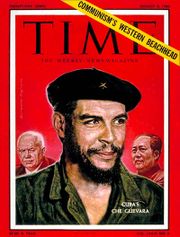 TIME magazine, August 8, 1960 He was appointed commander of the La Cabaña Fortress prison, and during his five-month tenure in that post (January 2 through June 12, 1959),[Anderson, Jon Lee. Che Guevara: A Revolutionary Life, New York: 1997, Grove Press, p. 372 and p. 425
] he oversaw the trial and execution of many people, among whom were former Batista regime officials and members of the "Bureau for the Repression of Communist Activities" (a unit of the secret police know by its Spanish acronym BRAC). According to José Vilasuso, an attorney who worked under Guevara at La Cabaña preparing indictments, these were lawless proceedings where "the facts were judged without any consideration to general juridical principles" and the findings were pre-determined by Guevara.["Executions at La Cabaña fortress under Ernesto "Ché" Guevara". Document written by José Vilasuso. Online accessed October 18, 2006. In this document Vilasuso (who, along with most of the other legally-trained participants, quit due to its excesses) described the La Cabaña tribunal as the “Purging Commission”. He described a process where “[t]he statements of the investigating officer constituted irrefutable proof of wrongdoing” and where "[t]here were relatives of victims of the previous regime who were put in charge of judging the accused." He also provided vivid recollections of the final hours of the condemned with their family and friends, and he gave a graphic description of the execution details. He recalled that Guevara "chastised us all: 'Don’t delay these trials. This is a revolution, the proofs are secondary. We have to proceed by conviction. They are a gang of criminals and murderers. Besides, remember that there is an Appeals Tribunals [sic]'." But the Appeals Tribunal, according to Vilasuso, "never decided in favor of the appeal. It simply confirmed the sentences. It was presided by Commander Ernesto Guevara Serna."]
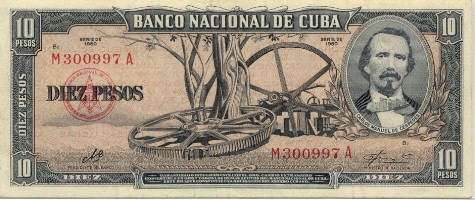
Later, Guevara became an official at the National Institute of Agrarian Reform,INRA[›] and President of the National Bank of CubaBNC[›] (somewhat ironically, as he often condemned money, favored its abolition, and showed his disdain by signing Cuban banknotes with his nickname, "Che").Signature[›]
During this time his fondness for chess was rekindled, and he attended and participated in most national and international tournaments held in Cuba.[chessgames.com, "Miguel Najdorf vs Ernesto Che Guevara".
Online at chessgames.com, accessed January 52006.][ar.geocities.com/carloseadrake/AJEDREZ/, Ernesto "Che" Guevara – Ajedrez Online, accessed June 292006.] He was particularly eager to encourage young Cubans to take up the game, and organized various activities designed to stimulate their interest in it.
Even as early as 1959, Guevara helped organize revolutionary expeditions overseas, all of which failed. The first attempt was made in Panama; another in the Dominican Republic (led by Henry Fuerte,[Puerto Padre website, "Cronologia" (List of anniversaries)
Online at Puerto Padre website, accessed January 42006.] also known as "El Argelino", and Enrique Jiménez Moya)[Peña, Emilio Herasme," La Expedición Armada de junio de 1959", 14 June 2004.Online at 'Listín Diario (Dominican Republic), accessed January 42006.] took place on 14 June of that same year.
Che Guevara with Fidel Castro� (Havana - April 1961) In 1960 Guevara provided first aid to victims during the La Coubre arms shipment rescue operation that went further awry when a second explosion occurred, resulting in well over a hundred dead.[Cuban Information Archives, "La Coubre explodes in Havana 1960." Online, accessed February 26 2006; pictures can be seen at Cuban site fotospl.com.] It was at the memorial service for the victims of this explosion that Alberto Korda took the most famous photograph of him. Whether La Coubre was sabotaged or merely exploded by accident is not clear. Those who favour the sabotage theory sometimes attribute this to the Central Intelligence Agency[Defensa Nacional, "SABOTAJE AL BUQUE LA COUBRE" Online, accessed February 26 2006] and sometimes name William Alexander Morgan,[The Miami Herald, "Dockworker set ship blast in Havana, American claims". Online, accessed February 26, 2006] a former rival of Guevara's in the anti-Batista forces of the central provinces and later a putative CIA agent, as the perpetrator. Cuban exiles have put forth the theory that it was done by Guevara's USSR-loyalist rivals.[Guaracabuya.org, "Recuento Histórico:El porque el PCC ordenó volar el barco "La Coubre".Online, accessed February 26 2006]
Guevara later served as Minister of Industries,MININD[›] in which post he helped formulate Cuban socialism, and became one of the country's most prominent figures. In his book Guerrilla Warfare, he advocated replicating the Cuban model of revolution initiated by a small group (foco) of guerrillas without the need for broad organizations to precede armed insurrection. His essay El socialismo y el hombre en Cuba (1965) (Man and Socialism in Cuba) advocates the need to shape a "new man" (hombre nuevo) in conjunction with a socialist state. Some saw Guevara as the simultaneously glamorous and austere model of that "new man."
During the 1961 Bay of Pigs Invasion Guevara did not participate in the fighting, having been ordered by Castro to a command post in Cuba's westernmost Pinar del Río province where he was involved in fending off a decoy force. He did, however, suffer a bullet wound to the face during this deployment, which he said had been caused by the accidental discharge of his own gun.[Anderson, Jon Lee. Che Guevara: A Revolutionary Life, ISBN 0-8021-1600-0, New York: 1997, Grove Press, p. 508.]
Guevara played a key role in bringing to Cuba the Soviet nuclear-armed ballistic missiles that precipitated the Cuban Missile Crisis in October 1962. During an interview with the British newspaper Daily Worker some weeks later, he stated that, if the missiles had been under Cuban control, they would have fired them against major U.S. cities.[Anderson, Jon Lee. Che Guevara: A Revolutionary Life, ISBN 0-8021-1600-0, New York: 1997, Grove Press, p. 545: "In an interview with Che a few weeks after the crisis, Sam Russell, a British correspondent for the socialist Daily Worker, found Guevara still fuming over the Soviet betrayal. Alternately puffing on a cigar and taking blasts from an inhaler, Guevara told Russell that if the missiles had been under Cuban control, they would have fired them off. Russell came away with mixed feelings about Che, calling him 'a warm character whom I took to immediately...�clearly a man of great intelligence though I thought he was crackers from the way he went on about the missiles.'"]
Disappearance from Cuba
Chronology (1964-66). MISIÓN PERMANENTE DE LA REPÚBLICA DE CUBA ANTE LAS NACIONES UNIDAS. Permanent Missions To The United Nations. Retrieved on 2006-10-09."> 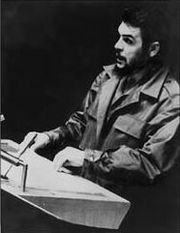 Che Guevara addressing the UN General Assembly� (New York City - 11 December 1964)[Chronology (1964-66). MISIÓN PERMANENTE DE LA REPÚBLICA DE CUBA ANTE LAS NACIONES UNIDAS. Permanent Missions To The United Nations. Retrieved on 2006-10-09.]In December 1964 Che Guevara traveled to New York City as the head of the Cuban delegation to speak at the UN (listen, requires RealPlayer; or read). He also appeared on the CBS Sunday news program Face the Nation, met with a gamut of individuals and groups including U.S. Senator Eugene McCarthy, several associates of Malcolm X, and Canadian radical Michelle Duclos,[Montreal Gazette, "Liberals picked the wrong issue". Online, accessed February 26 2006]
‡ Guaracabuya.org, "TERRORISTS CONNECTED TO CUBAN COMMUNIST GOVERNMENT". Online, accessed February 26 2006 and dined at the home of the Rockefellers.[Gálvez, William. Che in Africa: Che Guevara's Congo Diary. Melbourne: Ocean Press, 1999, p. 28.] On 17 December, he flew to Paris and from there embarked on a three-month international tour during which he visited the People's Republic of China, the United Arab Republic (Egypt), Algeria, Ghana, Guinea, Mali, Dahomey, Congo-Brazzaville and Tanzania, with stops in Ireland, Paris and Prague. In Algiers on 24 February, 1965, he made what turned out to be his last public appearance on the international stage when he delivered a speech to the "Second Economic Seminar on Afro-Asian Solidarity" in which he declared, "There are no frontiers in this struggle to the death. We cannot remain indifferent in the face of what occurs in any part of the world. A victory for any country against imperialism is our victory, just as any country's defeat is our defeat."[Ernesto Che Guevara, (editors Rolando E. Bonachea and Nelson P. Valdés), Che: Selected Works of Ernesto Guevara, Cambridge, MA: 1969, p. 350.]
‡ Ernesto Che Guevara, "English Translation of Complete Text of Algiers Speech",
Online at Sozialistische Klassiker, accessed January 42006. He then astonished his audience by proclaiming, "The socialist countries have the moral duty of liquidating their tacit complicity with the exploiting countries of the West." He proceeded to outline a number of measures which he said the communist-bloc countries should implement in order to accomplish this objective.[Ernesto Che Guevara, (editors Rolando E. Bonachea and Nelson P. Valdés), Che: Selected Works of Ernesto Guevara, Cambridge, MA: 1969, pp. 352-59. ][Ernesto Che Guevara, "English Translation of Complete Text of Algiers Speech", Online at Sozialistische Klassiker, accessed January 42006.] He returned to Cuba on 14 March to a solemn reception by Fidel and Raúl Castro, Osvaldo Dorticós and Carlos Rafael Rodríguez at the Havana airport.
Two weeks later, Guevara dropped out of public life and then vanished altogether. His whereabouts were the great mystery of 1965 in Cuba, as he was generally regarded as second in power to Castro himself. His disappearance was variously attributed to the relative failure of the industrialization scheme he had advocated while minister of industry, to pressure exerted on Castro by Soviet officials disapproving of Guevara's pro-Chinese Communist bent as the Sino-Soviet split grew more pronounced, and to serious differences between Guevara and the Cuban leadership regarding Cuba's economic development and ideological line. Others suggested that Castro had grown increasingly wary of Guevara's popularity and considered him a potential threat. Castro's critics sometimes say his explanations for Guevara's disappearance have always been suspect (see below), and many found it surprising that Guevara never announced his intentions publicly, but only through an undated and uncharacteristically obsequious letter to Castro.
The coincidence of Guevara's views with those expounded by the Chinese Communist leadership had become increasingly problematic for Cuba as the nation's economic dependence on the Soviet Union deepened. Since the early days of the Cuban revolution, Guevara had been considered by many an advocate of Maoist strategy in Latin America and the originator of a plan for the rapid industrialization of Cuba which was frequently compared to China's "Great Leap Forward". According to Western "observers" of the Cuban situation, the fact that Guevara was opposed to Soviet conditions and recommendations that Castro seemed obliged to accept might have been the reason for his disappearance. However, both Guevara and Castro were supportive of the idea of a "united anti-imperialist front" intended to include both the Soviet Union and China, and had made several unsuccessful attempts to reconcile the feuding parties.
Following the Cuban Missile Crisis and what he perceived as a Soviet betrayal of Cuba when Khrushchev agreed to withdraw the missiles from Cuban territory without consulting Castro, Guevara had grown more skeptical of the Soviet Union. As revealed in his last speech in Algiers, he had come to view the Northern Hemisphere, led by the U.S. in the West and the Soviet Un
|