| . |
: Celine Dion Named Queen of the World.
| Céline Dion
| Image:Céline Dion-AFR.JPG
Dion singing "God Bless America" at a May 2, 2002 concert aboard the USS Harry S. Truman. |
| Background information
| | Birth�name | Céline Marie Claudette Dion | | Born | March 30 1968 (age�39) | | Origin | Charlemagne, Quebec, Canada | | Genre(s) | Pop, Classical, Adult Contemporary | | Occupation(s) | Vocalist | | Years�active | 1981- present | | Label(s) | Epic Records/550 Music (1990 -present) | | Website | celinedion.com |
Céline Marie Claudette Dion (OC, OQ) (born March 30 1968) is a French Canadian Grammy and Juno award winning pop singer and occasional songwriter.[Britannica.com. Céline Dion. Retrieved January 13, 2006.] She began her career in the early 1980s as a French singer before breaking into the international music scene in the 1990s.
Dion was born to a large, impoverished family in Charlemagne, Quebec. As a teen, she achieved success in francophone Canada after her manager and future husband, René Angélil, mortgaged his home in order to finance her first record. She later gained recognition in parts of Europe and Asia after she won both the 1982 Yamaha World Popular Song Festival and the 1988 Eurovision Song Contest. In 1990 Dion established a foothold in the anglophone music market with the release of Unison, published by Epic Records. During the 1990s she achieved worldwide fame and success with several English and French records, of which her most successful were Falling into You (1996) and "My Heart Will Go On" (1998), the theme to the 1997 film Titanic. In 1999 she announced a temporary break from entertainment in order to focus on her husband, who was diagnosed with throat cancer.
Following a three-year hiatus, Dion returned to the music scene with the release of the aptly titled A New Day Has Come. By 2004 she had accumulated record sales of 175 million, and was presented with the Chopard Diamond award from the World Music Awards show for becoming the Best-selling Female Artist in the World.[Chart Attack.com "Celine Dion Named Queen of the World." Monday September 13, 2004. Retrieved November 21, 2006] As of 2003 Dion has performed nightly in her show A New Day... at Caesars Palace, Las Vegas, under a contract that extends through 2007. Dion's music has been influenced by various genres, which range from pop and rock to gospel and classical, and she is noted for her technically skilled and powerful vocals.
Contents
- 1 Childhood and early career
- 2 Music and recording career
- 3 Image
- 4 Other activities
- 5 Selected discography
- 5.1 Anglophone albums
- 5.2 Francophone albums
- 5.3 Singles
- 6 The Tours
- 7 See also
- 8 References
- 9 Notes
- 10 Further reading
- 11 External links
|
Childhood and early career
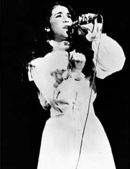 Dion's performance at the Yamaha World Popular Song Festival won her the gold medal as well as top performer The youngest of fourteen children born to Adhémar Dion and Thérèse Tanguay, Celine Dion was raised a Roman Catholic in a poverty-stricken but "happy home" in Charlemagne, a small town about thirty miles from Montreal. Dion grew up singing with her siblings in the small piano bar belonging to her parents called 'Le Vieux Baril,' and had always wanted to become a singer: in a 1994 interview with People magazine, she recalled, "I missed my family and my home, but I don't regret having lost my adolescence. I had one dream: I wanted to be a singer." [Rock on the Net. Celine Dion. Retrieved on November 30th, 2005.]
At age twelve Dion collaborated with her mother and her brother Jacques, to compose her first song, "Ce N'Était Qu'un Rêve " ("It Was Only a Dream"). Her brother Michel sent the recording to music manager René Angélil, whose name he discovered on the back of a Ginette Reno album. Angélil was brought to tears by Dion's voice and decided to make her a star. He mortgaged his home to fund her first record, "La Voix du Bon Dieu" (a play on words "The Voice of God/The Road to God") (1981). It became a local number-one record and made Dion an instant star in Quebec. Her popularity also spread to other parts of the world when she competed in the 1982 Yamaha World Popular Song Festival in Tokyo, Japan, and won the musician's award for "Top Performer" as well as the gold medal for "Best Song" with "Tellement J'Ai d'Amour Pour Toi" ("I Have So Much Love For You"). By 1983, in addition to becoming the first Canadian artist to receive a gold record in France for the single "D'Amour Ou d'Amitié" ("Of Love or of Friendship"), Dion had also won several Félix awards, including "Best Female performer" and "Discovery of the year".
At eighteen, Dion saw Michael Jackson performing on television and she told Angélil that she wanted to be a star like Jackson. Even though Angelil was confident in her talent, he realized that in order for her to be marketed worldwide, her image needed to be changed. Dion receded from the spotlight for a number of months, during which she underwent a physical makeover.
Further success in Europe, Asia, and Australia came in 1987, when Dion represented Switzerland in the 1988 Eurovision Song Contest with the song "Ne Partez Pas Sans Moi" ("Don't Go Without Me") and won the contest in Dublin, Ireland. However, her American success was yet to come, partially due to her status as a francophone artist. Finally, Dion was sent to the École Berlitz School in 1989 to polish her English and interviewing skills. It marked the start of her anglophone career.
Music and recording career
1990–1992: Career breakthrough
Dion's earlier work consisted of strong rock music influences. A year after she learned English, Dion made an attempt at breaking into the anglophone market with Unison (1990). She incorporated the help of many established musicians, including Canadian producer David Foster and Vito Luprano. The album was largely influenced by 1980s soft rock that was fit for the adult contemporary radio format. Unison hit the right notes with critics: Jim Faber of Entertainment Weekly wrote that Dion's vocals were "tastefully unadorned," and that she never attempted to "bring off styles that are beyond her."[Entertainment Weekly. Review--Celine Dion Unison. Retrieved on November 18, 2005.] Stephen Erlewine of All Music Guide declared it as "a fine, sophisticated American debut."[All Music Guide. Review--Celine Dion Unison. Retrieved on November 18, 2005.] Singles from the album included "(If There Was) Any Other Way," "The Last to Know," "Unison," and "Where Does My Heart Beat Now," a mid-tempo soft-rock ballad which featured an electric guitar. The latter became her first single to chart on the U.S. Billboard Hot 100, peaking at number four and number two on the AC chart. The album established Dion as a rising music artist in the United States, and across Continental Europe and Asia. In 1991, Dion was also a soloist in "Voices That Care", a tribute to American troops fighting in Operation Desert Storm; the single went Top 10 in the U.S.
While Dion was enjoying her rising success in the U.S., her French fans criticized her for neglecting them. After she won "Anglophone Artist of the Year" at the Felix Awards show, she attempted to reconnect with her French fans by openly refusing to accept the award. She stated she was — and will always be— a French, and not an English artist.[Celine Dion. Celine Dion Biography. Retrieved on April 26, 2006.][The Canadian Encyclopedia. Celine Dion Biography. Retrieved on July 14, 2006.]
"Where Does My Heart Beat Now" (1990) (file info) — play in browser (beta)
- "Where Does My Heart Beat Now", Dion's first North American hit, was comprised of 1980s soft rock. (Note the prominence of the electric guitar). It contrasts with the style of subsequent efforts.
"Beauty And The Beast"(1991) (file info) — play in browser (beta)
- "Beauty And The Beast" was largely influenced by classical music, which became a key feature of Dion's later work.
Problems playing the files? See media help.
Dion's real international breakthrough came when she paired up with Peabo Bryson to record the title track to Disney's animated film Beauty and the Beast (1991). The song captured a musical style that Dion would utilize in the future: sweeping, classically influenced ballads with soft instrumentation. Both a critical and commercial smash, the song became her second U.S. top ten hit, and also won the Academy Award for Best Song, and the Grammy Award for Best Pop Performance by a Duo or Group with Vocal.
"Beauty and the Beast" was featured on Dion's 1992 eponymous album, which, like her debut, had a strong rock influence that was combined with elements of soul and classical music. Due to the success of the lead-off single and her collaboration with Foster and Diane Warren, the album was as well received as Unison. Other singles that achieved moderate success included "If You Asked Me To" (a cover of Patti LaBelle's song from the 1989 movie Licence to Kill) which peaked at number four on the U.S. Billboard Hot 100, the gospel-tinged "Love Can Move Mountains," and "Nothing Broken but My Heart." As with Dion's earlier releases, the album had an overtone of love.
By 1992, Unison, Céline Dion and media appearances had propelled Dion to superstardom in the North America. She had achieved one of her main objectives: wedging her way into the anglophone market and establishing fame. Apart from her rising success, there were also changes in Dion's personal life, as Angélil would make the transition from manager to lover. However, the relationship was kept a secret as both feared that the public would find the twenty-six-year difference between their ages incongruous.
1993–1995: Popularity established
"Think Twice" (file info) — play in browser (beta)
- "Think Twice" became a major hit in the UK and established her as a success across Europe.
Problems playing the files? See media help.
In 1993, Dion publicly indicated her feelings for her manager by declaring him "the colour of [her] love" in the dedication section of her third anglophone album The Colour of My Love. However, instead of criticizing their relationship as Dion had feared, fans embraced the couple. Eventually, Angelil and Dion married in an extravagant wedding ceremony in December 1994.
As it was dedicated to her manager, the album's motif focused on love and romance. The album spawned Dion's first U.S. number-one single "The Power of Love" (a remake of Jennifer Rush's 1985 hit). However, subsequent singles such as "When I Fall in Love" (a duet with Clive Griffin), "Misled", and "Think Twice" failed to reach the top twenty on the Billboard charts. The album proved more successful in Europe, and in particular the United Kingdom, where both the album and "Think Twice" simultaneously occupied the top of the respective British charts for five consecutive weeks. "Think Twice," which remained at number one for seven weeks, went on to become the fourth single by a female artist to sell in excess of one million copies in the UK.[Celinedion.com. The Journey so Far. Retrieved on August 16, 2005.]
 The video for "Next Plane Out" depicts Dion and her lover on the beach in the sunset. It started a trend of typical and clichéd love ballads, lyrics and videos. Dion kept to her French roots, and continued to release many francophone recordings between each English record. These included Dion Chante Plamondon (1991); À l'Olympia (1994), a live album that was recorded during one of Dion's concerts at the Olympia Theatre in Paris; and D'eux (1995 — also known as The French Album in the United States), which would go on to become the best-selling French album of all time. As these albums were in French, the worldwide commercial success was limited. However, Dion's francophone fans embraced each release, and generally, they achieved more credibility than her anglophone works.
The mid-1990s was a transitional period for Dion's musical style, as she slowly moved away from strong rock influences and transitioned into a more pop and soul style (though the electric guitar remained a central part of her music.) Her songs began with more delicate melodies that used softer instrumentations, and built up to strong climaxes, over which her vocals could be displayed. This new sound received mixed reviews from critics, with Arion Berger of Entertainment Weekly accusing her of preferring vocal acrobatics over dynamics, and embarking on a trend of uninspiring, "crowd-pleasing ballads."[Entertainment weekly. Celine Dion--Review. Retrieved on July 18, 2006.] Resultantly, she earned frequent comparisons to artists such as Whitney Houston and Mariah Carey.[Entertainment weekly. The Colour of My Love--Review. Retrieved on July 13, 2006.] There were also signs that her work was becoming more clichéd: critically, The Colour of My Love was not consistent with earlier works. However, while critical praise declined, Dion's releases performed increasingly well on the international charts, and in 1996, she won the World Music Award for "World’s Best-Selling Canadian Female Recording Artist of the Year" — a title she had earned twice before. By the mid-1990s, she had established herself as one of the best-selling artists in the world, among female performers such as Carey and Houston.
1996–1999: Worldwide commercial success
"It's All Coming Back to Me Now" (1996) (file info) — play in browser (beta)
- A remake of Jim Steinman's "It's All Coming Back To Me Now" combined elements of both soft-rock and classical music.
"Falling into You" (1996) (file info) — play in browser (beta)
- The slow-tempo title track was noted for its considerable use of percussion instruments and the saxophone.
"Call the Man" (1996) (file info) — play in browser (beta)
- One of the final tracks on the album, "Call the Man" features a choir chanting and humming in an African language.
Problems playing the files? See media help.
Falling into You (1996) presented Dion at the height of her popularity, and showed a further progression of her music. In an attempt to reach a wider audience, the album combined many elements: ornate orchestral frills and African chanting, and instruments like the violin, Spanish guitar, trombone, the cavaquinho, and saxophone created a new sound.[Entertainment Weekly. Review --Falling into You. Retrieved on July 14, 2006.] The singles encompassed a variety of musical styles: the title track and "River Deep, Mountain High" (a Tina Turner cover) made prominent use of percussion instruments; "It's All Coming Back to Me Now" (a remake of Jim Steinman's song) and a remake of Eric Carmen's "All by Myself" kept their soft-rock atmosphere, but were combined with the classical sound of the piano; and the maudlin ballad, "Because You Loved Me", written by Diane Warren, served as the theme to the 1996 film Up Close & Personal. The song spent two weeks at number one in Canada and six weeks at number one in the United States.
Falling into You was met with generally favorable reviews. On the one hand, Dan Leroy wrote that Falling into You was not very different from her previous work,[Yahoo Music. Review --Falling into You. Retrieved on November 1, 2005.] and Stephen Holden of The New York Times and Elysa Gardner of Los Angeles Times wrote that the album was formulaic, and there was a lack of emotional connection to the songs.[Stephen, Holden. Review: Falling into you. New York Times. (Late Edition (East Coast)). New York, N.Y.: April 14, 1996. pg. 2.30, 2 pgs)][Gardner, Elysa. Review: Falling Into You. Los Angeles Times Los Angeles, Calif.: November 16, 1997. pg. 68)] However, other critics such as Chuck Eddy, Erlewine and Daniel Durchholz lavished the album as "compelling," "passionate," "stylish," "elegant," and "remarkably well-crafted."[All Music Guide. Review --Falling into You. Retrieved on November 1, 2005.] [Entertainment Weekly. Review --Falling into You. Retrieved on July 14, 2006.] Falling Into You became Dion's most critically and commercially successful album: it topped the charts in eleven countries and became one of the best-selling albums of all time.[Angelfire.com. Celine Dion Discography. Retrieved on November 1, 2005.] It also won Grammy Awards for Best Pop Album and Album of the Year. Dion's status on the world stage was further solidified when she was asked to perform "The Power of the Dream" at the opening ceremonies of the 1996 Atlanta Olympic Games. In March 1996, Céline launched the Falling into You Tour in support of her new album, giving concerts around the world for over a year.
Dion followed Falling into You with Let's Talk About Love (1997), which she publicized as its sequel. The recording process took place in London, New York City, and Los Angeles, and featured a host of special guests: Barbra Streisand on "Tell Him;" the Bee Gees on "Immortality;" and world-renowned tenor Luciano Pavarotti on "I Hate You Then I Love You." Other musicians included Carole King, Sir George Martin, and Jamaican singer Diana King, who added a reggae tinge to "Treat Her Like a Lady." As the name suggests, the album had the same theme as Dion's preceding albums: "love." However, emphasis was also placed on "brotherly love" with "Where Is the Love" and "Let's Talk About Love". The most successful single from the album became the classically influenced ballad "My Heart Will Go On," which was composed by James Horner, and produced by Horner and Walter Afanasieff. Serving as the love theme for the 1997 blockbuster film Titanic, the song topped the charts in many countries across the world, and has become Dion's signature song.
Dion embarked on the Let's Talk About Love Tour between 1998 and 1999 in support of her album. Comments were mostly favorable, but much focus was placed on her on-stage movements, which often consisted of chest-pounding, backward bending, and other flashy movements. While some people found these bombastic and even silly, others simply saw it as another extension of Dion's commanding stage presence.
Dion ended the 1990s with two more successful albums: the Christmas album, These Are Special Times (1998), and All the Way... A Decade of Song (1999). On These Are Special Times, Dion had a hand in writing some of the material. The album was her most classically influenced yet, with orchestral arrangements found on all tracks. "I'm Your Angel," a duet with R. Kelly, became Dion's fourth and final U.S. number one single, and another hit single across the world. All the Way... A Decade of Song was a compilation of her most successful hits coupled with seven new songs, including the leadoff single "That's the Way It Is," a cover of Roberta Flack's "The First Time Ever I Saw Your Face," and "All the Way," a duet with Frank Sinatra.
 "My Heart Will Go On" became one of the decade's biggest hits, winning four Grammy awards including Record and Song of the Year. Audio sample� (help·info)By the end of the 1990s Celine Dion had sold nearly 100 million albums worldwide, and had won a slew of industry awards. Her status as one of the biggest divas of contemporary music was further solidified when she was asked to perform on VH1's Divas Live special in 1998, with superstars Aretha Franklin, Gloria Estefan, Shania Twain, and Mariah Carey. That year she also received two of the highest honors from her home country: "Officer of the Order of Canada for Outstanding Contribution to the World of Contemporary Music" and "Officer of the National Order of Quebec." A year later she was inducted into the Canadian Broadcast Hall of Fame, and was honoured with a star on Canada's Walk of Fame.[canadaswalkoffame.com. Canada's Walk of Fame. Retrieved on October 30, 2006.] She also won the Grammy awards for "Best Female Pop Vocals" and the most coveted "Record of the Year" for "My Heart Will Go On" (the song won four awards, but two were presented to the songwriters).
Compared to her debut, both the quality and sound of Dion's music had also changed significantly. The soft-rock influences on her earlier releases were no longer prominent; they were replaced by more soul/adult contemporary styles. However, the theme of "love" remained in all her releases, and this led to many critics dismissing her work as banal. [findarticles.com. The unsinkable Celine Dion - French-Canadian singer - Interview. Retrieved on December 05, 2005.] In a scathing review of Let's Talk About Love, Rob O'Connor wrote:
"What never ceases to amaze me is how the trite-est, most cliché-ridden music often takes an assembly-line of lauded music industry professionals to perfect... Sinking ships are what I imagine as this tune ["My Heart Will Go On"] plows onward of four-plus minutes, and this album feels as if were never to end. Is it no wonder why I have such fears of going to the dentist?" [Yahoo Music. Let's Talk About Love:Review. Retrieved on November 30, 2005.]
Dion was also criticized for some of her remakes and duets: "The First Time Ever I Saw Your Face" and "All the Way" were described as disastrous and "creepy" by Allison Stewart of The Chicago Tribune and Erlwine of All Music Guide.[Stewart, Allison. Review:All the Way...A decade of Song. Chicago Tribune. Chicago, Ill.: December 12, 1999. pg. 10)] Even though she was still praised for her vocal abilities (Gardner of L.A Times called her voice a "technical marvel,")[Gardner, Elysa. Review: Falling Into You. Los Angeles Times Los Angeles, Calif.: November 16, 1997. pg. 68)] the much favored vocal restraint heard on her early releases had also waned, and Steve Dollar, in reviewing These Are Special Times wrote that Dion was a "vocal Olympian for whom there ain't no mountain—or scale—high enough."[Dollar, Steve. Review: These Are Special Times. The Atlanta Constitution. Atlanta, Ga.: November 3, 1998. pg. C.01)]
2000–2002: Career break
After releasing and promoting thirteen albums during the 1990s, Dion felt that she needed to settle down, and announced on her final album, All the Way... A Decade of Song, that she had experienced many things and needed to take a step back and enjoy life. Angélil's diagnosis with throat cancer also prompted her to retire. After undergoing fertility treatments, she gave birth to a son, René-Charles Dion Angélil, on January 25, 2001.
While on break, Dion was unable to escape the spotlight. In late 2002, the National Enquirer published a false story about the singer. Brandishing a picture of Dion and her husband, the magazine misquoted Dion, printing the headline: "Celine — 'I'm Pregnant With Twins!'" Dion later sued the magazine for over twenty million dollars. The editors of the Enquirer printed an apology and a full retraction to Dion in the next issue, and donated money to the American Cancer Society in honor of Dion and her husband.
Following the September 11, 2001 attacks, Dion returned to the music scene and in a televised performance sang "God Bless America" at the benefit concert America: A Tribute to Heroes. Chuck Taylor of Billboard wrote that "the performance... brings to mind what has made her one of the celebrated vocalists of our time: the ability to render emotion that shakes the soul. Affecting, meaningful, and filled with grace, this is a musical reflection to share with all of us still searching for ways to cope."[Taylor, Chuck. Celine Dion: God Bless America. Billboard magazine. New York: October 6, 2001. Vol.113, Iss. 40; pg. 22, 1 pgs.]
2002–2003: Return to music
"A New Day Has Come" (file info) — play in browser (beta)
- Dion's comeback single focussed on more mature lyrics and themes.
Problems playing the files? See media help.
Dion's aptly titled A New Day Has Come, released in March 2002, ended her two-year break from the music industry. The theme of the album was "new beginnings," and even though it did not incorporate many genres, a few dance-pop tunes ("I'm Alive" and "Sorry for Love") could be found among a throng of adult contemporary tracks. Shania Twain and Chantal Kreviazuk also appeared on the album and sang backing vocals. The album established a more mature side of Dion with the songs "A New Day Has Come," "Nature Boy" and "Goodbye's (The Saddest Word)." This change was as a result of her new-found maternal responsibilities, because, in her own words, "becoming a mother makes you a grown-up."[VH1. Celine Dion: Let's Talk About Success: The Singer Explains Her Career High-Points. Retrieved on December 19, 2005.] A New Day Has Come restarted her commercial success as it topped the charts in seventeen countries. The album featured the title track, "A New Day Has Come," and a cover of Etta James' "At Last." A CBS television concert helped to promote the album, during which Dion performed with Destiny's Child and Brian McKnight. While the album achieved success, critical comments suggested that it was "forgettable" and the lyrics were "lifeless." Rob Sheffield of Rolling Stone magazine wrote that Dion's music had not matured, and that she still suffered from mediocre vocal talent.[Rolling Stone. Review--A New Day has come. Retrieved on November 1, 2005.] Sal Cinquemani of Slant magazine called the album "a lengthy collection of drippy, gooey pop fluffer-nutter."[Slant Magazine. Review--A New Day Has Come. Retrieved on July 18, 2006.]
 The upbeat tempo of "One Heart" and the bright colours and "party" style of the music video were a new direction to Celine Dion's work. In drawing inspiration from personal experiences, Dion released One Heart (2003), an album that encapsulated her appreciation for the joys of life.[Flick, Larry. One Heart. Billboard magazine. New York: March 29, 2003. Vol.115, Iss. 13; pg. 30, 1 pgs] The album was largely comprised of dance music—a deviation from the soaring, melodramatic ballads, for which she had once been given mixed reception. Although it achieved moderate success, One Heart gave indication that Dion was unable to surpass the creative wall that she had hit, and words such as "predictable" or "banal" appeared even in the most lenient reviews.[All Music Guide. ]Review--One Heart. Retrieved on July 17, 2006.[Durchholz, Daniel. ]One Heart:Celine's a Diva Who Still Goes On and On. St.Louis Post - Dispatch. St. Louis, Mo.: Apr 24, 2003. pg. F.3 A cover of Roy Orbison's "I Drove All Night," released to launch her new advertising campaign with Chrysler, incorporated dance-pop and rock and roll and was called reminiscent of Cher's 1980s work, but it was dismissed as Dion trying to please her sponsors.[Murray, Sonia. ]Celine Dion's latest takes easy, well-worn route. The Atlanta Journal–Constitution. Atlanta, Georgia: March 25, 2003. pg. C.1.
By the mid 2000s, Dion's music had changed to the point where her releases possessed maternal overtones: Miracle
|