| . |
: Andre AgassiCountryImage:Flag of the United States.
Andre Agassi
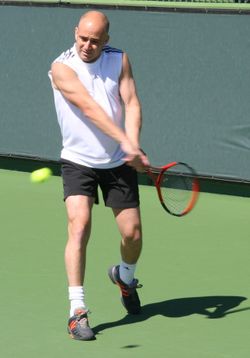
|
| Country | Image:Flag of the United States.svg�United States
|
| Residence | Las Vegas, Nevada, USA
|
| Date of birth | April 29, 1970
|
| Place of birth | Las Vegas, Nevada, USA
|
| Height | 5 ft 11 in (1.80 m)
|
| Weight | 177 lb (80 kg)
|
| Turned Pro | 1986
|
| Retired
| September 3, 2006
|
| Plays | Right; Two-handed backhand
|
| Career Prize Money | $31,152,975
|
| Singles
|
| Career record: | 870-274
|
| Career titles: | 60
|
| Highest ranking: | No. 1 (April 10, 1995)
|
| Grand Slam results
|
| Australian Open | W (1995, 2000, 2001, 2003)
|
| French Open | W (1999)
|
| Wimbledon | W (1992)
|
| U.S. Open | W (1994, 1999)
|
| Doubles
|
| Career record: | 40-42
|
| Career titles: | 1
|
| Highest ranking: | No. 123 (August 17, 1992)
|
|
Infobox last updated on: September 11, 2006.
|
| Olympic medal record
|
| Men's tennis
|
| Gold | 1996 Atlanta | Singles
|
Andre Kirk Agassi (born April 29 1970, in Las Vegas, Nevada) is a former World No. 1 professional tennis player from the United States. He is one of only five male players to have won all four Grand Slam singles events during his career. He is the only player in the open era to have won every Grand Slam singles title, to have won the Tennis Masters Cup, to have been part of a winning Davis Cup team, and to have won an Olympic gold medal. He has won 17 ATP Masters Series tournaments, more than any other player. He is generally considered to be one of the greatest tennis players of all time.
Because of sciatica caused by two bulging discs in his back, a Spondylolisthesis (shifting vertebrae), and a bone spur that interferes with the nerve, Agassi retired from professional tennis on September 3, 2006, after losing in the third round of the US Open. Agassi is married to Steffi Graf and has two children. He is the founder of the Andre Agassi Charitable Foundation, which has raised over $70 million for at-risk children in Southern Nevada.[http://www.agassifoundation.org] In 2001, the Foundation opened the Andre Agassi College Preparatory Academy in Las Vegas, a K-12 public charter school for at-risk children.[http://www.agassiprep.org]
Contents
- 1 Early life
- 2 Tennis career
- 3 Playing style
- 4 Personal and family life
- 5 Philanthropy
- 6 Ethnicity
- 7 Quotes
- 8 Trivia
- 9 Grand Slam singles finals
- 9.1 Wins (8)
- 9.2 Runners-up (7)
- 10 ATP Masters Series finals
- 10.1 Wins (17)
- 10.2 Runners-up (6)
- 11 Titles (61)
- 11.1 Singles (60)
- 11.2 Doubles (1)
- 11.3 Performance timeline
- 12 ATP Tour career earnings
- 13 Video games
- 14 References
- 15 External links
|
Early life
Agassi is of Iranian (Armenian and Assyrian) ancestry.[[1]][http://www.cnn.com/CNN/Programs/people/shows/agassi/profile.html] His father, Emmanuel "Mike" Agassi (who represented Iran in boxing at the 1948 and 1952 Olympic Games before emigrating to the United States), was intent on having a child win all four tennis Grand Slams. He called Agassi's two older siblings "guinea pigs" in the development of his coaching techniques. He honed Andre's eye-coordination when he was an infant by hanging tennis balls above his crib. He gave Agassi paddles and balloons when he was still in a high chair. When Agassi started playing tennis, his ball collection filled 60 garbage cans with 300 balls per can, and Agassi would hit 3,000-5,000 balls every day. When Andre was five years old, he was already practicing with pros such as Jimmy Connors and Roscoe Tanner. Later, Mike began working in one of the Las Vegas casinos that belonged to Armenian American tycoon Kirk Kerkorian. Mike and Kirk became good friends, and Andre's middle name "Kirk" is actually after Kirk Kerkorian.
Mike Agassi learned tennis by watching tapes of champions. He took a very systematic approach to the physics and psychology of tennis and is still active in the sport.
At the age of 14, Andre was sent to teaching guru Nick Bollettieri's Tennis Academy in Florida. He turned professional at the age of 16.
Tennis career
1986-1993: Image is everything
Agassi turned professional in 1986 and won his first top-level singles title in 1987 at Itaparica. He won six further tournaments in 1988, and, by December of that year, he had surpassed U.S. $2 million in career prize money after playing in just 43 tournaments – the fastest anyone in history had reached that level.
As a young up-and-coming player, Agassi embraced a rebel image. He grew his hair to rocker length, sported an earring, and wore colorful shirts that pushed tennis' still-strict sartorial boundaries. He boasted of a cheeseburger diet and endorsed the Canon "Rebel" camera. "Image is everything" was the ad's line, and it became Agassi's as well.
In addition to not playing the Australian Open (which would later become his best Grand Slam event) for the first eight years of his career, Agassi chose not to play at Wimbledon from 1988 through 1990 and publicly stated that he did not wish to play there because of the event's traditionalism, particularly its "predominantly white" dress code to which players at the event are required to conform. Many observers at the time speculated that Agassi's real motivation was that his strong baseline game would not be well suited to Wimbledon's grass court surface.
Strong performances on the tour meant that Agassi was quickly tipped as a future Grand Slam champion. While still a teenager, he reached the semifinals of both the French Open and the U.S. Open in 1988, and the U.S. Open again in 1989. He began the 1990s, however, with a series of near-misses. He reached his first Grand Slam final in 1990 at the French Open, where he lost in four sets to the seasoned veteran Andrés Gómez. Later that year, he lost in the final of the U.S. Open to another up-and-coming teenage star, Pete Sampras. The rivalry between these two American players became the dominant rivalry in tennis over the rest of the decade. Agassi did help the United States win its first Davis Cup in 8 years in 1990.
In 1991, Agassi reached his second consecutive French Open final, where he faced fellow Bollettieri Academy alumnus Jim Courier. Courier emerged the victor in a five set final. Agassi decided to play at Wimbledon in 1991, leading to weeks of speculation in the media about the clothes he would wear. He eventually emerged for the first round in a completely white outfit. He went on to reach the quarterfinals on that occasion.
To the surprise of many, Agassi's Grand Slam breakthrough came at Wimbledon, not at the French Open or the U.S. Open where he had enjoyed so much succes. In 1992, he defeated Goran Ivanišević in a five set final. Along the way, Agassi's baseline counter-punching dispatched two former Wimbledon champions in Boris Becker and John McEnroe. No other baseliner would triumph at Wimbledon until Lleyton Hewitt ten years later, on slower, higher bouncing grass better suited for baseline play. Agassi was named the BBC Overseas Sports Personality of the Year in 1992.
Agassi once again was a key player on the United States' Davis Cup winning team in 1992. It was their second Davis cup title in three years.
1993 saw Agassi win the only doubles title of his career, at the Cincinnati Masters, partnered with Petr Korda. Agassi missed much of the early part of this year with injury troubles and struggled at the major events. After a first-round exit at the U.S. Open, he had wrist surgery late in the year.
1994-1997: Rivalry and injury
Agassi started slowly in 1994, losing in the first week at the French Open and Wimbledon. Nevertheless, Agassi emerged during the hard court season, winning the Canada Masters event. His comeback culminated in his becoming the first man to capture the U.S. Open as an unseeded player, beating Michael Stich in the final after a fourth-round victory against Michael Chang.
In 1995, Agassi shaved his balding head, breaking with his old "image is everything" style. Agassi attended the Australian Open for the first time and won it in his first attempt, beating Sampras in a four set final. Agassi and Sampras met in five tournament finals in 1995, all on hardcourt, with Agassi winning three of the five. Agassi won three Masters Series events in 1995 - the Cincinnati Masters, the Miami Masters, and the Canada Masters, and seven titles total. Agassi compiled a career-best 26-match winning streak during the summer hardcourt circuit, which ended when he lost in a hugely anticipated U.S. Open final to Sampras.
Agassi reached the World No. 1 ranking for the first time in April 1995. He held the No. 1 ranking until November, for a total of 30 weeks. In terms of win/loss record, 1995 was Agassi's best year. He won 72 matches and lost only 10. This was a higher winning percentage than Sampras’ best season, 1994, in which he won 77 matches and lost 12. Agassi was also once again a key player on the United States Davis Cup winning team - the third and final Davis Cup title of Agassi's career.
1996 was a less successful year for Agassi, as he failed to reach any Grand Slam finals. The clear high point for Agassi was winning the men's singles gold medal at the Olympic Games in Atlanta, beating Sergi Bruguera of Spain in the final 6-2, 6-3, 6-1. Agassi also successfully defended his singles titles at the Cincinnati Masters and the Miami Masters.
1997 was the low point of Agassi's career. His wrist injury resurfaced, and he played only 24 matches on the year. He won no top-level titles and his ranking sank to World No. 141 in November. Agassi was also subject to intense publicity surrounding his high-profile and turbulent marriage to actress Brooke Shields (a marriage that ended in divorce).
1998-2005: Elder statesman of the game
In 1998, Agassi rededicated himself to tennis. He began a rigorous conditioning program and worked his way back up the rankings by playing in Challenger Series tournaments (a circuit for professional players ranked outside the world's top 50). Perhaps most remarkably, the one-time rebel emerged as a gracious and thoughtful athlete, admired by younger players. After winning matches, he bowed and blew two-handed kisses to spectators on each side of the court, a gesture seen as a rather humble acknowledgement of their support for him and for tennis. He played some classic matches in this period, most notably against his old rival Pete Sampras and popular Australian Patrick Rafter.
In 1998, Agassi won five titles and leapt from No. 141 on the rankings at the start of the year, to No. 6 at the end of it, making it the highest jump into the top 10 made by any player. He won five titles in ten finals and was runner-up at the Miami Masters.
Agassi entered the history books in 1999 when he came back from two sets to love down to beat Andrei Medvedev in a five-set French Open final, thereby becoming only the fifth male player (joining Rod Laver, Fred Perry, Roy Emerson, and Don Budge) to have won all four Grand Slam singles titles during his career. He is the only male player in history to have won all four Grand Slam titles on different surfaces, a tribute to his adaptability. Agassi also became the first male tennis player to win the Career Golden Slam.
He followed this by reaching the Wimbledon final, where he lost to Sampras. He then won the U.S. Open, beating Todd Martin in five sets (rallying from 2 sets to 1 down) in the final and finished 1999 ranked the World No. 1 again. This was the first and only time Agassi ended the year at number one, and it ended Sampras' record streak of six consecutive times ending the year ranked number one (1993-1998).
Agassi began 2000 by capturing his second Australian Open title, beating Sampras in a five-set seminifinal and Yevgeny Kafelnikov in a four-set final. He was the first male player to have reached four consecutive Grand Slam finals since Rod Laver achieved the Grand Slam in 1969. (Roger Federer has since duplicated this feat, appearing in six consecutive Grand Slam finals from 2005-2006.) Agassi was also only the third player since Laver to be the reigning champion of three of four Grand Slam events, missing only the Wimbledon title. (Sampras held the 1993 Wimbledon, 1993 U.S. Open, and 1994 Australian Open titles simultaneously, and Jimmy Connors won all three of those events in 1974, although at the time all three were on grass courts. Federer has since duplicated Sampras' and Connors' feat as well, holding all Grand Slam titles except the French Open at the end of 2004 as well as throughout 2006.)
2000 also saw Agassi reach the semifinals at Wimbledon, where he lost in five sets to Patrick Rafter in a match considered by many to be one of the best ever played at Wimbledon [2]. At the inaugural Tennis Masters Cup in Lisbon, Agassi reached the final after defeating Marat Safin 6-3, 6-3 in the semifinals to end the Russian's hopes to become the youngest World No. 1 in the history of tennis. Agassi eventually lost to Gustavo Kuerten 6-4, 6-4, 6-4. This loss allowed Kuerten to be crowned year-end World No. 1. Agassi finished 2000 ranked World No. 6, becoming the only male tennis player to have been ranked in the Top 10 in three different decades (1980’s - finishing No. 3 & 7 in 1988 and 1989; 1990’s - No. 4 in 1990, No. 10 in 1991, No. 9 in 1992, No. 2 in 1994 & 1995, No. 8 in 1996, No. 6 in 1998, and No. 1 in 1999; 2000’s - No. 6 in 2000, No. 3 in 2001, No. 2 in 2002, No. 4 in 2003, No. 8 in 2004, and No.7 in 2005).
Agassi opened 2001 by successfully defending his Australian Open title with a straight-sets final win over Arnaud Clément. Enroute, he beat a cramping Rafter (7-5, 2-6, 6-7, 6-2, 6-3) in front of a sell out crowd in what turned out to be the Aussie's last Australian Open. At Wimbledon, they met again in the semifinals, where Agassi lost another close match to Rafter, 8-6 in the fifth set. At the U.S. Open, Agassi lost in the quarterfinals to Sampras 6-7, 7-6, 7-6, 7-6, with no breaks of serve during the entire match.
2002 opened with disappointment for Agassi, as injury forced him to skip the Australian Open, where he was a two-time defending champion. The last duel between Agassi and Sampras came in the final of the U.S. Open. The battle saw Sampras emerge victorious in four sets and left Sampras with a 20-14 edge in their 34 career meetings. The match proved to be the last of Sampras' career. He did not play in an event on the professional tour again and officially announced his retirement in 2003. Agassi's U.S. Open finish, along with his victories at the Miami Masters, Rome Masters, and Madrid Masters, helped him finish 2002 as the oldest year-end No. 2 at 32 years and 8 months.
In 2003, Agassi won the eighth (and final) Grand Slam title of his career at the Australian Open, where he beat Rainer Schüttler in straight sets in the final. On March 31, 2003, he won his sixth Miami Masters, in the process surpassing wife Steffi Graf who was a 5-time winner of the event and completed a hat-trick from 2001-2003. The win was his 18th straight win in that tournament, which broke the previous record of 17 set by Sampras from 1993-1995. (Agassi's winning streak continued to 20 after winning his first 2 matches at the 2004 Miami Masters before eventually bowing to Agustin Calleri.) With the 2003 Miami Masters victory, Agassi became the youngest (19 years old) and oldest (32) winner of the tournament. In May of that year, he recaptured the World No. 1 ranking after a quarterfinal victory over Xavier Malisse at the Stella Artois Tennis Championships at Queens to become the oldest No. 1 ranked male player ever at 33 years and 13 days. He held the No. 1 ranking on that occasion for 14 weeks. Agassi's ranking slipped later on in the year, as injury problems forced him to withdraw from many events. He did manage to reach the U.S. Open semifinals, where he lost to Juan Carlos Ferrero. At the year-end Tennis Masters Cup, he lost in the final to Federer and finished the year ranked World No. 4.
In 2004, the 34-year-old Agassi won the Cincinnati Masters to bring his career total to 59 top-level singles titles and a record 17 ATP Masters Series titles, having already won seven of the nine ATP Masters tournament -- all except Monte Carlo and Hamburg. He became the second-oldest singles champion in Cincinnati tournament history (the tournament began in 1899), surpassed only by Ken Rosewall who won the title in 1970 at age 35.
Agassi's 2005 began with a quarterfinal loss to Federer at the Australian Open. Agassi had several other deep runs at tournaments, but had to withdraw from several events due to injury. He won his fourth Mercedes Benz Cup at Los Angeles and reached the finals of the Canada Masters before falling to world No. 2 Rafael Nadal.
Still, Agassi's 2005 was defined by an improbable run to the finals of the U.S. Open. After beating Razvan Sabau and Ivo Karlovic in straight sets, and defeating Tomas Berdych in four sets, Agassi won three consecutive five set matches to advance to the final. The most notable of these three matches was his quarterfinal victory over James Blake, where he rallied from two sets down to win in a fifth set tiebreak, 3-6, 3-6, 6-3, 6-3, 7-6(6). His other five-set victims were Xavier Malisse in the fourth round and Robby Ginepri in the semifinals. In the final, Agassi faced Federer, who was seeking his second consecutive U.S. Open title and his fifth Grand Slam title in two years. Federer defeated Agassi in four sets.
Agassi finished 2005 ranked No. 7, his 16th time in the year-end top 10 rankings, which tied Connors for the most times ranked in the top 10 at year's end. In 2005, Agassi left Nike after 17 years and signed an endorsement deal with Adidas [3].
2006: The end of an era
Agassi had a poor start to 2006. He was still recovering from an ankle injury and also suffering from back and leg pain and lack of match play. Agassi withdrew from the Australian Open because of the ankle injury, and his back injury and other pains forced him to withdraw from several other events, eventually skipping the entire clay court season, including the French Open. This caused his ranking to drop out of the top 10 for the last time.
Agassi returned for the grass court season, playing a tune-up and then Wimbledon. At Wimbledon, Agassi announced his plans to retire following the U.S. Open. He was defeated in the third round [4] by world #2 (and eventual finalist) Rafael Nadal, 7-6(5), 6-2, 6-4.
Agassi played only two events during the summer hardcourt season, with his best result being a quarterfinal loss in the Countrywide Classic[5] in Los Angeles to Fernando González of Chile 6-4, 3-6, 7-5. As a result, he was unseeded at the U.S. Open.
Agassi had a short but dramatic run in his final U.S. Open. Due to extreme back pain, Agassi was forced to receive anti-inflammatory injections after every match. After a tough four-set win against Andrei Pavel, Agassi faced #8 seed Marcos Baghdatis in the second round. Agassi won 6-4, 6-4, 3-6, 5-7, 7-5 as Baghdatis succumbed to muscle cramping in the final set.
In his last match, Agassi was in obvious pain on court and fell to 112th ranked big-serving Benjamin Becker of Germany in four sets. Agassi received an 8 minute standing ovation from the crowd after the match and delivered a memorable retirement speech.
Agassi earned more than US$30 million in prize-money throughout his career, second only to Sampras. In addition, Agassi earned over US$25 million a year through endorsements, the most by any tennis player during his career and fourth in all sports at the time (first place was Tiger Woods at US$70 million a year).
Playing style
Agassi employed a baseline style of play, but unlike most such players, he typically made contact with the ball inside the baseline — exceptionally difficult even for professionals. This was possible because of his short backswing and his extraordinary hand-eye coordination. These same attributes helped him aggressively return serves. John McEnroe, Jim Courier and others have called Agassi the best service returner ever to play tennis. Many, including Brad Gilbert, call him the best ball striker in the history of tennis.
Agassi was known for his ability to hit sharply angled winners from the baseline. Early on in his career, Agassi would look to end points quickly, typically by inducing a weak return with a deep, hard shot, and then playing a winner at an extreme angle. In 1995, he added a backhand drop shot to his repertoire, which was one of the most effective drop shots on tour (partly due to the fact that Agassi's groundstrokes forced most opponents to play far behind the baseline).
After Agassi's rededication to tennis in 1998, he focused more on physical conditioning than in the past and became one of the fittest players on the tour. His upper-body strength allowed him to bench press 350 lb (159 kg), which helped him retain pace on his shots late into a match, as well as adding to his serve power. He had remarkable endurance and rarely appeared tired on court.
Because of his conditioning and groundstrokes, one of Agassi's central strategies was to wear down his opponents. Agassi tried to minimize time between points, so that his opponents had as little recovery time as possible. Agassi continually put pressure on opponents by returning the ball early and at deep angles, and attempted to dictate play from the center of the baseline and make his opponent scramble. When in control of a point, Agassi would often pass up an opportunity to attempt a winner and hit a slightly more conservative shot, both to minimize his errors and to make his opponent run more. His penchant for running players around point after point has earned him the nickname "The Punisher."
In the last year of his career, various injuries, most notably in his back, robbed Agassi of consistent speed and court coverage. As a result, players who were able to consistently hit at sharp angles with pace, particularly those who could do this on the run, gave him trouble. To make up for this weakness, Agassi began playing more aggressive shots, to keep his opponent on the defensive and deny them opportunities to run Agassi around the court. This both limited his options from the baseline and increased his errors.
Agassi's serve was never the strength of his game, but it improved steadily over the course of his career, and went from being a liability to being one of the better serves on tour. His most effective serve was a hard slice, which he would use to ace opponents in the ad court, and to send his opponent wide off the court when serving on the deuce side, followed by a shot to the opposite corner to send his opponent scrambling. He relied on a heavy kick serve for his second serve, particularly early in his career.
Personal and family life
Agassi dated famed American singer Barbra Streisand in the early 1990s before marrying actress Brooke Shields on April 19, 1997. That February, they had filed suit against The National Enquirer claiming it printed "false and fabricated" statements about the couple. The case was dismissed. He later filed for divorce from Shields, which was granted on April 9, 1999.
After the divorce was finalized, Agassi began dating retired tennis star Steffi Graf. They were married on October 22, 2001. Their son, Jaden Gil, was born on October 26 and their daughter, Jaz Elle, was born on October 3, 2003.
The couple live in Las Vegas and own several vacation homes. They paid $23 million to purchase a six-bedroom, eight-bathroom house in Tiburon, California from John E. McCaw Jr., former owner of Cellular One. The home is currently listed for sale. Agassi used to own a 10-seat Lockheed JetStar 731 jet with call letters on the tail representing his first Grand Slam title at Wimbledon (N-792AA) [6].
Agassi's older sister, Rita, was married to the late former tennis legend Pancho Gonzales. In 1995, when Gonzales died in Las Vegas, Agassi paid for the funeral.
Agassi is also a staunch Democrat [7] and has donated over $84,000 to different Democratic candidates.[8]
Philanthropy
Agassi has participated in many charity organizations and founded the Andre Agassi Charitable Association in 1994, which assists the youth of Las Vegas. He was awarded the ATP Arthur Ashe Humanitarian award in 1995 for his efforts to help disadvantaged youth. He is regularly cited as the most charitable and socially involved player in professional tennis.
Agassi's charity often takes the form of assisting children with their athletic potential. His Boys & Girls Club sees 2,000 children throughout the year and boasts a world class junior tennis team. It also has a basketball program (the Agassi Stars) and a rigorous system that encourages a mix of academics and athletics.
In 2001, Agassi opened up the Andre Agassi College Preparatory Academy [9] in Las Vegas, a tuition-free charter school for at-risk children in the area. Ironically, Agassi never finished his own formal education due to his decision to turn pro.
Among other child-related programs [10] that Agassi supports through his Andre Agassi Charitable Foundation [11] is Clark County's only residential facility for abused and neglected children called Child Haven. In 1997, Andre donated funding to Child Haven for a six-room classroom building now named the Agassi Center for Education. His foundation also provided "$720,000 to assist in the building of the Andre Agassi Cottage for Medically Fragile Children. This facility opened in December 2001 and accommodates developmentally delayed or handicapped children and children quarantined for infectious diseases. It houses approximately 20 beds and gives children with special needs the attention needed to make them feel comfortable in their new surroundings."
Ethnicity
Agassi's ethnicity, beyond being an American citizen, has been a subject of discussion by fans around the world. His father Mike Agassi is an Iranian of Assyrian His father has written a book entitled "The Agassi Story." The book is about his experiences in Iran. Andre also has shown interest in the Iranian aspect of his heritage. In February 2005, he expressed a desire to visit Iran, which holds "a special place" in his heart.
Andre's mother is American of French descent.
Quotes
- About Pete Sampras' retirement: "You grow up with a guy, you compete against him for so long, he's such a big part of your career, something that's pretty special, so you do have that sense of personal regret that he's not around any more. You miss having that around."
- During the 2005 U.S. Open: "I've been motivated by overcoming challenge and overcoming the hurdles and obstacles that face me. There still is plenty out there to get motivated by." And after defeating James Blake in a quarterfinal, Agassi said, "First of all, let me say, 1:15 in the morning, for 20,000 people to still be here, I wasn't the winner, tennis was. That's awesome. I don't know if I've ever felt so good here before."
- When Mats Wilander was asked in 2005 to name the top five tennis players of all time, he placed Agassi, Pete Sampras, Roger Federer, and Bjorn Borg in the top four (in no order) and tied John McEnroe, Ivan Lendl, and Jimmy Connors for fifth place. Concerning Agassi, Wilander said, “He has some limitations, like he can’t serve and volley, yet he has won all four Slams. He has a very high energy level, quite like Borg. He is on fifth gear from the very first point. There is some abnormality in his eyes, otherwise he wouldn’t have had such a phenomenal return. He sees the ball like no one else and just guides it wherever he wants to. He’s just played a Grand Slam final at 35, that tells me he wasted the first five years of his career, otherwise he couldn’t have lasted this long. No one has done more to tennis than Agassi and Borg.”
- When a fan would say, "We love you Andre!" Agassi would respond, "I love you too, man!"
- On September 3, 2006, after playing his final match and losing in the third round of the U.S. Open to Benjamin Becker, Agassi gave these departing remarks to his fans: "Thanks. The scoreboard said I lost today, but what the scoreboard doesn't say is what it is I have found. And over the last 21 years, I have found loyalty. You have pulled for me on the court and also in life. I've found inspiration. You have willed me to succeed sometimes even in my lowest moments. And I've found generosity. You have given me your shoulders to stand on to reach for my dreams, dreams I could have never reached without you. Over the last 21 years, I have found you. And I will take you and the memory of you with me for the rest of my life. Thank you."
- Tennis star Andy Roddick likened his feelings on Agassi's retirement to how rookies in the NBA must have felt when Michael Jordan retired.
- Rafael Nadal, currently the second ranked male tennis player, said, "Agassi was a reference point in world tennis. He’s someone who, by changing style and image, left his mark on the game."
Trivia
- During the third set of the 1988 U.S. Open quarterfinals against Jimmy Connors, Agassi was famously made fun of on national television when a fan yelled to Connors, “He's a punk, you're a legend!" Connors laughed at the remark and hit a ball into the stands as a gift to the fan. Andre went on to win the match 6-2 7-6 6-1.
- On August 29, 2006, a columnist for The Philadelphia Inquirer asserted that Agassi's career will never be characterized by sheer recordbreaking. He then went on to humorously observe that "Agassi doesn't even have the record for most Grand Slam wins in his house," a passing reference to Agassi's wife Steffi Graf (who won 22 Grand Slam singles titles). [13]
- Agassi won singles titles in 11 different countries: Australia, Austria, Canada, People's Republic of China, Czech Republic, France, Germany, Italy, Spain, United Kingdom, United States.
- Agassi and Graf appeared in a Gensworth Financial television commercial.
Grand Slam singles finals
Wins (8)
| Year
| Championship
| Opponent in Final
| Score in Final
|
| 1992 | Wimbledon | Image:Flag of Croatia.svg Goran Ivanišević | 6-7, 6-4, 6-4, 1-6, 6-4
|
| 1994 | U.S. Open | Image:Flag of Germany.svg Michael Stich | 6-1, 7-6, 7-5
|
| 1995 | Australian Open | Image:Flag of the United States.svg Pete Sampras | 4-6, 6-1, 7-6, 6-4
|
| 1999 | French Open | Image:Flag of Ukraine.svg Andrei Medvedev | 1-6, 2-6, 6-4, 6-3, 6-4
|
| 1999 | U.S. Open (2) | Image:Flag of the United States.svg Todd Martin | 6-4, 6-7, 6-7, 6-3, 6-2
|
| 2000 | Australian Open (2) | Image:Flag of Russia (bordered).svg Yevgeny Kafelnikov | 3-6, 6-3, 6-2, 6-4
|
| 2001 | Australian Open (3) | Image:Flag of France.svg Arnaud Clément | 6-4, 6-2, 6-2
|
| 2003 | Australian Open (4) | Image:Flag of Germany.svg Rainer Schüttler | 6-2, 6-2, 6-1
|
Runners-up (7)
| Year
| Championship
| Opponent in Final
| Score in Final
|
| 1990 | French Open | Image:Flag of Ecuador.svg Andrés Gómez | 6-3, 2-6, 6-4, 6-4
|
| 1990 | U.S. Open | Image:Flag of the United States.svg Pete Sampras | 6-4, 6-3, 6-2
|
| 1991 | French Open | Image:Flag of the United States.svg Jim Courier | 3-6, 6-4, 2-6, 6-1, 6-4
|
| 1995 | U.S. Open | Image:Flag of the United States.svg Pete Sampras | 6-4, 6-3, 4-6, 7-5
|
| 1999 | Wimbledon | Image:Flag of the United States.svg Pete Sampras | 6-3, 6-4, 7-5
|
| 2002 | U.S. Open | Image:Flag of the United States.svg Pete Sampras | 6-3, 6-4, 5-7, 6-4
|
| 2005 | U.S. Open | Image:Flag of Switzerland.svg Roger Federer | 6-3, 2-6, 7-6, 6-1
|
ATP Masters Series finals
Wins (17)
Runners-up (6)
|