| . |
: Al Gore, Vice President of the United States, official portrait 1994.
- This article is about the former United States Vice President. For his father, Congressman from Tennessee, see Albert Gore, Sr.
| Albert Arnold Gore, Jr.
|
Image:Al Gore, Vice President of the United States, official portrait 1994.jpg
Al Gore, official portrait 1994
|
45th Vice President of the United States
|
In�office
20 January 1993�–�20 January 2001
|
| Preceded�by
| Dan Quayle
|
| Succeeded�by
| Dick Cheney
|
| President
| Bill Clinton
|
|
| Born
| 31 March 1948
Washington, D.C.
|
| Political�party
| Democratic
|
| Spouse
| Mary Elizabeth "Tipper" Gore
|
| Religion
| Baptist
|
Albert Arnold Gore, Jr., commonly known as Al Gore (born March 31, 1948) is an American politician, teacher, businessman, and environmentalist who was the 45th Vice President of the United States in the Clinton administration from 1993 to 2001. Previously, he had served in United States House of Representatives (1977-85) and United States Senate (1985-93) for Tennessee.
Gore was the Democratic nominee for President in the 2000 election. He won a plurality of the popular vote, with over half a million more votes than the Republican candidate George W. Bush, but was defeated in the Electoral College by a vote of 271 to 266.
Gore currently is president of the American television channel Current TV, chairman of Generation Investment Management, a director on the board of Apple Computer, and an unofficial adviser to Google's senior management. He lectures widely on the topic of global warming, which he calls "the climate crisis"[http://wired.com/wired/archive/14.05/gore.html], including on the August 31 2006 MTV Video Music Awards.
Although speculation about a possible Presidential run in 2008 continues, he said as recently as June 4, 2006, "I have no plans to run for President again", [Financial Times: Buzz around Gore fuels talk of another run for president] [Yahoo News: Gore in movie campaign to protect Earth] but hasn’t ruled out a future in politics.[MSNBC: Al Gore denies planning an ’08 presidential bid]
Gore's popularity has increased among grassroots Democrats, with Gore getting 68% of support among potential 2008 Democratic presidential candidates on a May 2006 Daily Kos poll[http://www.dailykos.com/poll/1148396397_RcAkIUdC], and 35% on July 13 2006 AlterNet poll.[http://www.alternet.org/story/38849/] A Gallup poll of August 2006 showed that nearly half of Americans view Gore favorably (48 percent to 45 percent). [http://www.washtimes.com/national/20060803-112138-5988r.htm] [http://poll.gallup.com/content/default.aspx?ci=23992] CNN telephone poll conducted by the Opinion Research Corporation of registered or independent leaning Democrats in November 2006 has Gore with 14% support.[[1]]
Contents
- 1 Early life
- 2 Family
- 3 Soldier and journalist
- 4 Politics
- 4.1 Congressional Service
- 4.2 1988 Presidential run
- 4.3 Son's accident and effect on 1992 presidential campaign
- 4.4 Vice Presidency
- 4.4.1 Debate with Perot
- 4.4.2 Initiatives
- 4.4.3 Environment
- 4.4.4 Space
- 4.4.5 Foreign policy
- 4.4.6 Economy
- 4.5 2000 presidential election
- 5 Private citizen
- 5.1 Education
- 5.2 Criticism of Bush Administration
- 5.3 Hurricane Katrina
- 5.4 Future plans
- 5.5 Environment
- 5.5.1 An Inconvenient Truth
- 5.5.2 Investment firm
- 5.6 Television network
- 6 2004 presidential election
- 6.1 Endorsing Dean
- 6.2 Campaign against Bush
- 6.2.1 2004 Democratic National Convention
- 6.2.2 Post-convention
- 6.2.3 Policy positions
- 6.2.3.1 Abortion
- 6.2.3.2 Gay Rights
- 7 The Internet and the Webbys
- 7.1 Gore bill
- 7.2 Information superhighway
- 7.3 Mosaic
- 7.4 CNN interview about role in Internet's creation
- 7.4.1 Cerf and Kahn response
- 7.5 Apple Computer and Google
- 7.6 Webby award
- 8 Trivia
- 9 Controversies
- 10 See also
- 11 Footnotes
- 12 Further reading
- 13 External links
- 13.1 General sites
- 13.2 Film and television
- 13.3 Recent speeches by Al Gore
- 13.4 Al Gore and the Internet
- 13.5 Al Gore's early career in journalism
- 13.6 Al Gore myths and media bias
|
Early life
Al Gore was born in Washington, D.C., to Albert Arnold Gore, Sr., a U. S. Representative (1939-44, 1945-1953) and Senator (1953-1971) from Tennessee, and Pauline LaFon Gore, one of the first women to graduate from Vanderbilt University Law School. Al Gore Jr. thus divided his childhood between Washington, D.C., and Carthage, Tennessee: During the school year, he lived in a hotel in Washington; during summer vacations, he worked on the Gore family tobacco farm in Carthage.[Bob Zelnick: Al Gore: A Political Life. Regnery Publishing, 1999, ISBN 0-89526-326-2.]
Gore had one elder sister, Nancy Gore Hunger (1938-1984), who died of lung cancer, an issue important to him in subsequent years.
Education
Gore attended the elite St. Albans School where he ranked 25th (of 51) in his senior class. In preparation for his college applications, Gore scored a 1355 on his SAT (625 in verbal and 730 in math). Al Gore's IQ scores, from tests administered at St. Albans in 1961 and 1964 (his freshman and senior years) respectively, have been recorded as 133 and 134.[Maraniss, David; Ellen Nakashima. Gore's Grades Belie Image of Studiousness. The Washington Post. Retrieved on 2006-06-17.]
In 1965, Gore enrolled at Harvard College, the only university to which he applied. His roommate (in Dunster House) was actor Tommy Lee Jones. He scored in the lower fifth of the class for two years in a row
Family
Al Gore's wife Tipper Gore, around 2000 In 1970, Gore married Mary Elizabeth Aitcheson (Tipper Gore), whom he had first met at his high school senior prom in Washington, D.C. They have four children: Karenna Gore (born August 6, 1973), married to Drew Schiff; Kristin Gore (born June 5, 1977); Sarah (born January 7, 1979); and Al Gore III (born October 19, 1982). The Gores also have two grandchildren: Wyatt (born July 4, 1999) and Anna Schiff.
The Gores reside in Nashville, Tennessee, and own a small farm near Carthage. The family attends New Salem Missionary Baptist Church in Carthage. The Gores in late 2005 bought a condo at San Francisco's St. Regis.[Al Gore's Move to San Francisco Generates Real Estate Buzz Newswire]
Soldier and journalist
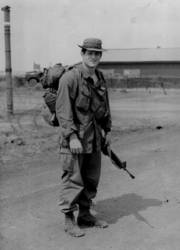 Gore served as a field reporter in Vietnam for five months. Although opposed to the Vietnam War, on August 7, 1969, Gore voluntarily enlisted in the army in order to participate in the war. After basic training at Fort Dix, Gore was assigned as a military journalist writing for The Army Flier, the base newspaper at Fort Rucker. With seven months remaining in his enlistment, he was shipped to Vietnam, arriving January 2, 1971. He served for four months with the 20th Engineer Brigade in Bien Hoa and for another month at the Army Engineer Command in Long Binh. As his unit was standing down, he applied for and received a non-essential personnel discharge two months early in order to attend divinity school at Vanderbilt University.[[2]] The chronology of Gore's military service is:
- August 1969: Enlisted at the Newark, New Jersey recruiting office.
- August to October 1969: Eight weeks of basic training at Fort Dix, New Jersey.
- Late October 1969 to December 1970: writer for the Army Flier newspaper at Fort Rucker, Alabama.
- January 2, 1971 to May 22, 1971: field reporter in Vietnam, part of the 20th Engineer Brigade, stationed primarily at Bien Hoa Air Base near Saigon.
- May 24, 1971: Given an honorable discharge, after his early discharge request was granted.
Gore opposed the Vietnam War, but chose to volunteer anyway though he could have avoided serving in Vietnam in a number of ways. A friend of the Gore family reserved a spot for him in the National Guard, which he turned down. Gore has stated that his sense of civic duty compelled him to serve.[[3]]
Gore said in 1988 that his experience in Vietnam:
- didn't change my conclusions about the war being a terrible mistake, but it struck me that opponents to the war, including myself, really did not take into account the fact that there were an awful lot of South Vietnamese who desperately wanted to hang on to what they called freedom. Coming face to face with those sentiments expressed by people who did the laundry and ran the restaurants and worked in the fields was something I was naively unprepared for.
[Turque, Bill. Inventing Al Gore, Houghton Mifflin, 2000. ISBN 0-395-88323-7. cited by Issues2000.org More Al Gore on Homeland Security]
After returning from Vietnam, Gore spent five years as a reporter for The Tennessean, a newspaper in Nashville, Tennessee. During this time, Gore also attended Vanderbilt University Divinity School and Law School, although he did not complete a degree at either.
Politics
Congressional Service
When Congressman Joe L. Evins announced his retirement after 30 years, Gore quit law school in March 1976 to run for the United States House of Representatives, in Tennessee's fourth district. Gore defeated Stanley Rogers in the Democratic primary, then ran unopposed in the general election and was elected to his first Congressional post. He was re-elected three times, in 1978, 1980, and 1982. In 1984 Gore successfully ran for a seat in the United States Senate, which had been vacated by Republican Majority Leader Howard Baker. Gore served as a Senator from Tennessee until 1993, when he became Vice President.
While in Congress, Gore was a member of the following committees: Armed Services (Defense Industry and Technology Projection Forces and Regional Defense; Strategic Forces and Nuclear Deterrence); Commerce, Science and Transportation (Communications; Consumer; Science, Technology and Space- chairman 1992; Surface Transportation; National Ocean Policy Study); Joint Committee on Printing; Joint Economic Committee; and Rules and Administration.
1988 Presidential run
Main article: Al Gore presidential campaign, 1988
In 1988, Gore ran for President but failed to obtain the Democratic nomination, which went to Michael Dukakis. During the campaign, Gore's strategy involved skipping the Iowa caucus and putting little emphasis on the New Hampshire Primary in order to concentrate his efforts on the South. He won Arkansas, Kentucky, North Carolina, Oklahoma and Tennessee in the Super Tuesday primaries but dropped out of the presidential race in April after a poor showing in the New York primary.[Gore Chronology up to 2000 Frontline PBS.org]
Son's accident and effect on 1992 presidential campaign
On April 3, 1989, Gore's six-year-old son Albert was nearly killed in an automobile accident while leaving the Baltimore Orioles opening game. Because of the resulting lengthy healing process, his father chose to stay near him during the recovery instead of laying the foundation for a presidential primary campaign. Gore started writing Earth in the Balance, his book on environmental conservation, during his son's recovery. It became the first book written by a sitting Senator to make The New York Times bestseller list since John F. Kennedy's Profiles in Courage.
Vice Presidency
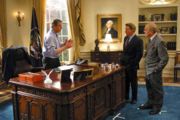
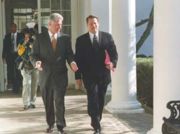 Vice President talking with President Clinton as the two pass through the Colonnade at the White House. Bill Clinton chose Gore to be his running mate on July 9, 1992, to the surprise of many as the two were both young and from the same region of the nation. After winning the 1992 election, Al Gore was inaugurated as the 45th Vice President of the United States on January 20, 1993. Clinton and Gore were re-elected to a second term in the 1996 election.
During his time as Vice President, Gore was mostly a behind the scenes player. However, many experts consider him to be one of the most active and influential Vice Presidents in U.S. history.[citation�needed] This was evident as Gore had weekly lunches with Clinton to keep each other abreast of current developments.
Debate with Perot
In 1993, Gore debated Ross Perot on CNN's Larry King Live on the issue of free trade, with Gore arguing for free trade and the passage of NAFTA, and Perot arguing against it. Public opinion polls taken after the debate showed that a majority of Americans agreed with Gore's point of view and supported NAFTA.[citation�needed] Some claim that this performance may have been responsible for the passing of NAFTA in the House of Representatives, where it passed 234-200.[http://clinton5.nara.gov/WH/EOP/OVP/initiatives/reinventing_government.html]
Initiatives
One of Gore's major accomplishments as Vice President was the National Performance Review[National Performance Review], which pointed out waste, fraud, and other abuse in the federal government and stressed the need for cutting the size of the bureaucracy and the number of regulations. His book later helped guide President Clinton when he down-sized the federal government.[http://clinton2.nara.gov/WH/EOP/OVP/speeches/interego.html]
Environment
While a Representative, Gore co-sponsored hearings on toxic waste in 1978-79, and hearings on global warming in the 1980s.[http://pbs.org/now/science/climatechange.html] While a senator working on his book Earth in the Balance, Gore had traveled around the world on numerous fact-finding missions. During Gore's tenure as Vice President, he was a proponent for environmental protection. On Earth Day 1994, Gore launched the worldwide GLOBE program, an innovative hands-on, school-based education and science activity that made extensive use of the Internet to increase student awareness of their environment and contribute research data for scientists.
In the late 1990s, Gore strongly pushed for the passage of the Kyoto Treaty, which called for reduction in greenhouse gas emissions ["Remarks By Al Gore, Climate Change Conference". Retrieved on 2006-09-01.]
["Vice President Gore: Strong Environmental Leadership for the New Millennium". Retrieved on 2006-09-01.]. However, many of these proposals were not enacted by Congress, and/or were not implemented to the satisfaction of critics such as Ralph Nader.[http://debatethis.org/gore/enviro/naderopenletter.html#globalwarming] In 1998, Senator Robert Byrd of West Virginia wrote Resolution S. 98 that opposed ratification of the Kyoto treaty, and in turn the Senate voted 95 to 0 against the treaty.
Space
Since 1998, Gore heavily promoted a NASA satellite that would provide a constant view of Earth, marking the first time such an image would have been made since The Blue Marble photo from the 1972 Apollo 17 mission. The "Triana" satellite would have been permanently mounted in the L1 Lagrangian Point, 1.5 million km away. [[4]] The finished satellite was not launched due to opposition from the Republican congress.
Foreign policy
Because of President Clinton's relative inexperience in foreign policy matters and Gore's service in Vietnam and in the Senate, Clinton often looked to Gore for advice in the area of foreign policy. Gore was one of the first to call for action to remove Yugoslavia's President Slobodan Milošević from power in 1998. Gore also supported Operation Desert Fox, a three day bombing campaign against Iraq that attempted to "degrade Saddam Hussein's ability to make and to use weapons of mass destruction."[http://www.defenselink.mil/specials/desert_fox/] [http://clinton5.nara.gov/WH/EOP/OVP/initiatives/foreign_policy.html]
Economy
Gore supporters point out that during the Clinton/Gore administration, the American economy expanded for eight years. They attribute this growth to the policies of the Clinton/Gore administration, and especially to the passage of the Omnibus Budget Reconciliation Act of 1993, for which Gore cast the tie-breaking vote. The Administration worked closely with the Republican-led House to slow federal spending and eventually balance the federal budget.
During his 2000 campaign for the presidency, Gore himself attributed positive economic results to his and Clinton's policies[http://clinton5.nara.gov/WH/EOP/OVP/initiatives/economy.html] -- more than 22 million new jobs, the highest homeownership in American history (up to that time), the lowest unemployment in 30 years, the paying off of $360 billion of the national debt, the lowest poverty rate in 20 years, higher incomes at all levels, the conversion of the hitherto largest budget deficit in American history into the largest surplus, the lowest government spending in three decades, the lowest federal income tax burden in 35 years, and more families owning stocks than had up to that point. However Gore later placed a large share of the blame for his election loss on the economic downturn and NASDAQ crash of March 2000 in an interview with National Public Radio's Bob Edwards.[http://www.npr.org/templates/story/story.php?storyId=848572]
2000 presidential election
Main articles: Al Gore presidential campaign, 2000 and U.S. presidential election, 2000
Al Gore and running-mate Joe Lieberman at the 2000 Democratic National Convention. After two terms as Vice President, Gore ran for President. In the Democratic primaries, Gore faced an early challenge from Bill Bradley. Gore's nomination was never really in doubt and Bradley withdrew from the race in early March 2000 after failing to win any state primary or caucus.
In August 2000, Gore surprised many[citation�needed]when he selected Senator Joe Lieberman to be his vice-presidential running mate. Lieberman, who is a more conservative Democrat than Gore, had publicly admonished President Clinton to speak unambiguously to the U.S. people about the Lewinsky scandal. Many pundits saw Gore's choice of Lieberman as another way of trying to distance himself from the scandal-prone Clinton White House.[citation�needed] Lieberman was also the first Jewish nominee on a major party's national ticket.
During the entire campaign, Gore was neck-and-neck in the polls with Republican Governor of Texas George W. Bush. On Election Day, the results were so close that the outcome of the race took over a month to resolve, highlighted by the premature declaration of a winner on election night, and an extremely close result in the state of Florida. On election night, news networks first called Florida for Gore, later retracted the projection, and then called Florida for Bush, before finally retracting that projection as well.
The race was ultimately decided by a margin of only 537 votes in Florida. Florida's 25 electoral votes were awarded to Bush only after numerous court challenges. Gore publicly conceded the election after the Supreme Court of the United States in Bush v. Gore voted 7 to 2 to declare the ongoing recount procedure unconstitutional because it feared that different standards would be used in different parts of the state, and 5 to 4 to ban recounts using other procedures. Gore strongly disagreed with the Court's decision, but decided "for the sake of our unity of the people and the strength of our democracy, I offer my concession." Following the election, a subsequent recount conducted by various U.S. news media organizations indicated that Bush would have won using the partial recount method of four strongly Democratic areas advocated by Gore, but that Gore would have won given a full recount of the state if overvotes (i.e. optical ballots where the oval next to a candidate was blacked in and the candidate's name was mistakenly written in the space on the ballot headed "Write in Candidate's Name", which were rejected by optical scoring machines but unmistakably assignable by a human scorer) were counted, regardless of whether the undervotes (mainly the infamous punch ballots where "chads" were not completely punched out) were subjected to rigorous (only fully punched out) or loose (any dimple or mark) standards, or a standard in between (i.e. at least one corner detached, at least two corners detached), and/or disputed absentee ballots (including those which were unsigned, undated, dated too late, etc.) were counted.[http://www.consortiumnews.com/Print/111201a.html] [Miami Herald, December 3, 2000] [Los Angeles Times, November 12, 2001]
The states that ultimately voted for Gore over Bush in were New York (by 1.7 million votes), New Jersey, Rhode Island, Connecticut, Delaware, Maine, Vermont, Massachusetts, Pennsylvania, Michigan, Wisconsin, New Mexico (by mere 366 votes), California (by 1.3 million votes), Oregon, Washington, Illinois, Iowa, Maryland, Minnesota, and Hawaii giving Gore 267 electoral votes to Bush's 271. During the formal Electoral College vote in DC, one of Gore's electors cast a blank ballot to protest what she called DC's "colonial status", thus Gore's final number of electoral votes was 266.[http://www.fec.gov/pubrec/2000presgeresults.htm] Gore became only the third nominee to win the popular vote but lose the electoral vote.[http://www.time.com/time/pacific/magazine/20001120/schlesinger.html. Retrieved on 6 September, 2006]
The Florida election has been closely scrutinized since the election. Critics have argued that the Governor of Florida, Jeb Bush (brother of George W. Bush) and the Secretary of State of Florida, Katherine Harris, did play a part in ensuring that the state was in the red column of the Republicans come election day.[citation�needed] Some irregularities are thought to have favored Bush, while others may have given Gore an edge. Irregularities favoring Bush included the notorious Palm Beach "butterfly ballots," which were alleged to have produced a large number of mistaken votes for Reform Party candidate Pat Buchanan intended for Gore, and a purge of some 50,000 alleged felons from the Florida voting rolls that included some voters who were again eligible to vote under Florida law. Furthermore, most major news networks prematurely projected Gore as the winner of Florida's 25 electoral votes at 7:52 p.m. Eastern Time. This happened before the polls closed in ten Florida counties in the heavily Republican western panhandle which are in the Central Time Zone, and thus closed at 7 p.m. Central Time (8 p.m. Eastern). This may have depressed the pro-Bush vote as panhandle residents waiting to, or going to, cast their ballots did not do so because they thought their votes were meaningless in the aftermath of the calling of Florida for Gore, although the degree to which this influenced Bush's vote totals are unknown and debatable.[http://archives.cnn.com/2001/ALLPOLITICS/stories/02/02/cnn.report/cnn.pdf] During the numerous recounts (which made the phrase "hanging chads" infamous in the American vocabulary), there were also allegations of both pro-Bush and pro-Gore tampering by low-level operatives in the controversial counties.[http://www.newsmax.com/archives/articles/2000/11/26/230955.shtml] It is unclear what effect, if any, this may have had. Both camps fought (with some success) to keep overseas absentee votes out in counties thought to be favorable to the other candidate, arguing, for example, that votes in envelopes lacking cancellation marks could have been cast after the election. The counterargument was that, regardless of the law, many of the votes were cast by military personnel, and some could have been delayed due to emergency duty shifts by those overseas who chose to submit their ballots at the last hour.[citation�needed]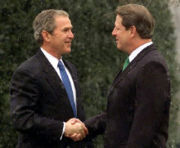 After a close campaign, Gore greets President-elect Bush at the White House in late December of 2000. As a matter of law, the issue was settled when the Congress of the United States accepted Florida's electoral delegation, only after a challenge to the Florida electors was presented in the congressional chambers on January 6, 2001 by members of the Congressional Black Caucus. Member after member went up decrying the lack of a senator who would be willing to co-sponsor the challenge without any effect.[citation�needed] They thus failed to bring the challenge to a debate.
Concern about the possible disenfranchisement of voters in the Florida vote led to widespread calls for electoral reform in the United States, and ultimately to the passage of the Help America Vote Act, which authorized the United States federal government to provide funds to the states to replace their mechanical voting equipment with electronic voting equipment. However, this has led to new controversies, because of the security weaknesses of the computer systems, the lack of paper-based methods of secure verification, and the necessity to rely on the trustworthiness of the manufacturers whose employees also count those votes.
Joe Lieberman later criticized Al Gore for adopting a populist theme during their 2000 campaign. Lieberman said he objected to Gore's "people vs. the powerful" message, believing it was not the best strategy for Democrats to use to retain the White House.[http://www.worldnetdaily.com/news/article.asp?ARTICLE_ID=28519]
The popular political weblog The Daily Howler contends that Gore lost the election due to a relentless media "war," in which his positions were misconstrued and his personal idiosyncrasies exaggerated or even invented altogether by members of the mainstream press corps. Singled out for particularly misleading accounts of Gore and his candidacy are Ceci Connolly of the Washington Post, Katherine "Kit" Seelye of the New York Times and television talk-show host Chris Matthews.[http://www.dailyhowler.com/dh052306.shtml]
Private citizen
Education
Following his election loss, Gore accepted visiting professorships at Columbia University's Graduate School of Journalism, Middle Tennessee State University, University of California, Los Angeles, and Fisk University.
Criticism of Bush Administration
On September 23, 2002, Gore spoke in San Francisco to The Commonwealth Club and made a controversial speech blasting Bush on the timing of the Iraq war,[http://www.usatoday.com/news/world/2002-09-23-gore_x.htm] although he admitted Saddam was a potential danger and suggested Saddam had WMD saying: "We know that [Saddam] has stored secret supplies of biological and chemical weapons throughout his country. Iraq's search for weapons of mass destruction has proven impossible to deter and we should assume that it will continue for as long as Saddam is in power."[http://www.commonwealthclub.org/archive/02/02-09gore-speech.html]
Gore also spoke against rushing to war with Iraq, advising caution and saying that Iraq was a diversion from fighting Al-Qaeda and terrorism in Afghanistan and elsewhere: "I don't think that we should allow anything to diminish our focus on avenging the 3,000 Americans who were murdered and dismantling the network of terrorists who we know to be responsible for it. The fact that we don't know where they are should not cause us to focus instead on some other enemy whose location may be easier to identify."
|